

Google Search is changing, but SEO is not disappearing.
AI Overviews and AI Mode are changing how people discover information, compare options, and explore complex questions. For website owners, this has created an obvious concern: Do we now need an entirely different SEO strategy to appear in AI-generated search results?
According to Google, the answer is largely no.
Google’s current guidance says that its generative AI features are built on its existing Search ranking and quality systems. In other words, Google AI Overviews SEO is still fundamentally SEO. There is no secret AI schema, special file, artificial writing format, or guaranteed “GEO hack” required to appear.
What has changed is the type of content that becomes valuable.
In 2026, publishing another generic article that repeats information already available across dozens of websites is becoming increasingly difficult to justify. Google is explicitly encouraging website owners to create useful, distinctive, experience-driven content that provides information worth retrieving and citing.
This guide explains what actually matters for Google AI Overviews SEO in 2026, what you can safely ignore, and how to adapt your existing SEO strategy without chasing every new AI-search theory.
What Are Google AI Overviews?
AI Overviews are AI-generated responses that Google can display for searches where its systems believe a synthesized answer would add value beyond traditional search results.
Instead of simply returning ten links, Google may summarize information from multiple sources and provide supporting links that allow users to explore those sources further.
Google also operates AI Mode, which is designed for more complex searches involving exploration, comparisons, follow-up questions, and reasoning.
These experiences do not operate completely separately from Google Search. Google’s current documentation explains that its generative AI systems retrieve relevant information from Google’s Search index using techniques including retrieval-augmented generation, or RAG.
That point is important.
Your first objective is not to “optimize for an AI model.”
Your first objective is still to create a page that Google can discover, understand, index, trust, and retrieve when it is relevant to a search.
Is Traditional SEO Still Relevant for AI Overviews?
Yes.
Google now explicitly says that its existing SEO best practices continue to apply to generative AI experiences.
AI Overviews and AI Mode rely on Google’s core Search ranking and quality systems to retrieve information from its index. A page generally needs to be indexed and eligible to appear in Google Search with a snippet before it can be considered for Google’s generative AI search features.
This means technical SEO, crawlability, internal links, useful content, page experience, search intent, images, and overall site quality still matter.
The mistake is assuming that AI Overviews require a completely separate discipline.
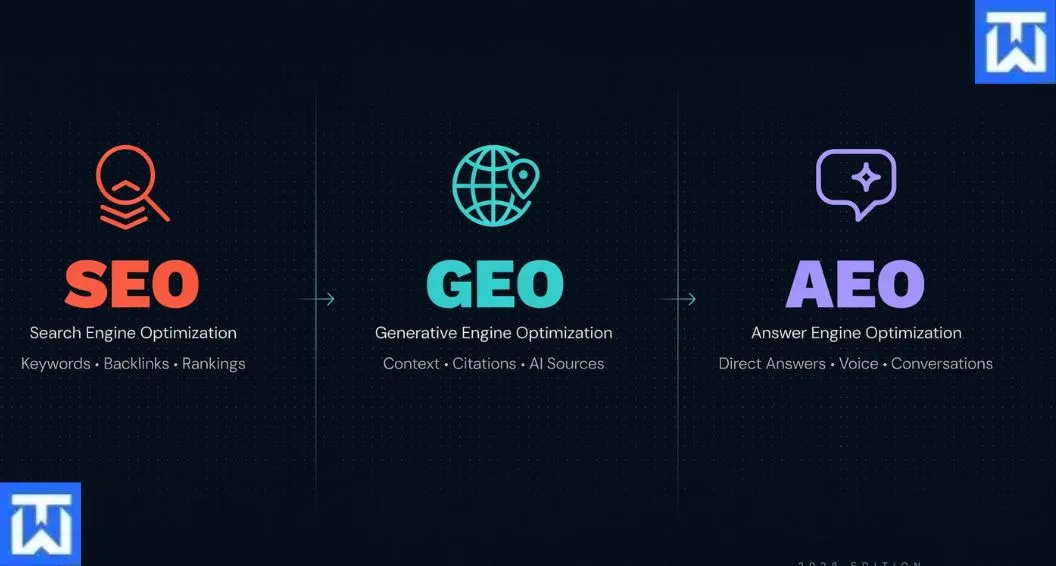
Terms such as GEO — Generative Engine Optimization — and AEO — Answer Engine Optimization — are widely used in the SEO industry. Google does not say that every idea associated with these terms is useless, but its official position is much simpler: optimizing for Google’s generative search experience is still part of optimizing for Search.
So rather than replacing your SEO strategy, AI search should refine it.
How Google Finds Information for AI Overviews
One of the most useful concepts Google has explained is query fan-out.
When someone enters a complicated search, Google’s AI systems may conduct several related searches behind the scenes to gather enough information to answer the broader question.
For example, a single question may cause Google’s system to investigate several subtopics, comparisons, definitions, or supporting facts before generating a response.
This has an important implication for content strategy.
You should not create hundreds of thin pages targeting every imaginable long-tail variation of a keyword. Instead, create strong pages that cover a topic clearly enough that relevant portions can satisfy multiple related questions.
Topical depth therefore matters, but page multiplication is not the same thing as topical authority.
A comprehensive, useful page with real expertise may be considerably more valuable than ten weak pages created simply to target ten slightly different queries.
What Actually Works for Google AI Overviews SEO in 2026

Create Information That Adds Something New
This is arguably the most important change website owners should understand.
Google’s 2026 generative AI guidance places strong emphasis on what it calls valuable, non-commodity content.
Commodity content is information almost anyone could reproduce. A generic article containing the same definitions, tips, and examples found across the web provides Google with little reason to prefer it as a supporting source.
Google recommends producing content with original perspectives, experience, expertise, analysis, or information that goes beyond simply summarizing what already exists.
For example, instead of publishing:
“10 Ways to Improve Website SEO”
you might produce:
“We Audited 40 Crawled-Not-Indexed Pages: Here Are the Patterns We Found”
The second article contains something specific.
It creates information instead of merely reorganizing information.
Original screenshots, tests, comparisons, case studies, observations, workflows, examples, data, mistakes, results, and first-hand experience can make an article substantially harder to replace with a generic AI-generated summary.
That is increasingly important in AI-powered search.
Match Search Intent Completely
Keywords still matter, but Google’s systems have become increasingly capable of understanding meaning instead of relying entirely on exact keyword matching.
Google specifically states that website owners do not need to rewrite content for every possible query variation or stuff pages with every long-tail keyword they can find. Its systems can understand synonyms and broader meaning.
For Google AI Overviews SEO, start with the user’s actual problem.
Ask what someone searching the topic would need to understand before leaving the page satisfied.
If someone searches for Google AI Overviews SEO, they probably do not only want a definition of AI Overviews.
They want to know:
what affects visibility,
whether normal SEO still works,
whether schema is necessary,
whether special AI files are required,
how content should be written,
and how AI visibility can be measured.
A strong article should resolve those questions naturally.
That is better than repeating “Google AI Overviews SEO” every few paragraphs simply to increase keyword density.
Make Important Information Easy to Understand
Google says there is no requirement to break articles into artificially small “AI-friendly chunks.”
Its systems can understand multiple subjects and sections on a page without requiring content to be formatted into tiny blocks. Google also says there is no ideal page length specifically for generative AI search.
That does not mean structure is irrelevant.
Good structure helps readers.
Use descriptive headings, short enough paragraphs, clear explanations, tables where comparisons genuinely benefit from them, and examples where concepts would otherwise remain abstract.
The distinction matters:
Structure content because people need clarity, not because somebody claimed AI can only read 50-word sections.
Make Sure Google Can Crawl and Index the Page
No amount of AI-search optimization can compensate for a page Google cannot properly access.
Google says that a page must meet its Search technical requirements, be indexed, and be eligible to appear with a snippet to qualify as a supporting link in generative AI Search features.
That means basic technical SEO remains essential.
Check that important pages are not unintentionally blocked through robots.txt or meta robots directives. Make sure Google can follow your internal links, render important content, understand canonical URLs, and reach the pages you actually want indexed.
For JavaScript-heavy websites, important content should also be accessible to Google’s rendering systems. Google can process JavaScript, but JavaScript SEO introduces additional complexity compared with straightforward HTML pages.
AI visibility starts with crawlability.
Build Strong Internal Links
Internal linking remains useful because it helps both visitors and Google discover the relationship between pages.
A website publishing about SEO, for example, could internally connect an article about AI Overviews to deeper resources about indexing, Search Console, technical SEO, structured data, content quality, and AI-generated content.
This creates meaningful topic relationships rather than isolated articles.
Avoid vague anchor text such as “click here” whenever a descriptive phrase would better explain where the link leads.
Internal links should exist because the linked page genuinely helps someone continue learning about the topic.
Use Images and Video When They Add Value
AI-powered Search is not exclusively text-based.
Google’s 2026 guidance specifically recommends supporting textual content with relevant high-quality images and video where appropriate, because generative search experiences can surface visual content as well as normal web links.
For an SEO tutorial, valuable visuals could include an original Search Console screenshot, an indexing example, a process diagram, a before-and-after content structure, or results from an actual experiment.
Uploading a generic stock image of a laptop labelled “AI SEO” contributes very little.
Visuals should explain something.
Keep Structured Data Accurate, but Do Not Expect an AI Overview Schema
Structured data still has a role in SEO, particularly when a page qualifies for supported rich results.
However, there is currently no special schema markup required for AI Overviews or AI Mode.
Google explicitly warns website owners against over-focusing on structured data as an AI optimization technique.
Continue implementing relevant supported schema where it makes sense, but make sure structured data accurately reflects visible page content.
Do not add unnecessary schema simply because someone claims it will make an article easier for AI to cite.
Improve the Overall Page Experience
Once someone clicks a supporting link from an AI Overview, the page still has to satisfy them.
Google recommends creating a good experience across devices, reducing unnecessary latency, and making the primary content easy to distinguish from other elements on the page.
An article buried beneath aggressive ads, pop-ups, giant banners, or distracting widgets may technically contain useful information while still providing a poor experience.
Page experience does not replace content quality, but content quality does not make usability irrelevant either.
The two should work together.
Keep Ecommerce and Local Information Accurate
For ecommerce and local businesses, optimization is not limited to articles.
Google says generative AI responses can include products, product information, and local business information. Maintaining accurate Merchant Center information and Google Business Profile data can therefore help Google’s systems understand current business and product details.
For businesses, this means AI-search visibility can depend on more than blog SEO.
Product feeds, availability, business information, images, location details, and other structured sources can all form part of the broader Google Search ecosystem.
Google AI Overview SEO Tactics You Do Not Need
One of the most helpful parts of Google’s latest documentation is that it directly addresses several popular AI SEO theories.
Google says it does not require an llms.txt file to appear in Google Search or its generative AI experiences. Google Search currently ignores these files for ranking and visibility purposes.
Google also says there is no special AI markup required, no need to artificially “chunk” every article, no requirement to rewrite text into a special AI-friendly writing style, and no special schema designed to unlock AI Overview inclusion.
It also discourages attempts to manufacture inauthentic mentions around the web merely because AI systems may reference external discussions.
None of this means experimentation is bad.
It means experiments should be separated from documented Google requirements.
If a consultant tells you that every page urgently needs an AI-specific file, special schema, unnatural FAQ blocks, or dozens of long-tail pages in order to “rank in AI,” ask for evidence before reorganizing your website around the claim.
Does FAQ Content Help With AI Overviews?
Useful FAQs can improve an article when they answer genuine questions that have not already been explained clearly.
But an FAQ section is not a magic AI Overview trigger.
Google does not require FAQ formatting for generative search visibility.
The same principle applies here as everywhere else: use FAQs because they improve the page for readers, not because you are trying to create artificial fragments for an AI system.
If a question deserves a full section, give it one.
If it only needs two sentences, two sentences may be enough.
Should You Use AI to Write SEO Content?
Using AI itself is not automatically against Google’s guidelines.
Google’s guidance focuses more heavily on the quality and purpose of the finished content than on whether AI assisted with its creation.
The problem arises when automation is used to publish large quantities of low-value pages primarily to manipulate search rankings. Google’s guidance on generative AI content warns that producing many pages without meaningful added value can violate its policy against scaled content abuse.
AI can be useful for organizing research, creating outlines, identifying missing subtopics, proofreading, summarizing your own notes, or helping turn original expertise into a clearer article.
But the final content should contain something worth reading.
If an AI model could create essentially the same article without knowing anything about your business, experience, research, or audience, that is a warning sign that the content may still be too generic.
How to Measure Google AI Overview Visibility in 2026
This is one area where SEO changed significantly during 2026.
Google introduced dedicated Generative AI performance reports in Search Console, and as of August 31, 2026, Google says those insights have been rolled out to websites worldwide.
The report provides visibility into impressions generated through Google’s generative AI features, including AI Overviews and AI Mode.
Website owners can examine which pages appeared, visibility by country, device information for Search, and performance over time.
That is much more useful than trying to manually search hundreds of keywords and recording whether an AI Overview happens to appear.
AI results can vary, and Google itself notes that different AI features may use different models and techniques.
Use Search Console data to identify pages gaining AI exposure, then compare those pages.
Look for patterns in subject depth, originality, formatting, internal links, media, query intent, and existing organic performance.
Instead of asking:
“What AI SEO hack did this page use?”
ask:
“Why was this page useful enough for Google to retrieve for this subject?”
That question generally leads to better SEO decisions.
Do AI Overviews Reduce the Importance of Clicks?
AI Overviews can answer some questions directly in the search result, which means not every impression will necessarily produce a website visit.
That makes it important to think beyond raw rankings.
Your content should give people a reason to visit the source.
Original research, templates, detailed examples, downloadable resources, calculators, interactive tools, deeper comparisons, case studies, photographs, demonstrations, and first-hand experience are difficult to reproduce completely inside a short generated response.
This is another reason generic informational content is becoming less defensible.
If the complete value of your article can be summarized in three sentences, users may have little reason to leave Google’s result page.
Create pages that contain value beyond the summary.
A Practical Google AI Overviews SEO Checklist
Before publishing or updating a page for AI-search visibility, check whether:
- the page can be crawled and indexed;
- the main search intent is answered clearly;
- the article contains original information, expertise, experience, examples, analysis, or another meaningful differentiator;
- the title and primary heading clearly describe the topic;
- important content exists in accessible text;
- headings make the article easy for readers to navigate;
- useful internal links connect the article to related resources;
- relevant images or video genuinely improve the page;
- structured data, where used, matches visible content;
- duplicate or near-duplicate pages are not competing unnecessarily;
- the mobile experience is clear and usable;
- Search Console is being used to monitor both traditional Search and generative AI visibility.
You do not need to complete every possible optimization before publishing. The objective is to build pages that are technically accessible and genuinely useful.
The Biggest Google AI Overviews SEO Mistake
The biggest mistake in 2026 may be treating AI search as an excuse to produce even more generic content.
Google’s direction is almost the opposite.
Its official generative AI optimization guide specifically emphasizes unique perspectives and non-commodity content.
AI has made ordinary information easier to generate.
That means publishing ordinary information alone is becoming less valuable.
A website’s advantage increasingly comes from what it knows, sees, tests, creates, measures, experiences, or explains better than competing sources.
SEO still helps Google discover that value.
But SEO cannot manufacture the value itself.
Final Thoughts: SEO for AI Overviews Is Still SEO
Google AI Overviews SEO does not require abandoning traditional search optimization.
The fundamentals remain remarkably familiar: create valuable content, make it technically accessible, organize it clearly, build meaningful site relationships, provide good user experiences, and give Google accurate information about your pages, products, and business.
The difference in 2026 is that generic content has even less room to hide.
Google’s AI systems can retrieve information from multiple sources, fan queries out across related subjects, and synthesize common knowledge without needing another article that merely repeats what is already online.
So the strongest strategy is not to write “for AI.”
Write something worth retrieving.
Then use SEO to make sure Google can find it.
Frequently Asked Questions
How do I optimize for Google AI Overviews?
Start with normal SEO fundamentals: make the page crawlable and indexable, satisfy search intent, provide useful original information, use clear internal links, maintain a good page experience, and support important content with relevant media where appropriate. Google says no additional technical requirements are necessary specifically for AI Overviews.
Is there special schema for Google AI Overviews?
No. Google currently says there is no special Schema.org markup required for its generative AI search features. Structured data should still be used appropriately for supported Search features and should match the visible content on the page.
Does Google use llms.txt for AI Overviews?
Google’s 2026 documentation says Google Search does not use llms.txt for visibility or ranking in Search, including its generative AI capabilities. Maintaining one for another service is a separate decision, but it does not currently improve Google Search visibility.
Do I need GEO instead of SEO?
Google’s position is that optimizing for its generative AI search experiences remains part of SEO. The labels GEO and AEO may describe certain industry practices, but Google’s AI Search systems remain connected to its Search index, ranking systems, and existing SEO fundamentals.
Can I see whether my pages appear in AI Overviews?
Yes. In 2026, Google introduced dedicated Generative AI performance reporting in Search Console. Google says the reporting was rolled out worldwide by August 31, 2026, allowing site owners to inspect AI-feature impressions, pages, countries, devices where applicable, and performance over time.