
This On-Page SEO checklist includes all the key elements that need to be optimized for your website to achieve the best possible ranking and more organic traffic. These best practices can enhance search visibility and provide a better user experience for 2026.
What is On-Page SEO?
On-page optimisation is defined as the optimisation of individual pages to direct relevant audiences towards them to achieve higher rankings, as well as in search engine results. It encompasses all the things that can be directly controlled on a webpage, like content, keywords, headings, title tags, images, URLs, internal links, and so on.
An on-page SEO checklist should refer to the user experience optimizations, technical enhancements, and content optimizations. Together, these elements aid both search engines in better understanding a page’s content and help the user absorb it.
To develop an effective modern SEO strategy, you must rely on four key principles:
- Technical SEO
- On-Page SEO
- Off-Page SEO
- Content SEO
All three pillars provide solid grounds for longer-term growth organically.
These are the key benefits of On-Page SEO
Increases search engine optimisation.
- The optimization process helps search engines comprehend your content and figure out when and the way your content ought to be in search results.
Enhances user experience.
- Organised content, headings, and quick pages make visitors happy.
Increases organic traffic.
- More relevant search clicks mean higher ranking.
Boosts conversion rates.
- Your audience would be more likely to become subscribers or buyers, or contact your business if they find exactly what they were looking for.
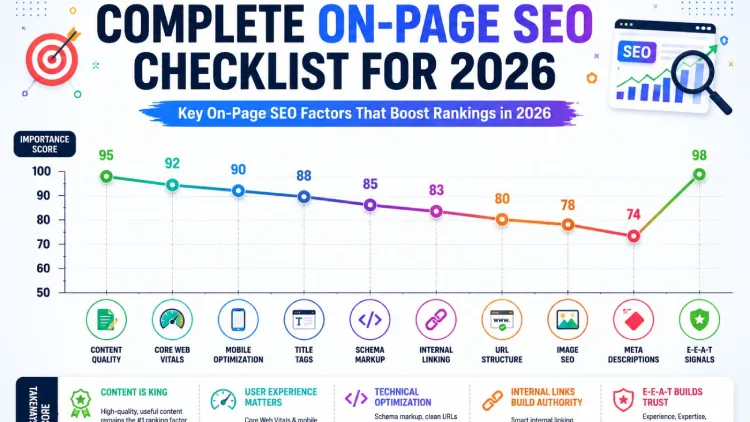
Complete On-Page SEO Checklist for 2026
1. Conduct Proper Keyword Research
All of SEO campaigns start with keyword research. Knowing what people look for and how they word their search is important before developing content.
Keyword research is a vital component for discovering keywords that have the relevant traffic needed, as well as a low level of competition. It also clearly shows user intent, being very essential in crafting content that meets searchers.
Checklist
- Select the main keyword
- Find related secondary keywords
- Research long-tail keywords
- Analyze competitor keywords
- Understand search intent
Why It Matters
Even good content can fail to achieve high rankings if it’s not SEO-optimized with the right keywords. Generally, it’s best if it adheres to the 80/20 rule, which means that a small number of high-impact keywords will drive the bulk of traffic. Paying attention to those great opportunities will yield greater results than targeting hundreds of terms that have nothing to do with it.
2. Place Your Primary Keyword Strategically
Keyword usage is still one of the key ranking factors. Keyword positioning indicates to search engines the relevance of a page.
Checklist
- Include the keyword in the SEO title
- Include the keyword in the opening 100 words
- Have at least one heading that includes a keyword
- Include the keyword in the conclusion
- Preserve natural keyword density
Best Practice
The keyword should not be inserted in each sentence. Google’s algorithms have evolved to identify context, synonyms, and the underlying semantics.
Creating a successful on-page SEO checklist involves being relevant and readable instead of overstuffing and repeating keywords.
3. Optimize the SEO Title Tag
The widgets, like title tags, are the first thing the users will see in the search listings. As it has a direct impact on click-through rates and search visibility.
Checklist
- The title should not be more than 60 characters in length.
- Use the main keyword as early as possible.
- Add in a word of strength.
- Provide a number if applicable.
- Make it click-worthy
Example
The on-page SEO checklist is valuable since it will help you to get better rankings for your web page.
Ranking might stay the same, but with an interesting title, you can surely get more clicks.
4. Design an Engaging Meta Description
Meta descriptions are mini ads for your content that show up in search results.
Checklist
- Try to maintain a length of 150-160 characters
- Include primary keyword
- Use action-oriented language
- Highlight benefits.
Example
To achieve the best web content optimisation, ranking, traffic and visibility in 2026, follow this On-Page SEO Checklist.
Meta descriptions may not be ranking factors in and of themselves, but they do affect user action, and their impact can help boost overall good SEO.
5. Use SEO-Friendly URLs
A URL should be simple, clearly descriptive, and easy to understand.
Checklist
- Include primary keyword
- Do not use underscoring. Correctly use hyphens
- Avoid unnecessary numbers
- Keep URLs concise
Example
yourwebsite.com/on-page-seo-checklist
Clean URLs have advantages for the user and for the search engines, because they are better able to understand what pages are about.
6. Optimize Heading Structure
Headings organize content around the user and enhance user and search engine reading.
Checklist
- Only use H1 once
- Use a keyword in the H1 title
- Logically use H2 and H3 tags
- Make headings descriptive
Benefits
When your page is organized correctly, it allows visitors to quickly scan content. The headings are also important to the search engines that are used for understanding the hierarchy and context information.
For many websites that are successfully built, there is a model of content that allows for usability, navigation, accessibility, and information architecture.
7. Create High-Quality Content
In today’s world, the most crucial component of any SEO strategy is content.
Checklist
- Cover topics comprehensively.
- Answer user questions.
- Provide original insights.
- Include examples/stats.
- Keep information updated.
Why It Matters
Google prioritizes content that shows it has Experience, Expertise, Authority, and Trustworthiness.
High-quality content should be written to satisfy user needs, not just for the purpose of targeting keywords. Write for people, not for search engines: In SEO, there’s one golden rule, and that’s to write for the people first and the search engines second.
Authentic content which include readers to help readers naturally brings them engagement, share, and get backlinks.
Need Help Creating SEO Content?
Creating high-quality, SEO-friendly content consistently can be challenging. At TechishWeb, we provide professional SEO content writing, on-page SEO optimization, website development, and digital marketing services to help businesses improve their search rankings and grow their online presence. Contact us today to learn how we can help your website attract more traffic and customers.
However, knowing what kind of intent an individual has when they search is important in getting a high ranking.
Types of Search Intent
- Informational
- Navigational
- Commercial
- Transactional
Checklist
- Know the needs of users
- Align content format, context with intent
- Provide complete answers
Let’s take the same example with someone looking for a guide, looking for educational content, and someone looking for a product comparison, being closer to making a purchase decision.
Relevant content is more likely to get better SERPs or user satisfaction.
9. Use Internal Links
Internal links are those links that go within your site.
Checklist
- Link to relevant pages
- Link with descriptive anchor text
- Add links naturally
- Make additions to old articles by adding links
Benefits
Internal links can share authority amongst your site and direct users to more content that is relevant to your site.
These also enhance the crawlability of the site, making it easier for search engines to locate information.
10. Add External Links
Outside links do so as a form of context and proof of credibility.
Checklist
- Cite reputable websites
- Use relevant references
- Avoid low-quality sources
Benefits
Connecting to reliable sources can improve the users’ experience and build trust in your content.
Search engines refer to authoritative information when applicable.
11. Optimize Images
Images make it more engaging and break up text blocks.
Checklist
- Compress image sizes
- Have descriptive named files
- Fill in rich keyword Alt Text
- Implement responsive images
Example
- on-page-seo-checklist-guide.jpg
Why Image SEO Matters
Optimized images can boost page performance and ranking in image search, increase accessibility, and enable landing pages to generate more views. Optimized images can help pages perform better, be found in image search results, make the page more accessible, and help customers see more views on a landing page.
Pictures should enhance the text content.
12. Improve Page Speed
Page speed not only impacts rankings but also user experience.
Checklist
- Compress images.
- Optimize CSS and JavaScript.
- Enable browser caching.
- Use a CDN.
- Upgrade hosting as needed.
Benefits
Faster loading pages give better bounce rate and engagement.
Users don’t appreciate having to wait long for a website to load. Minutes or even seconds wasted can have a negative effect on traffic and conversions.
Page speed optimization is an essential part of every modern on-page SEO checklist.
13. Ensure Mobile Friendliness
The main criteria used by Google for websites are mobile-first indexing.
Checklist
- Responsive design
- Readable text sizes
- Fast mobile loading
- Easy navigation
Why It Matters
The vast majority of people who are online use a smartphone or tablet to access the web. If your website doesn’t perform well on mobile, it can negatively affect your ranking and user satisfaction.
The website should be responsive but not intrusive, and fit on a variety of screens without an issue.
14. Use Schema Markup
Schema Markup facilitates search engines in comprehending the information on a page.
Checklist
- Article schema
- FAQ schema
- Breadcrumb schema
- Product definitions/rules – as applicable
Benefits
Schema can produce abundant results like FAQs, ratings, and improved search presentations.
These features boost visibility and can boost the click-through rates.

15. Optimize For Featured Snippets
Featured snippets are featured in the search results.
Checklist
- Answer questions directly
- Use numbered lists
- Include bullet points
- Create FAQ sections
Presented content with a good organizational structure creates a better opportunity to come up in snippet positions.
Short and succinct answers and detailed explanations are typically best.
16. Improve Readability
Readability can impact engagement and user satisfaction.
Checklist
- Short paragraphs.
- Simple language.
- Bullet points.
- Clear headings.
Benefits
Readers like reading content that is easy to scan and grasp.
The most successful ones are those that are detailed enough for the experts, yet are understandable for the novices.
One of the simplest things to do on a page that will improve its SEO and increase its capacity to give a clear message is to write it so that it is readable for readers.
17. Add FAQ Sections
FAQ sections give a swift response to the frequently asked questions and provide extra searchability.
Common Questions
What is On-Page SEO?
On-page optimization is the optimization technique that is used to optimize the elements of the webpage, like the content, images, and inbound links, to boost the ranking of the website on search engines.
So, what is on-page SEO and why is it important?
It aids search engines in comprehending content and enhances the user experience.
How should I replace the content?
Important pages are to be reviewed periodically or updated whenever necessary to keep the information accurate and competitive.
FAQs also offer more of an opportunity for rich results with schema.
18./User Experience (UX) optimization
The user experience has grown to be more significant in the newest search algorithms.
Checklist
- Easy navigation.
- Clean design.
- Clear CTAs.
- Minimal intrusive ads.
Benefits
Many websites that are good places to stay achieve this by using many of the principles for good usability, including:
- Clear navigation
- Consistent design
- Credible information
- User-friendly layout
- Accessibility
- Valuable content
- Effective communication
These principles help to build and maintain trust and engagement – both of which positively impact SEO.
Finally, it’s crucial for a website to have navigation menus, content sections, headers and footers, contact forms and contact information, calls-to-action, images, search, security, and responsive design.
19. Monitor SEO Performance
SEO is an ongoing effort that needs constant evaluation and enhancement.
Tools to Use
- Google Search Console
- Google Analytics
- Ahrefs
- Semrush
- Screaming Frog
Metrics to Track
- Organic traffic
- Keyword rankings
- Click-through rate
- Bounce rate
- Conversions
Best On-Page SEO Tools
There are a few tools that can aid in automating and better optimizing efforts:
- Yoast SEO
- Rank Math
- Surfer SEO
- Ahrefs
- Semrush
- Google Search Console
- Screaming Frog
- ChatGPT
AI tools are proving to be more and more useful in keyword research, content planning, clustering topics, and providing optimization recommendations. But human skills in strategy, creativity, and control of the quality are still needed.
20. Regularly Update Content
SEO isn’t a single assignment!
Checklist
- Update statistics.
- Refresh screenshots.
- Add new information.
- Improve outdated sections.
Benefits
New content can often be more effective due to its freshness and the fact that it is relevant to what people are searching for and looking for now.
The importance of updating content for the purpose of maintaining rankings and competitiveness as search algorithms evolve.
Content updates are often a significant boon for many companies, leading to substantial increases in website traffic and engagement.
Final On-Page SEO Checklist Summary
To publish any webpage, make sure that you:
- Conduct keyword research
- Optimize title tags
- Create engaging meta descriptions
- Use SEO-friendly URLs
- Structure headings properly
- Create valuable content
- Optimize images
- Improve page speed
- Ensure mobile friendliness
- Include hyperlinks both within the document and from other sources
- Implement schema markup
- Improve readability
- Add FAQs
- Monitor performance
- Update content regularly
A checklist for on-page optimization, in essence, becomes a quality control system that ensures that each page adheres to the requirements of the latest developments in SEO before it is published.

Conclusion
An on-page SEO checklist can boost your positioning, increase the number of organic visitors, and enhance the website experience. This process involves optimising keywords, content, headings, images, page speed, and internal links to produce pages that are easier to understand for users and search engines.
The basics of on-page optimization will still be vital in 2026, even as SEO continues to change. Use these checklist points on a regular basis to make a website stronger and more search-friendly.
Frequently Asked Questions
1. What does an on-page SEO checklist include?
It involves on-page optimisation, quality content, headings, meta tags, internal links, image optimisation, page loading, and mobile optimisation.
2. How do you conduct on page seo?
Choose keywords, strategically optimise titles and content, enhance page loading speed, incorporate internal links, and align search intent.
3. Can I declare a separate variable like UPS or FedEx for my product?
Yes. Several tools are easy to utilise, and some standard search engine optimisation methods allow you to optimise your website without having to pay a search engine optimisation expert.
4. What will be the main SEO strategy for 2026?
Yes. It’s an ever-changing landscape for SEO, but content, user experience, and on-page optimisation are always vital.