

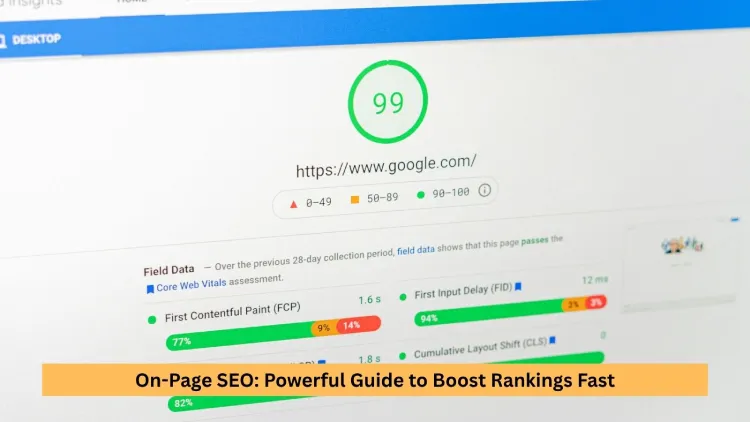
On-page SEO refers to what you can do to the content and structure of your web pages, to the facets of your web pages, to have them higher in the search engine results list. It is concerned with enhancing the user experience, the location of keywords, the quality of content, and technical indications on a page. In 2026, the SEO field is changing in the area of AI, yet on-page SEO is one of the strongest ranking factors. With the correct strategies (such as content optimisation, internal linking, and page speed), you can generate more traffic, better rankings, and grow your site on.0 .0.0.0.00a regular basis.
What is On-Page SEO?
On-page SEO is the technique of enhancing the content of a single web page to help the webpage attain a higher ranking by the search engine. It also puts emphasis on content, keywords, HTML tags and user experience, and it is in charge of fully optimising a page.
Important On-Page SEO Areas.
- Content Optimisation: Dealing with useful, relevant and original content, which provides answers to the questions of the users, and enhances the interest.
- HTML Tags Optimisation: Appropriate use of title tags, meta descriptions, headings and alt text to assist search engines in making sense of the page.
- User Experience (UX): Developing a clear design, user-friendly navigation and mobile-friendly layout to ensure customers will stay longer with the websites.
The on-page SEO is contrasted with the technical SEO and the off-page SEO. Technical SEO revolves around the performance of the website, such as the speed and indexing, whereas off-page SEO revolves around backlinks and other external indicators.
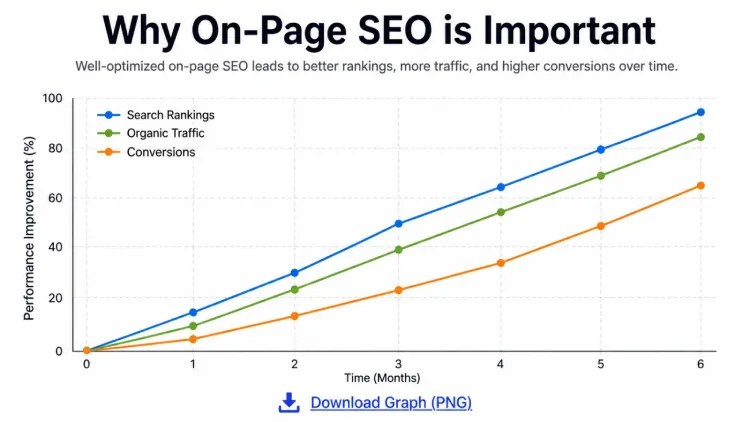
Why On-Page SEO is Important
The most effective SEO strategy cannot be effectively implemented without on-page SEO. And without it, even effective backlinking or technical optimisation can not bear any fruit.
Improves Search Rankings
Search engines will give preference to well-optimised and relevant pages. A good on-page SEO will enable your content to climb up the rankings for the specific keywords.
When your pages are on the first page of search results, you just get more traffic, without paying to have people view your pages.
Enhances User Experience
Organised information, high loading speed and after that easy navigation allow the users to dwell longer and browse through more pages.
Complementary to the other types of SEO
On-page SEO combines with off-page and technical SEO. A combination of all three types will result in a complete SEO strategy.
Develops Authority and Trust
When your content is useful and well-optimised, the users trust your site, and this enhances conversion.
Important Aspects of On-Page SEO
To grasp the art of on-page SEO, a person must comprehend the fundamental elements of this practice, along with the manner in which these aspects interconnect.
1. Title Tag Optimisation
One of the topmost ranking factors in on-page SEO is the title tag. It can be found in the search engine results, and it plays a role in determining whether users will open your page.
- Use Target Keywords: Carry your main keyword in the title that would enhance relevancy.
- Be Concise and to the Point: To be effectively displayed on the web, the range of characters acceptable in titles is between 50 and 60 characters.
- Add Power Words: The words such as best, ultimate, and guide raise the level of engagement.
- Make It Unique: The titles of the pages should be different to avoid duplication problems.
2. Meta Description
Meta descriptions are a summary of your pages and encourage visitors to get clicking.
- Write Engaging Descriptions: Identify the attention by using straightforward and effective words.
- Include Keywords Naturally: Relevance can be enhanced by the addition of keywords, but not overdone.
- Optimise Length: It should be fewer than 150-160 characters and work the best.
3. Heading Tags (H1, H2, H3)
Headings enhance the ease of reading and even the search engine optimisation.
- Use One H1 Tag: This ought to have your primary keyword, and it signifies the subject of your page.
- Divide Content by subheadings: H2 and H3 tags subdivide the content into parts to comprehend it better.
- Improve Content Flow: A good design aids its users in scanning and reading conveniently.
4. Keyword Optimisation
Keywords are very important in assisting the search engine to comprehend the contents of your webpage.
- Primary Keyword Placement: Insert your primary keyword in the title, headings and opening paragraph.
- Use LSI Keywords: Relevant terms and synonyms enhance coverage of topics.
- Maintain Natural Flow: There is no need to stuff the keywords; concentrate on readability.
5. URL Structure
A simple URL is well-formed and is simple and effective.
- Brief and concise URLs: Simple URLs are better off in search engines.
- Include Keywords: The addition of the main key will assist in ranking.
- Avoid Complexity: Make URLs simple without parameters that are not important.
6. Internal Linking
Inner connections: internal links are links connecting two or more distinct pages in your website.
- Improve Navigation: Facilitates users’ access to the relevant information in a short time.
- Boost SEO Value: Crosses control between pages.
- Increase Engagement: Pushes users to open up additional pages.
7. Image Optimisation
Images are also engaging content, but should be optimised.
- Use Alt Text: Search engines like Google know images.
- Compress Images: Reduces loading time.
- Use Relevant Visuals: You should show pictures to support what you are saying.
8. Page Speed
An important ranking factor is speed.
- Optimise Resources: Minimise file sizes and code.
- Use Fast Hosting: Hosting should be reliable to enhance performance.
- Enable Caching: Enhances the loading time of returning customers.
9. Mobile Friendliness
In contemporary SEO, mobile optimisation is crucial.
- Responsive Design: Is compatible with any device.
- User-Friendly Layout: Small screens are easily navigated.
- Fast Mobile Performance: Reduces bounce rates.
10. Content Quality
On-page SEO depends on the quality of the content as a determinant of success.
- Answer User Intent: Give explicit and useful responses.
- Use Simple Language: Content that can be easily read is better.
- Update Regularly: New content maintains rankings.
The 2026 best on-page SEO tips
SEO is ever-changing, yet there are strategies that are still strong.
- Focus on Search Intent: It should know what the users desire to know, what products they want, and so on.
- Follow the 80/20 Rule: Concentrate on the 20% of the efforts that give 80% of the results, including content and keywords.
- Use Structured Content: Definite titles and structures assist AI and search engines.
- Increase Voice Search: Speak in normal language and ask questions.
- Leverage AI Tools: AI assists in terms of keyword research and content optimisation, but does not substitute SEO.
- Balance Any Type of SEO: On-page SEO should be used in combination with off-page and technical SEO to achieve the best results.
Similar On-Page SEO Blunders
By preventing easy errors, your on page seo performance and rankings can quickly improve.
Keyword Stuffing
An oversaturation of keywords creates the unnaturalness of the content, making it difficult to comprehend. It is also able to demote rankings rather than uplift them. Omit keywords and put an emphasis on meaning.
Duplicate Content
Duplicating information on third or fourth pages or web pages diminishes credibility. Search engines can omit or give a lower ranking to your page. It is important to always write unique content.
Ignoring Meta Tags
The lack or poor quality of titles and descriptions will decrease search result clicks. Good meta tags can be used to enhance visibility in on page seo.
Poor Internal Linking
Unless pages are appropriately linked, users and search engines cannot easily navigate. Internal links do enhance structure and search engine optimisation.
Slow Website Speed
Slow site promotes bounce rate. Visitors abandon in a short time when loading pages are very slow. Rankings highly depend on speed.
By addressing these problems, your on page seo gets boosted and helps your site to do better in the search results.
Other SEO Concepts That You ought To know
You must also be conversant with wider concepts of SEO and marketing to have a full understanding of on-page SEO.
- Types of SEO: Three primary ones are on-page SEO, off-page SEO, and technical SEO. The combination of these forms a complete strategy.
- Four Types of SEO: These are on-page, off-page, technical, and local SEO.
- Five Pillars of SEO: Information, search terms, tech function, backlinks, and interactivity.
- Which SEO is Most Important: On-page SEO is believed to be the most significant since it is the foundation of optimisation.
- Is On-Page SEO Enough: No, it also requires backlinks and technical enhancements so that it works better.
- On-Page SEO vs Off-Page SEO: With on-page SEO targeting the content of your website, and off-page SEO targeting backlinks and external signals.
- On-Page vs Technical SEO: On-page deals with content and format, and technical SEO deals with back-end stuff such as speed and indexing.
- Best SEO Tools: Performance can be enhanced by using tools such as keyword planners, analytics tools and auditing tools.
- Basic SEO Skills: Keyword search, content, analytics and technical insights.
- SEO Salary: SEO specialists receive various salaries according to their experience, yet experts of an adequate level are sought after all over the planet.
- Is SEO Dead in 2026: There is no death of SEO as it evolves with AI and human-oriented approaches.
Need SEO Help?
At TechishWeb, we also provide professional SEO services, including on-page SEO, keyword research, and website optimisation, to help you rank higher and grow faster.
SEO Marketing Intelligences
SEO is most effective when it is accompanied by digital marketing strategies. On page seo and also utilising other techniques will be useful to boost traffic, engagement, and conversions.
The 7 kinds of online marketing
- SEO: Enhances search results.
- Content Marketing: Produces worthy content.
- Social Media Marketing: Mark’s content on social networks.
- Email Marketing: Develops a customer relationship.
- PPC: Paid traffic on a hurry-up basis.
- Affiliate Marketing: Make money through joint ventures.
- Influencer Marketing: Market with influencers.
There are five C’s of Marketing
- Company: Your business objectives.
- Customers: Your intended audience.
- Competitors: Market competition.
- Collaborators: Business partners.
- Climate: Market trends.
Marketing and the seven Cs of marketing
- Content: Useful information.
- Context: Right message, Right time.
- Community: Build an audience.
- Customisation: Personalisation.
- Communication: Engagement.
- Connection: Relationships.
- Commerce: Sales.
3 C’s of SEO
- Content: Quality content
- Code: Technical structure
- Credibility: Trust and authority.
3-3-3 Rule in Marketing
- 3 Seconds: Grab attention
- 30 Seconds: Show value
- 3 Minutes: Build trust
SEO Tools and Checklist
The availability of proper tools and a checklist based on simplicity will facilitate the process of SEO, making it more productive. It can make you organised and not miss certain important steps in on page seo.
Basic SEO Tools
Simple tools assist you in attempting to comprehend your website and enhance its operation.
- Keyword Research Tools: Assist you in locating what people are searching for so that you can get the appropriate keywords.
- Analytics Tools: Display traffic, user activity and the pages that are doing so well.
- Site Audit Tools: Locate such problems as broken links, low speed, and missing tags.
On-Page SEO Tools
These are the tools that are aimed at enhancing your page content and organisation.
- Content Optimisation Tools: Give recommendations on how to improve it and make it rank higher and be readable.
- Keyword Density Tools: Make sure that your use of keywords is not overloaded.
- Readability Checkers: Simplify your content and make it easy to comprehend.
SEO Checklist
With a checklist, you are sure you have fully optimised your page, and then it can be published.
- Insert your keyword in the title, headings and the contents.
- Write an effective meta title and description.
- Include an appropriate structure of headings (H1, H2, H3).
- Add internal links and update pictures.
- Enhance the mobile friendliness and page speed.
Number of SEO Tools
- SEO tools are numerous, and you are not required to have all of them.
- Employ some tools which you are sure of rather than numerous ones.
- Those post beginners to use free tools.
- Tools that are paid provide advanced features.
Conclusion
On-page SEO is one of the most potent means of raising search engine rankings in 2026. It is concerned with the maximisation of content, structure and user experience in order to provide actual value to the users.
Although SEO is still developing and changing with the realisation of AI and new technologies, the principles of on-page SEO persist and impact the industry. With the combination of high-quality content, the use of appropriate keywords and technical advances, you will be able to experience long-term success.
By using these strategies regularly, you will not only have a higher ranking, but you will also have a level of trust, authority and the ability to increase your rank within the search engine as time goes by.
Frequently Asked Questions
1. What is on-page SEO, and why is it important?
On page seo designates the procedure of arranging website content, framework and HTML tags to enhance search ranking. This is essential as it assists the engines to know about your page and user experience, thus enhancing increase in traffic and rankings.
2. What is the difference between on-page and off-page?
Page seo makes optimisations in factors within your site, such as content, keywords and structure. Off-page SEO dwells upon external influences, such as backlinks, social signals and mentions of a brand. Both collaborate to achieve improved results in terms of SEO.
3. Can on-page SEO get a website ranked?
Being on page seo is insufficient on its own. It is the base, yet you need off-page SEO (backlinks) and technical SEO (site speed, indexing, structure) to attain high and long-term ranking.
4. What are the greatest on-page SEO considerations?
The key aspects of on page seo are good, high-quality content, appropriate use of keywords, good title tags and meta description, use of internal links, mobile-friendly layout and fast page loading.
2 thoughts on “On-Page SEO: Powerful Guide to Boost Rankings Fast”
I am regular reader, how are you everybody? This post posted at this site is in fact nice.
Thank you! Glad you enjoyed the post and appreciate your regular support