


To fix website Issues, to gain better ranks, begin with a complete SEO audit, correct technical mistakes, optimize content, and reinforce your backlinks. The reasons why most sites lose their traffic are due to low speed, ineffective structure, and content strategy. In a systematic method, technical fixes, on-page enhancements, and contemporary AI SEO, you can gradually increase your presence on the search engine marketplace, such as Google. With this guide, you can solve any problem in websites with simple steps to enable you to build a high-performing site.
What Are SEO Issues?
SEO problems are concealed or apparent challenges that cannot allow your web pages from making a good appearance on search engines. These problems can impact the crawling, comprehension, and ranking of your pages by search engines.
By failing to correct site problems promptly, you could lose traffic rankings and even the credibility of your site. Most website owners think that SEO is restricted to keywords, but the real matter is that it deals with technical makeup, content, and user experience.
Some of the common SEO issues are:
- Technical issues that prevent crawling and indexing.
- Poor loading speed, which annoys the user.
- Misplaced or excessively optimized keywords.
- Duplicated or skimming content.
- Weak backlink profile.
- Bad links and expired pages.
These problems tend to co-exist. To illustrate, low speed with ineffective content might massively decrease rankings. This is the reason why it is necessary to address errors on the website as a whole and not as a single point.
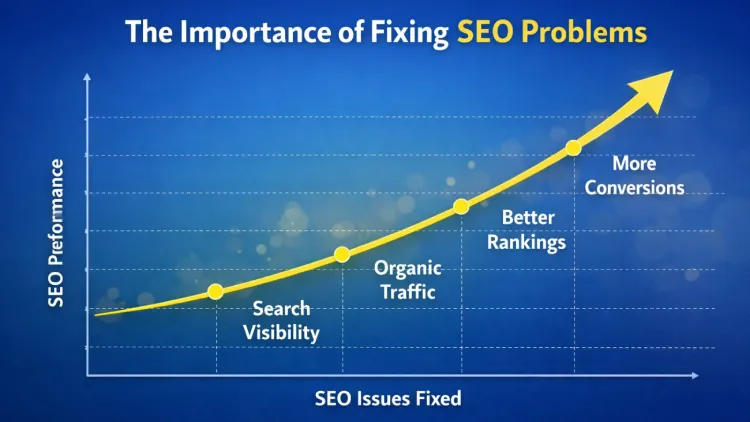
The importance of fixing SEO problems
When you neglect SEO problems, you may be harming the development of your site without much commotion. Big ranking drops can also occur as a result of small mistakes.
After eliminating the problems on the website continuously, you build a powerful platform, which contributes to success in the long run.
Key benefits of fixing SEO issues:
- Enhances search engine visibility.
- Organic traffic is consistently driven.
- Develops credibility and power.
- Enhances user experience.
- Enhances conversions and involvement.
An optimized website is in tune with search engine algorithms and with human expectations. It loads quickly, responds to queries properly, and takes one through the information.
Need Expert Help to Fix SEO Issues?
If you don’t want to handle everything yourself, we’ve got you covered. At TechishWeb, we provide professional SEO and website optimization services to help you fix website issues, improve rankings, and grow your traffic.
We offer:
- Complete SEO audits
- Technical SEO fixes
- On-page & content optimization
- Website speed improvements
- Backlink & ranking strategies
Let our experts handle your SEO while you focus on your business growth.

A Step-By-Step Guide to Address SEO Problems
1. Conduct a Full-scale SEO Audit
The initial and most significant step to completely repair issues with the websites is known as an SEO audit. You do not know what is wrong, and without knowing this, you cannot know the right solutions.
The first thing to do is to review your entire web structure, content, and technical setup:
- Detect broken pages and lost information.
- Analyze keyword rankings.
- Review competitor strategies.
- Evaluate internal linking.
An audit is a kind of medical check-up. It shows the areas of weakness and opportunities. Lots of specialists rely on such a tool as Google Search Console to track performance and identify mistakes.
An effective audit makes sure you correct any problems on the site, depending on data and not guessing.
2. Resolve Technical SEO Problems
The cornerstone of your website is technical SEO. Even great content will not rank if your technical setup is poor.
To troubleshoot it, pay attention to the search engine’s access and processing of your site to fix it:
- Speed up the site by compressing files and images.
- Repair invalid links and redirect bugs.
- Make use of HTTPS to ensure safe browsing.
- Maximise XML sitemap and robots.txt.
- Remove duplicate URLs.
Bad links are a significant problem. The good side is that they can be easily fixed by updating the URLs, redirecting, and eliminating old pages. Repairs of such contribute to keeping the user experience uninterrupted and better search engine optimization.
Technical optimization will make sure that your website is reachable, fast, and crawlable.
3. Optimize On-Page SEO
On-page SEO is concerned with optimizing each page by ensuring its relevance and usefulness.
You can remedy on-page SEO problems on websites, which will make search engines gain a clear idea about the content:
- Use keywords effectively in the headings and body of the paragraph.
- Write compelling meta titles and descriptions.
- Form substance with correct headings.
- Include in-page links to related pages.
- Maximize pictures using descriptive alt text.
An optimized page is not only rich in keywords, but also user-friendly. Clearly formatted, readable text and logical organization are important.
4. Improve Website Content
The most important thing in SEO is content. Your perfect technical SEO is bound to drag you down when you have poor content.
To resolve content-related problems of a website, pay attention to the quality and relevance.
- Produce exceptional and advantageous content.
- Avoid duplication.
- Update outdated information.
- Add richness and brightness.
- Directly respond to user intent.
Content strategies that are driven by AI can now also be considered modern SEO. Software such as ChatGPT can be utilized to create ideas, outlines, and drafts. Human editing, however, is critical to uphold originality and quality.
On the one hand, an AI can help; on the other hand, it will not be possible to reconstruct and substitute a web strategy completely. Proper planning, design, and optimization are still needed.
5. Resolve Mobile Usability Problems.
Mobile is no longer an option. The majority of users use smartphones to access websites.
Unless you rectify site problems touching on mobile usability, you may soon lose a significant number of visitors:
- Use responsive design.
- Make sure to load the mobile fast.
- Maximize fonts and design.
- Fit buttons that are easy to hit.
- Avoid intrusive pop-ups.
Being mobile-friendly gives search engines priority over websites, and this is a crucial step in terms of rankings.
6. Improve Page Speed
- Speed has a direct influence on user experience and SEOs.
- To correct speed-related problems of websites, emphasize efficiency.
- Reduce the size of pictures without quality sacrifices.
Enable browser caching
- Reduce a minimum of CSS and JavaScript files.
- Leverage quality hosting services.
A slow site raises the bounce rates and reduces the conversion. Any delay, even a couple of seconds, can make a big difference in terms of user satisfaction.
7. Build High-Quality Backlinks
One of the most powerful rankers is backlinks.
This is a fix on the authority and trust problem with websites:
- Guest post on relevant websites
- Create shareable content
- Avoid spammy backlinks
- Connect with people within your niche
Quality is preferred to quantity. One effective link can be done by a small number of strong backlinks in comparison to hundreds of weak links.
8. Fix Indexing Issues
Unless your pages are indexed, they are not going to be found in search results.
To correct problems in the indexing process of a site:
- Periodically index the checks.
- Remove unnecessary “noindex” tags.
- Submit revised pages to the search engine.
- Correct duplicate content problems.
Indexing is done properly so that your content is there.
9. Search using AI optimizations and AEO.
SEO itself is being transformed to AI SEO and Answer Engine Optimization (AEO).
To troubleshoot the problems in websites within the current search conditions:
- Organize information to respond to questions.
- Utilize frequently asked questions and structured data.
- Make voice search optimization.
- Target intent on the users.
In this way, your odds of making featured snippets and artificial intelligence-powered responses will rise.
Basic SEO Tips to Shun
Revenues The established site owners also commit errors that do not favor performance.
To successfully resolve any website problems, beware of these pitfalls:
- Keyword stuffing
- Ignoring technical SEO
- Publishing low-quality content
- Not updating old pages
- Buying low-quality backlinks
By correcting these errors, the rankings and user experience are enhanced.
Familiarity with Website Strategy and Principles of Design
With regards to successful websites, it is not only based on the aspect of SEO, but also on the aspects of structure, usability, and design.
In troubleshooting the problems with your website, it is important to consider the following fundamental structures:
The 7 Cs of a Website
A good website generally observes seven basic components:
- Clear context (purpose of the site)
- Quality content
- Strong community engagement
- Customization options
- Effective communication
- Dependable contact with connection (technical performance)
- Easy trade (in case of selling products/services)
These aspects make your website provide value to the users.
Marketing 3-3-3 Rule
This rule assists in enhancing user engagement and conversion:
- Lesson 1: First 3 seconds: Attention capture.
- Next 3 minutes: Develop interest.
- Introductions 1-3: Establish trust.
And as you fix the problems with your web page, ensure your design and your text are in line with this principle. Quick loading, excellent headlines, and captivating content contribute to this.
The 7 Design Rules
Design has effects on user experience and SEO. A site with good design will retain the user.
Major design principles are:
- Simplicity
- Consistency
- Visual hierarchy
- Readability
- Accessibility
- Balance and alignment
- User-focused navigation
These rules aid in troubleshooting the usability-related and user experience problems encountered in the website you build.
Is it the full resolution of Website People?
Problems with websites can be reduced, though never concluded. Google and other user actions constantly evolve; therefore, be sure you periodically update and resolve web problems in order to keep your site functioning.
The importance of Continuous Improvement
Despite addressing the problems with a website, new problems may emerge with time:
- Technical errors can be caused by the use of Plugins or themes.
- Duplicate or thin pages might be tackled by new content.
- Outside links can be broken or become out-of-date.
- Added features have the potential to slow down page speed.
- Rivalry can surpass you in superior planning.
This is how SEO cannot be a one-time solution; it is a continuous process of monitoring, updating, and improving.
The technique of constantly correcting web problems
You must have a regular strategy to have a powerful and healthy site:
Monitor Performance Regularly
Measure the performance of your site with search engines and analytics. Search the changes, prioritize, and search for errors. Early detection will assist you in correcting the problems with the websites before they become a huge problem.
Update Content Frequently
Material can even go rapidly out of date. Reboot- old articles, update information, and introduce new information. This maintains your site and is useful to users and search engines.
Change according to New SEO Trends
SEO is ever-changing. Keep abreast with such trends as AI SEO, voice search optimization, and user intent-based content. Being fast adapted helps you to stay ahead of others.
Enhance the user experience Ongoingly
The key aspect of rankings is user experience. Stress on the speed of loading, effortless navigation, the ability to adapt to mobile devices, and a clean design. An enhanced experience will make users remain and increase SEO performance.
The Real Object Stability, not Perfection
Rather than pursuing an idealized site, concentrate on developing a stable and streamlined platform. Being able to always correct the problems on the websites makes your site more robust, flexible, and resilient.
A well-maintained website:
- Performs well on search rankings
- Gets frequent organic traffic
- Builds long-term authority
- Provides a user-friendly interface

Final Thoughts
To develop a successful site, it is crucial to fix SEO problems. Technical optimization to content strategies and design improvements has specific steps, each necessary to your growth.
As you keep correcting any problems in the site, your site will be faster, less complicated, and higher in search engine results. This results in increased traffic, increased interaction, and increased conversions.
It is also important to remember that success in SEO is only achieved through saving, not exchanging. Continue to improve, continue to optimize, and your results will go with you.
Frequently Asked Questions
1. What do I do when there is a problem with a website?
To fix website issues quickly, start with a complete SEO audit to identify problems. Pay attention to eliminating technical flaws, increasing the load speed of a page, optimizing the content, and fixing broken links. Issues can be spotted and repaired more quickly with the help of tools, such as the Google Search Console.
2. Are AI tools able to resolve problems on websites?
And, yes, AI, such as ChatGPT, can be used to troubleshoot websites by thinking about content, optimizing on-page search, and determining gaps. Nevertheless, they are to be coupled with human experience to achieve the best outcomes.
3. Is it possible to repair broken links on a site?
Yes, broken links are simple to repair through updates on URLs, redirects, or deletion of updated pages. Mending broken links is significant since they influence user experience and search engine rankings.
4. What about the frequency of checking and repairing the problem on websites?
Regularly check your website- preferably weekly or monthly- to solve the problems of your site. It requires constant upgrades, monitoring performance, and content to ensure high-quality SEO performance.