


Shopify Site Speed Optimization boosts user experience, conversions, and search rankings. Focus on a lightweight theme, image compression, fewer apps, optimized code, external script management, and Core Web Vitals to make your store faster and more profitable.
The Importance of Site Speed in Shopify
The speed is a direct factor; it is a direct relationship with the performance of your store. When an individual visits your site, only a few seconds should be enough to create a good first impression. When it is too long to open the pages, visitors can leave and not even see your products.
The optimization of the speed of theShopify site is not only a technical job, but it is also a business plan. Quick stores sell better, have a better rank, and make the shopping process easier. This is the reason why speed is so essential.
1. Higher Conversion Rates
Any additional one second of load time can lessen the likelihood of making a sale. The online customers require the online websites to load in almost no time. When pages respond quickly:
- Users browse more products
- Add-to-cart actions increase
- Completion of checkout is enhanced.
A hurried store is secure and professional. It gains trust in making purchases. Conversely, delay in loading may have a certain degree of doubt. Customers might not want to wait long to see a product page, and people might fail to do so at all.
Revenue has a direct relationship with the optimization of theShopifyy site speed since it eliminates friction, which adds dynamism to the shopping process and keeps the momentum towards the checkout.
2. Better SEO Rankings
The search engines give preference to websites that give the best user experiences, and speed is one of the ways of experiencing this. The ranking criteria at Google include page speed.
Such tools as Google PageSpeed Insights can be used to reveal the problems that can be dragging your shop.
Search engines also consider the following:
- Page load time
- Mobile performance
- Not during loading, visual stability.
- Sensitivity to user interaction.
Investing in site speed optimization, you not only enhance user satisfaction but also have a higher likelihood of rising in the search results when you invest in Shopify site speed optimization. Categories of the improved ranking result in increased traffic,c and increased traffic implies more opportunities to make sales.
Search engines favor fast websites, considering page speed, mobile performance, visual stability, and user interaction. Tools like Google PageSpeed Insights can reveal issues slowing your store.
Investing in Shopify site speed optimization boosts user experience, rankings, traffic, and sales. At TechishWeb, we help make your Shopify store faster, more profitable, and SEO-friendly!
3. Improved User Experience
User experience does not just begin and end with design,gn but it is the feel one has when they deal with your store. A site that loads quickly is smooth and effortless. The content is loaded promptly, pages are switched effortlessly, and the buttons are responded to instantly.
Slow loading can lead to:
- Frustration
- Higher bounce rates
- Shorter browsing sessions
- Lower repeat visits
Quick websites develop trust,t and customers want to get to know more. Visitors who have a pleasant experience will be inclined to come back and buy once again.
Briefly, the optimization of the Shopify site speed enhances performance in terms of conversion, search engine optimization, and general customer satisfaction. Speed is not the sole technical enhancement – it is also a competitive advantage.
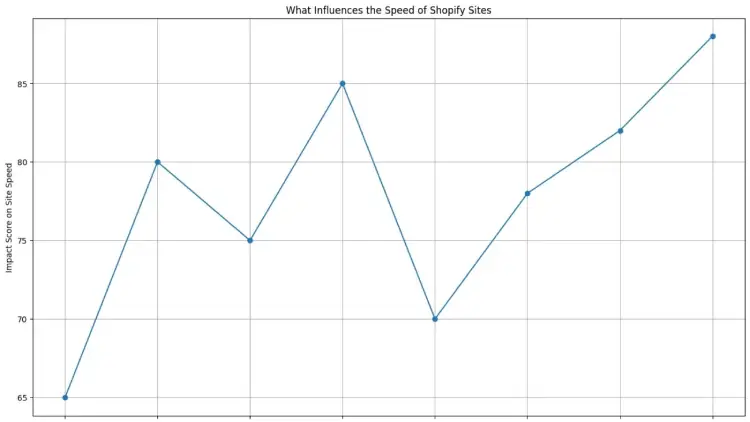
What influences the Speed of Shopify Sites
Shopify offers high-performance hosting, secure infrastructure, and anin-builtt global content delivery network. This implies that server uptime, scalability, t,y and baseline performance are to a great extent taken care of. Nonetheless, several performance variables remain dependent on the manner in which your store is created and maintained.
Speaking about optimization of the speed of Shopify sites, one should know that the majority of the bottlenecks begin with the frontend elements and not the backend servers.
The important influencers on Key Performance Include:
- Theme structure, quality of coding.
- App scripts
- Image sizes
- Custom code
- Third-party integrations
- Font loading
- Animation effects
These can be necessarily subdivided.
Theme Structure and Coding Quality
The way HTML, CSS, JavaScript, and Liquid templates are organized is determined by your theme.
A poorly coded theme may:
- Load large unused CSS files
- Introduce render-blocking JavaScript.
- Shock huge numbers of DOM elements.
- Liquid loops: Use liquid loops ineffectively.
Code of Browser Parsing. Clean code is faster and fewer time to first meaningful paint.
App Scripts
Each app installed has the potential to inject scripts into your store. A few are loaded on all pages throughout the world, even when they are only required in one or two templates. This increases:
- HTTP requests
- JavaScript execution time
- Layout shifts
A close audit of the behavior of the app is vital in the optimization of Shopify sites’ speed.
Image Sizes
Big images cause considerable weight gainonn the page. A large number of high-resolution banners on a homepage is easily more than the optimal size.
Less compression and size optimization spares:
- Bandwidth usage
- Server response time
- Time to interact
- Custom Code h3
Often, experimental features, custom tracking scripts, and the occasional developer edits are accreted over time. Any little inefficiency may be multiplied into felt slackness.
Third-Party Integrations
Outside dependencies are services like payment buttons,chatbotss or marketing, which are external. All dependencies raise the level of loading.
Font Loading h3
Several font families and weights are available, and add render time. Custom fonts can sometimes prevent the view of text until they are loaded,d and this affects animated speed.
Animation Effects
Animations would be attractive and make use of JavaScript and CSS resources. Over-provisioning of animations might slow the speed of interactivity and affect the performance of mobile devices enormously.
Finally, optimizing the speed of the Shopify site is aimed at perfecting these variables that can be controlled without modifying the server infrastructure of Shopify.
1. Select a lightweight optimized theme
Thematic is the structural backbone of your store. The theme dictates minimum performance even before the addition of apps or uploading products.
The place to begin with is a dependable one, the Shopify Theme Store, where the reviewed themes are reviewed on quality and compatibility.
Why Theme Choice Matters
Themes contain:
- Layout structure
- CSS files
- JavaScript files
- Liquid templates
- Embedded animations
- Interactive components
All these determine the speed at which the browsers are able to display content.
For example:
A homepage theme that has many sliders on its home page heightens the use of JavaScript.
Background videos increase the weight of the first page.
The collection pages can be slow due to dynamic product filtering.
Performance vs Aesthetics
Performance and visual effects are some of the themes that are emphasized. Although it may be visually appealing, excessive use of animations and video backgrounds may damage the speed of mobile devices.
A themed store, considered by Shopify as an example of a high-performing site, focuses on:
- Minimal dependencies
- Modular sections
- Efficient CSS delivery
- Deferred JavaScript
- Best Practices
- Select minimalistic and conversion-oriented designs.
- Do not have unnecessary sections on the home page.
- Eliminate theme features that are not utilized.
- Minimal font changes.
- Turn off the features that you do not need.
Demo stores applied before committing:
- GTmetrix
- Lighthouse
Measurement of performance scores and check waterfall charts to determine which of the resources uses the most load time.
A perfectly coded, clean theme is the basis of good optimization of a Shopify site’s speed.
2. Automate and Reduce Image Dimensions
The pictures usually occupy over half of a page.
Niche product photography is very relevant to conversions, but it needs to be optimized.
Optimization of Image best practices.
Scaling of pictures to the real size of the display.
Use modern formats like WebP.
- Send files after compressing.
- Do not use too huge hero banners.
- Enable lazy loading
Tools such as:
- TinyPNG
- ImageOptim
help not only make files much smaller, but also with a quality that is not obviously reduced.
Why It Matters
Assuming you have five 3MB pictures on your homepage, then that is 15MB of information, and other scripts are not loaded yet. This wait time is very high in mobile networks.
Optimized images improve:
- Largest Contentful Paint (LCP)
- Bounce rate
- Conversion probability
Shopping sites optimized withthe best speed using Shopify filters between both visual and performance optimization.
3. Minimise and Audit Shopify Apps
Apps are often added on top and often add performance overhead.
Each app may:
- Add JavaScript files
- Load additional CSS
- Generate external network requests.
- Insert tracking/ analytics scripts.
- Uninstallation of even an app can leave behind some code in theme files.
App Audit Strategy
- List all installed apps
- Among the necessary reserved versus optional tools.
Remove unused apps
- Eliminate duplicated tools in favor of a multifunctional tool.
- What is the review theme? Liquid and snippet files do not have any leftover scripts.
Reducing scripts lowers:
- Time to interact
- Total blocking time
- Network congestion
The optimization of the speed of the Shopify site should be done through careful management of the apps and regular audits.

4. CSS and JavaScript Minification and Optimization
Your store is configured using CSS and JavaScript. Nonetheless, large files or defectively formatted files slug rendering.
- Key Techniques
- Minify CSS and JS
- Bigger files Standardize the smaller files.
Remove unused CSS
- Postpone the non-important sanctioned JavaScript.
- Load the scripts asynchronously.
Minification removes whitespace and comment and it reduces the size of the files.
Defering JavaScript means that critical data loads at first, and thereafter, interactive scripts run.
Since a failure to make edits correctly may upset layout functionality, copy your theme prior to editing.
The development of an optimized site speed in Shopify crequiresan advanced developer who can safely restructure code dependencies.
5. Limit Third-Party Scripts
Elasticity External scripts often produce the biggest performance bottlenecks.
Common additions include:
- Analytics tools
- Marketing pixels
- Live chat widgets
- A/B testing platforms
- Heatmap software
Both external tools present DNS lookups and request delays. Although tools such as Google Analytics can be useful, the ability to combine several tracking tools can lead to a massive decrease in performance.
Best Practices
- Get rid of duplicate tracking systems.
- Load unnecessary scripts when interacting with the page.
- None of the chat widgets should be auto-loaded.
- Managing tags responsibly.
Shopify site speed optimization relies on third-party control as one of its fundamental pillars.
6. Enable Lazy Loading
Lazy loading only loads off-screen content when the online users scroll.
Benefits include:
- Faster initial rendering
- Reduction in bandwidth usage.
- Improved perceived speed
A majority of contemporary Shopify themes have lazy-loading product images.
Otherwise, native loading attributes or JavaScript-based solutions can be adopted by the developers.
Lazy loading does not ruin the user experience, even in terms of media richness.
7. Web Content Delivery Network (CDN)
Shopify automatically distributes its resources through its CDN and is delivered at a faster pace in geographic areas.
When optimizing:
- Do not have the pictures hosted outside.
- Test that assets are loaded in the CDN of Shopify.
- Lessen reliance on third-party realms.
- CDN reduces the distance between destinations and end users, thereby reducing latency.
The appropriate use of the CDN of Shopify can reinforce the general optimization of the Shopify site speed.
8. Monitor Core Web Vitals
Core Web Vitals are offers of real-life performance.
They include:
- Largest Contentful Paint (LCP)
- First Input Delay (FID)
- Cumulative Layout Shift (CLS)
Track performance using:
- Google Search Console
- PageSpeed Insights
- Why Core Web Vitals Matter
These metrics influence:
- Search rankings
- Mobile usability
- User trust
To improve LCP:
- Compress hero images
- Preload key assets
- Minimise render-blocking JavaScript.
Regular testing is very important during the optimization of the Shopify site speed.
9. Disorganize and Clean up Code and Remove Unused Features
Over time, stores build up the digital clutter.
Sources include:
- Removed apps
- Outdated themes
- Custom developer edits
- Cleanup Checklist
- Garbage Clean up ETC Liquid snippets.
- Delete redundant font files
Simplify animations
- Eradicate duplicity of tracking codes.
- Streamline homepage layout
- A lean codebase gives the codebase stability and consistency.
The performance of store speed optimization on Shopify is an ongoing maintenance process and not a project.
10. Think about Shopify Speed Apps
There are even apps that are dedicated to performance enhancement.
They may offer:
- Image compression
- Code minification
- Automated lazy loading
- Performance diagnostics
Nonetheless, the deployment of a speed application that inserts hefty scripts goes against the aim of optimization.
Before Installing:
- Compare the existing performance.
- Install the app
- Retest metrics
- Compare improvements
- In case there is no tangible advantage, delete the app.
Strategic analysis will make sure that the optimization of the speed of the Shopify site does not have the opposite effect.

Final Thoughts
The optimisation of the speed of Shopify websites is among the best investments of ecommerce expansion. Everything can be influenced by speed, such as SEO, conversion rate, user trust, and general revenue.
To recap:
- Choose a lightweight theme
- Compress and resize images
Minimize apps
- Optimize CSS and JavaScript
- Limit third-party scripts
- Enable lazy loading
- Monitor Core Web Vitals
- Perform regular audits
An expedited Shopify store generates a smooth shopping experience that makes customers become brand followers.
Competitive markets in e-commerce make performance your edge. Your customers will remain longer, view more goods,s and return to make purchases knowingly when your pages are faster than those of your competitors.
Some of the strategies that are presented in this guide will leave your store in a position to grow sustainably and achieve improvements in performancthatch are measurable.
Frequently Asked Questions
1. What do I do to test the speed of my Shopify Store?
To verify loading time, mobile performance, and Core Web Vitals, you may use such tools as Google PageSpeed Insights or GTmetrix. Frequent testing will enable you to know what is wrong and what the consequences are of the efforts to make your Shopify site faster.
2. What is the desired speed score of a Shopify store?
A score of above 80 is considered to be strong in the area of mobile performance. Nevertheless, pay more attention to such objective measurements as quick loading, consistent layout, and rapid interactivity, and not only the general score.
3. Slowdown of a store by Shopify apps?
Yes, they can. With apps, you are likely to add scripts and outside requests,s which makes this load time consume more time. An analysis of scripts that are not needed, as well as the deletion of apps that are not used, is a valuable step in optimizing the speed of a Shopify site.
4. Is it the slow speed of Shopify hosting?
Usually not. Shopify offers good hosting and CDN. The vast majority of the problems with speeds are caused by heavy themes, giant images, excessive number of apps, or alternative scripts, all of which can be addressed with the help of appropriate Shopify site speed optimization.



2 thoughts on “Shopify Site Speed Optimization: for Fast, Winning Sales”
Hi there to all, for the reason that I am genuinely keen of reading this website’s post to be updated on a regular basis. It carries pleasant stuff.
Thank you so much for your kind words! I’m really glad you enjoy the content. Stay connected, more helpful and interesting posts are coming soon!