

Modern digital marketing cannot exist without SEO analytics as the latter offers practical data on the work of the respective websites, the effectiveness of the applied keywords, the level of engagement with the users, and traffic dynamics. It enables marketers and companies to optimise the content, improve the ranking of search engines and make decisions based on the data. With the knowledge of the pillars of SEO, including the audits and strategies done with AI tools, mastering analytics in SEO is a key component to the achievement of the person in digital marketing and business online.
What is SEO Analytics?
The systematic procedure of measuring, examining, and interpreting how your site is performing in search engines is known as SEO analytics. It includes gathering information about traffic origin, user activities, search words, backlinks, and interactions. Marketers know which tactics are working and what should be improved using this information.
SEO analytics not only make you observe what the activity is like on your site, but it directs future decisions as well. Judging by the most frequented pages, the kinds of keywords that can make sales, and the kinds of content that interest users, you will be able to improve your plans and get the maximum ROI.
With time, AI-driven tools, predictive analytics, and automated insights have become inseparable from SEO analytics,s as it is a vital skill of a digital marketer in the 21st century.
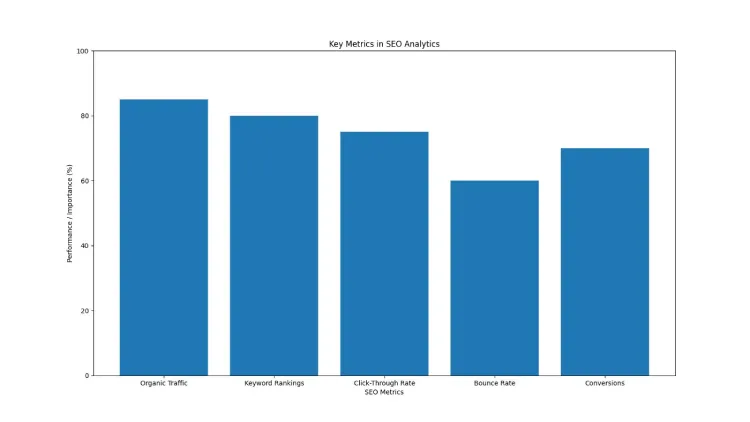
Key Metrics in SEO Analytics
The measurement of site performance refers to monitoring the most important metrics that indicate site health, engagement, and SEO success.
- Organic Traffic: This displays the number of people who visit through search engines. Monitoring it will enable where the pages and keywords perform better.
- Keyword Rankings: Discovers what keywords direct the users to your site and provides content that is aligned with the search purpose.
- Click-Through Rate (CTR): This is the number of times that users use your links in the search results. High CTR will denote relevant titles and meta descriptions.
- Bounce Rate: The rate of percentage of visitors who leave after viewing one page. Poor engagement or misfit content is possible with high bounce rates.
- Backlinks: The links established by credible websites increase the credibility and ranking.
Regular tracking of the measures will enable you to optimise the content, enhance engagement, and maximise search visibility, which should keep your SEO tool effective.
Looking to boost your website’s SEO performance? TechishWeb offers professional SEO analytics and optimisation services to help you track key metrics, improve rankings, and drive more traffic. Contact us today to get started!
The Categories of SEO and Their Significance
SEO encompasses various strategies that are interactive in enhancing the visibility and performance of a website. Knowing the key forms of SEO allows for developing a balanced approach.
On-Page SEO
Gives attention to the optimisation of the contents of your website, headings, meta ttags URL, and internal linking. Effective on-page SEO is useful in getting your content figured out by the search engines and also in enhancing the user experience.
Off-Page SEO
And the art of establishing credibility courtesy of backlinks, social cues and mentions of brand names. Quality off-page optimisation is indicative of credibility to the search engines and might attract more traffic.
Technical SEO
Discusses the structure of the sites, indexing, mobile friendliness, speed and crawlability. Technical SEO makes sure that the search engines have the ability to access and rank your website.
Local SEO
Location Targets positioning searches to enable companies to show up in local search and maps. Local SEO optimisation will draw local customers who are currently searching for information about products and services.
The combination of these forms of SEO and analytics, as well as digital marketing strategies,s will provide a comprehensive strategy of ensuring that websites are ranked higher, have a greater number of visitors and a strong online presence.
Critical Software to SEO
The analysis of SEO relies on numerous tools that allow the site to monitor its performance, optimise the content, and stay in the lead with competitors. The appropriate mix of tools helps marketers make decisions that are made based on the data, recognising growth opportunities, and enhancing their positions in the search engines.
Google Analytics
Google Analytics offers comprehensive data about traffic and behaviour of the websites and measures of engagement. It assists you in seeing the pages with the highest traffic, the duration per page that is spent by the users, and actions that result in a conversation. Knowing this, you can make optimisations, better navigation choices, and well-informed SEO choices.
Google Search Console
Google search engine Google Search Console is necessary to keep track of the performance of your site. It displays the number of keywords that are bringing in the traffic, indicates indexing problems, describes the number of page errors, and the number of click-through rates (CTR). Periodic search console usage on your site is a health guarantee that enables the site to be visible to search engines.
Ahrefs & SEMrush
Ahrefs and SEMrush are all-encompassing tools of SEO, which offer backlink analysis, competitor research, and keyword tracking. The tools aid in analysing the strategies of competitors, discovering valuable keywords, finding content gaps and building the power of your site with the right link-building programs.
Ubersuggest & Moz
Ubersuggest and Moz help in researching keywords, trending topics, and low-competition keywords. They also offer such metrics as domain authority, difficulty of challenging keywords, and search volume, which allows you to focus the highest amount of energy on content creation and optimisation.
AI Tools in SEO
Artificial intelligence applications such as ChatGPT assist in generating content with optimal search engine algorithms, conducting audits, proposing improvements, and forecasting keyword trends. Though effective, AI is most effective when left to human judgment.
The combination of various tools, such as analytics, keyword research, backlink monitoring, and AI, provides an overview of the site’s performance and assists in increasing traffic, interaction, and search ranking.
SEO and Digital Marketing Pillars
SEO is built on four pillars: content quality, technical performance, user experience, and authority. These work alongside broader digital marketing frameworks, including content marketing, email, PPC, social media, and analytics.
Understanding principles like the 80/20 rule and golden SEO guidelines helps prioritise the most impactful actions, while broader strategies may follow five pillars or seven tactics covering content, engagement, paid promotion, and analytics.
AI in SEO Analytics
Although AI is capable of performing analysis automatically, it does not exclude human skills. SEO is a skill that is still critical, and it needs to be judged, think strategically and create content creatively. Over the next five years, SEO will keep on growing with the integration of AI tools, but will still stay effective in using human insight at the strategic decision-making level.
Career Prospects and Competencies in SEO
SEO is not a low-income profession but a digital marketing skill as well. Good SEO experts may be employed in a company, agency, or as freelancers. Great salaries depend on experience, expertise and location, yet SEO experts tend to receive good wages.
Key skills include:
- Technical and on-page SEO.
- Keywords and content optimisation.
- Interpretation and reporting of analytics.
- Knowledge of the basics of coding (counter-intuitive yet optional).
- SEO expertise and technical skill in AI technology.
One can study SEO alone by taking online courses, tutorials and through practical experimentation. Though it may be stressful with the constantly changing methods of algorithms and other pressures of performance, there are opportunities for the job, remote work, career development of the career, and a way to become a high-income skill.
Types of SEO Audits and SEO Analytics
SEO audits have significance in the determination of problems and performance enhancement. They assist in making sure that your site will rank high, the experience is convenient to the users, and they adhere to the best practices in SEO.
Types of SEO Audits
- Technical Audit: Access site framework, indexation, plenty, and ease of use on mobile devices. It makes the search engines able to view and comprehend your site in an excellent manner.
- Content Audit: Review your content in terms of relevancy, quality, your optimisation of keywords, and your engagement. This assists in enhancing poor content and updating the information.
- Backlink Audit: Checks whether your link profile looks good and eliminates any toxic or bad links that will damage the rankings.
- Competitor Audit: Comparisons of the performance of your site with your competitors assist in identifying the strengths and weaknesses of your site as well as the opportunities to improve your performance.
Types of Analytics
Analytics will assist you in comprehending user behaviour and patterns of traffic, as well as performance trends.
Key types include:
- Descriptive Analytics: Displays what has occurred on your site, i.e. the amount of traffic or pageviews.
- Diagnostic Analytics: Reasons certain trends exist, such as a decline in traffic or engagement.
- Predictive Analytics: Uses the previous data to make predictions about the future performance and trends.
- Prescriptive Analytics: Provides recommendations to be actioned on improvement of content, keywords, and structure of the site.
With audits and these forms of analytics, you will have a clear view of the health of your website and have a well-informed choice to make regarding SEO.

The Best Practices and Rules in SEO
Effective SEO is based on adequate guidelines and concrete principles that inform the creation of the content, optimisation of the websites, and the general digital strategy. Due to these best practices, your site will be ranked high, besides actually being of value to its visitors.
Golden Rule of SEO
The Golden Rule of SEO is quite easy: you need to produce content that people value and ensure that it is search engine-friendly. This translates to being able to write down clear, informative and engaging information which has automatically added keywords, optimised headings, and meta description. Taking a balanced approach between user experience and SEO is the assurance that there will be increased engagement and more rankings.
3-3-3 Rule in Marketing & Sales
The 3-3-3 rule is useful in focusing the efforts on three messages, three channels and three user actions. Driving this to SEO would guarantee that one has targeted, measurable, and meaningful engagement, be it in the form of clicks, sharing, or conversion.
40-40-20 Rule
It is the 40-40-20 rule, which instructs on effective resource distribution: 40% on how to reach the audience and comprehend them, 40% on how to create the appropriate message, and 20% on how to select the medium. In SEO, it is an optimisation of content for the search purpose, the crafting of great copy, and theimpacts it makes through the best channels.
SEO Checklists
The SEO checklists make the ooptimisation organisedand uniform. Dwelling on on page aspect, technological aspects and off-page planning will not leave anything behind. This involves the optimisation of meta tags, headings, and internal links, site speed, mobile response and backlinks.
Additional Best Practices
Additional critical elements are the need to keep the content at the optimum length (1, 200 to 1,800 words in a detailed guideline), good natural use of key words, and improving the readability. Bullet points and visualisation with clear formatting provide a better user experience, which has a positive indirect effect on boosting SEO.
Future of SEO
The world of search engine optimisation is changing constantly. The optimisation of websites has undergone changes with the introduction of AI, voice search, mobile-first indexing, and changes in algorithms. The automation will not replace SEO skills, as they will be useful in those spheres of work where strategic considerations, content creation, and sophisticated analytics are needed.
As AI is helping solve tasks such as audits and keyword searches, SEO specialists are able to concentrate on the most important elements of strategy, creative optimisation, and competitive differentiation. The use of SEO as an important part of digital marketing is predicted to be a significant element of digital marketing in the coming 10 years, and it will evolve with changes in technology.

Conclusion
SEO analytics is an analytical process that is both holistic and data-focused, so that websites will be as visible as possible in search engines. Traffic monitoring, analysing performance based on keywords, auditing, and integration of artificial intelligence (AI) tools allow marketers to make all the necessary decisions, resulting in the ranking of the products, high levels of engagement, and market conversion.
It is important to understand the science of SEO analytics, either as you begin your career, run an online enterprise or in the management of a digital marketing department. It is the gap between strategy and execution and is useful in ensuring that content is delivered to the right audience, and allows the content to remain a step ahead in an ever-competitive digital environment.
Knowing the technology of SEO, its analytics, pillars, and practices, businesses and professionals may be maximising ROI, being agile, and futureproofing their digital presence.
Frequently Asked Questions
FAQ 1: What is SEO analytics?
SEO analytics refers to monitoring and analysing the performance of websites in search engines in order to enhance their rankings and user-friendliness.
FAQ 2: What are the most common types of SEO?
The primary ones include On- page SEO, Off-Page SEO, Technical SEO and Local SEO, each of which has its own area of expertise regarding ooptimisation
FAQ 3: Can AI tools help with SEO?
Admittedly, AI applications such as ChatGPT may help with audits, content optimization and keywords, though human strategy remains a must.
FAQ 4: What is the way to track SEO performance?
Monitor the traffic, keywords, CTR, bounce rate, and backlinks with the help of tools such as Google Analytics, Google Search Console, Ahrefs, and SEMrush.