


TIS can secure your website by providing a level of encrypted user data, increased protection against cyber threats, and anti-data theft. It inspires the desire of a visitor, does not breach browser warnings of insecurity, and yields better search results because Google prefers secure websites. To have more optimised press coverage, improved user trust and more business in the long run, HTTPS is necessary.
What Is HTTPS and Website Security?
Its secure counterpart, which is known as HTTPS (Hypertext Transfer Protocol Secure), is the protocol that is used to transfer data between theuser’sr browser and a site, but in a secure version. It secures this information with the encryption of the data with the help of the SSL or TLS certificates.
This encryption ensures that the confidential data, like log-in data, form submissions and payment data, is secured against hackers and cyber attacks. It is confidential, and it eliminates wrongdoings of data and ensures that the users are communicating with the right site.
The padlock icon in the browser and a start-up URL with the prefix of HTTPS help you to be aware that you are using it. This minor visual cue creates user confidence, as well as enhances search results, since search engines give preference to secure sites.
The use of HTTPS by Google as an SEO Ranking policy
In 2014, Google ratified HTTPS as a ranking signal, and the weight has become more significant since then. Although HTTPS will not help to improve the rankings significantly, it will improve the overall performance of SEO in several ways:
- Gives credibility and trustworthiness- Trusting websites will boost user confidence and interaction.
- Enhances safer crawling and indexing – Guarantees the integrity of data when utilising search engines to crawl.
- Enhances user experience -Increases not secure browser warnings that drive up bounce rates.
- Gives a competitive edge – HTTPS may be the difference-maker in near-tie berries.
- The lack of HTTPS can make your site vulnerable to trust issues and disadvantages in the rankings. Security is critical in contemporary SEO.
- Optimise your site to grow your business today! We are TechishWeb, and we provide HTTPS implementation and complete protection of the entire website. Get Started Now”
Cautionary Messages on a Browser and User Confidence
The user gets an announcement of the site bot being secured as HTTP in modern browsers such as Chrome, Safari, and Firefox, especially on web pages with form or login boxes. This gives an immediate suspicion to the users:
Is the site safe?
Will my confidentiality be put in jeopardy?
Can I trust this brand?
No sensitive information is needed to create the perception of risk, thus scaring visitors away and thereby increasing bounces, decreasing engagement, and reducing session length, which indirectly can damage SEO.
With HTTPS, the related warnings are eliminated, users’ data is secure, and trust is established, which enhances user experience and search.

User Experience Signals and HTTPS
SEO, however, is no longer about the use of keywords and backlinks, but Google is starting to judge the interaction of users with your site. These user experience indicators, which may affect user search performance indirectly, are environmentally formed through HTTPS.
1. Builds Trust and Confidence
Safe websites have padlock icons and the URLs on them name begins with https://, an indicator which individuals understand as safe. The more confident the visitor is, he or she is to stay and visit more than one page and make various conversions, including buying or filling out a form.
2. Removes Browser Warnings
Modern browsers display an HTTP site with the warning of Not Secure, particularly sites that contain a form or a login field. Such warnings are likely to drive away users at once, boosting bounces and diminishing engagement. There is no friction produced by HTTPS, and this provides an easier experience when browsing.
3. Enables Modern Web Features
Numerous features of the advanced web technology demand the use of HTTPS, such as HTTP/2 to load web pages faster, progressive web applications (PWAs), geolocation, and protected API integration. These enhance the speed of the sites, interactivity and ease of use.
4. Promotes Improved Engagement Measures.
Although not allbehaviourall metrics are applied by Google as direct ranking variables, engagement measures such as time on the site, number of pages visited during a given session and behavioural conversion measures tend to be associated with improved search ranking. These good behaviours are stimulated by a secure site, whereas an insecure site may keep away customers.
To the point, HTTPS allows improved user experience and better security of websites. It also improves SEO output as well as conversions by fostering trust and confidence, eliminating warnings and encouraging interactions.
Two fundamental Web Vitals and HTTPS Compatibility
Core web vital is a speed, responsiveness and visual stability of a page, which have been taken into consideration in the Google page experience ranking. Although HTTPS is not one of the Core Web Vitals in itself, it also allows technology that enhances performance.
Only supported HTTP/2 and HTTP/3- socket- There is a higher-speed andbetter-optimisedd data transfer and faster load time.
Enables optimisations in performance – Secure connections enable optimisation by caching, lazy loading, etc.
Enabling more web functionality reveals itself as an HTTPS requirement, especially for service workers and PWAs.
Concisely, HTTPS will give the foundation to a quick, stable, and user-friendly site, which will be beneficial in enhancing core web performance, user experience, and SEO levels.

Any security issues will harm SEO in a rush
Security breaches can quickly cause organic search visibility to be lost. Hacked web pages, malware-infected web pages, phishing web pages are put instantly at stake of harm that can have a fatal impact on the search engine optimisation and web page trust.
- The most significant implications of security issues on search engine optimisation:
- Eradication of the outcome: The result can be removed either temporarily or permanently by Google to ensure that the user is not put at risk, and this will result in a sudden loss of traffic.
- Security warnings on search results:– Messages like, this site might be hacked make the click-through level decrease, and your credibility goes down.
- Blocking by antivirus and browsers: Antivirus and browser software may classify certain sites as potentially dangerous and alert users before they visit.”
- Slow recovery: The search positions and the site might require weeks or months (depending on the severity of the problem) to clean up.
Subsequently, though, HTTPS does not guarantee that your site will not be attacked, but it reduces the risks of data interception, data manipulation, and certain cyber attacks to a minimum. It also gives a hint to the search engines that your site is abiding by the basic security benchmarks that stipulated long term stability of the SEO.
HTTPS and Accuracy of Referral Data
HTTPS helps in preserving referral data which are likely to be lost as the traffic routes between the HTTPS sites and the HTTP sites. Without it, visits may be considered direct, and it will be hardly possible to:
- The measurement of the performance of SEO.
- Attributes need to be coded and converted properly.
- Understand user behaviour
Full adoption of HTTPS provides better analytics and reliable information to make marketing choices based on data first and foremost.
Trust Signal: HTTPS Conversion.
User trust, which is increased with the help of HTTPS, also directly affects conversions:
Submission of the form: When the user finds safe pages, he or she will submit information.
Signs of credibility padlocks and a badge of trust built with the help of S.S.L lowers resistance.
Checkout payment E-commerce secure pages boost sales and minimise cart abandonment.
Lead generation: Even minor improvements on trust may boost enquiries and calls.
Concisely, HTTPS does not merely secure information but also instils confidence, which will transform traffic into clients.
Typical Migration Concerns of HTTPS
The adoption of HTTPS is feared by most businesses since it might disrupt the SEO process, but both problems are easily avoided when properly planned.
Best processesforo a smooth migration:
- Use 301 redirects between URLs of the HTTP and HTTPS protocols.
- Include internal links and resources to HTTPS in order to prevent mixed content.
- XML sitemaps: Resubmit XML sitemaps in Google Search Console.
- Sixty crawl errors and indexation errors.
HTTPS is now the baseline:
- Google holds it in trust and ranking.
- Only non-secure sites are labelled by the browser, which may send a visitor away.
- Customers would be inclined to trade with websites that are secure.
Correctly executed, HTTPS migrations preserve or enhance rankings, increase trust levels and ensure future lucrativeness of SEO.
Website Safety and SecurityChecker.
Our Free Website Safety Checker and Security Checkerassists you in getting to know whether a site is safe to visit or not, and give information. All someone needs to do is type in a URL, and the tool scans over 80 security databases (Google, Comodo, Opera, Securi) to identify any malware, scam, or phishing threats.
It is also a knowledgeable verifier of the presence of the fine example of theSSL certificates, which verify the correctness of the security of the site and encrypt it. Even though there is no 100 per cent risk-free site, this tool will enable you to safely visit websites and make knowledgeable choices on the internet.
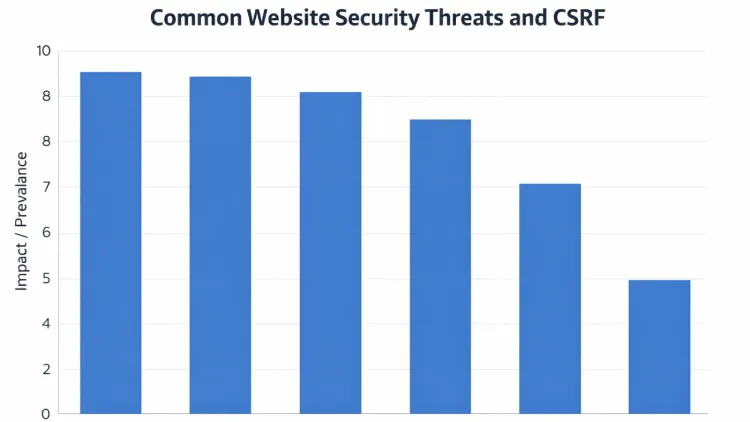
Common Website Security Threats and CSRF
Cross-site request forgery (CSRF):
Fraudsters would log in users to give orders that were not their own.
Configured to work due to the automatic transfer of cookies (stored session cookies) by browsers.
Prevention: All sensitive actions must use user-specific tokens generated by the server.
Other Common Threats:
Clickjacking Hijacks using nefarious embedded frames. Fix: block embedding using headers.
- Denial of Service (DoS): Overloads the site with requests to discontinue access. Fix: filter and limit traffic.
- Directory Traversal: Uses manipulated paths to access files that it is not authorised to access. Fix: sanitise input.
- File Inclusion: Interprets unwanted files, which are dangerous because it exerts the risk of allowing code implementation or XSS. Fix: validate inputs.
- Command Injection: Scan with command injection on systems. Fix: sanitise all input.
- Central Implication: These attacks may breach information, negatively affect search engine optimisation, and harm customer trust. Appropriate input validation, token-based security and security best practices are needed.
The reason HTTPS is Safe and how HTTPS is Secure
Risks of HTTP:
- Downgrade attacks: Push connections to insecure HTTP.
- Mixed content: Malware can be injected by loading HTTPS Web pages with HTTPS scripts/images.
- Legacy systems: Obsolete tools based on HTTP provide a security vulnerability.
- How HTTPS Works:
- TLS handshake: Server and browser are communicating using protocols supported by the browsers and the servers, and random values.
- Authentication: Identity is demonstrated by the server with an SSL/TLS certificate of a credible CA.
- Encryption: The encrypted session keys lock out all the information between the server and browser.
Best Practices for SSL/TLS (2025–2026):
- Use short-lived certificates (200 days -47days by 2029).
- Enhance TLS 1.3 and turn the old ones off.
- Automate the renewal and trace the illegal certificates.
- Implement HSTS to inhibit the downgrading of protocols.
Lesson Learned: HTTP is unsecure whereas when using proper management of ccertificates then, HTTPS offers a level of encrypted, verified and trusted web interactions.
Introduction to SecurityScorecard, HTTPS Issues Detection,n and HTTPS Detection
Detecting Misconfigurations:
Application Security, DNS Health and Attack Surface Intelligence (ASI) help flag applications at SecurityScorecard:
- Out-of-date or ineffective certificates.
- Insecure HTTPS redirects
The certificates of untrusted or revoked CA.
It is also useful in the evaluation of the security of a third-party vendor to mitigate supply chain risk.
How HTTPS Protects Data:
SSL/TLS Certificate: Server is transmitting a certificate which contains the public key, domain and the validity information.
- CA Checking: Browser checks the certificate that the Certificate Authority has signed.
- Session Key: Browser and server come up with a common key through which they operate in an encrypted mode.
- Safe Data Transfer: All the information is passed via HTTPS and decrypted on the server.
- Note on Performance: The operation is performed in milliseconds, though when dealing with heavy traffic, encryption can be slightly slowed down, and the use of SSL offloading can be used to make the process as fast as possible.
- Lesson learned: HTTPS is effective for secure and trusted communication. SecurityScorecard assists in identifying incorrect BP setups and enhancing web and supply chain safety.
Inclined To Find Out Why Some Web Sites do not use HTTPS
Initially, the implementation of HTTPS was complicated, slow and more expensive:
- Canada was costly in certifying.
- The installation demanded technical skills.
- Web requests were slowed by performance overhead.
Most of these problems are now mostly countered, but the fears and anticipations that are old still keep most of the website owners wary. A few of these popular myths shall be discussed:
Myth 1: I do not make any personal transactions with sensitive information, and thus, do not require HTTPS.
The problem is that a good number of site owners assume that they do not need to gather sensitive data, so there is no need for HTTPS. This is too simplisticforf several reasons:
ISP-Injected Ads. ISPs inject advertisements on the websites of the HTTP protocol, which can be inappropriate or even obscene. This is prevented by using HTTPS, whichsecuress the site.
- Browser Restrictions: The current browsers have limitations on non-secure websites.
- Examples: Geolocation, push notifications, and progressive web applications (PWAs) are all based on HTTPS.
- User Trust: The warning signs of browser insecurity are becoming more and more familiar to visitors; unsafe sites can send them away, irrespective of the sensitivity of the data that they manage.
Myth 2: You will slow down my website with HTTPS.
- The issue of performance is justified because the speed of the page influences user experience and Google search results.
- The HTTPS protocol provides an additional TLS/SSL handshake to the regular TCP connection that might slightly add to the latency.
- Current TLS and wweb serverenhancements, though, ameliorate this overhead and the speed impact is insignificant on most websites.
- Techniques such as HTTP/2, HTTP/3, and SSL offloading optimise the performance of the secure sites more.
Myth 3: “The migration process to HTTPS will damage my SEO.
Migration of websites has certain risks that can be eliminated through proper preparation and execution.
Potential SEO risks include:
- Temporary downtime
- Uncrawled pages
- Duplicate content occurs when there is an HTTP and an HTTPS version.
Recent best practices of safe migration:
- 301 Redirects: Relocate the HTTP pages to HTTPS to inform the search engines of the new location.
- Canonical Tags: Canonical tags on the HTTPS pages indicate them to be deemed the canonical version.
- Google Crawl Management: Large sites. When using HTTPS pages instead of HTTP, use Google Crawl Management to tell Google to crawl faster to index your pages.
The correct migration will make sure that your rankings in terms of SEO will not drop, and in fact, they can be better because of the trust and security signs that are going to be offered by HTTPS.
The Way Our WordPress Security Services can work.
We provide advanced WordPress security services to enhance the security of the site and guarantee security in the long term:
1. Security Review specific
- In-depth analysis of your WordPress site.
- Determination of vulnerabilities and misconfigurations, and likely threats.
2. Fortification Measures
- Enforce powerful policies on passwords.
- RTC: 2FA Facilitate two-factor authentication (2FA)
- Bayes themes, plugins, and WordPress core.
- Install security dependent on guarding offenses.
3. Continuous Monitoring
- Constant monitoring of threats.
- Periodic updates and maintenance to provide constant protection.
- Suspicion fixtures and warnings.
Advantages of HTTPS and WordPress Security.
Enhanced Security
Wards off spam attacks, malware and brute force attacks as well as others.
Data Protection
Ensure to protect personal information obtained from users and establish trust and credibility.
Operational Continuity
Apple keeps your website safe and online, avoiding downtimes or violations that will affect your reputation and operations.
Key Takeaways
- HTTPS is not an option anymore; it is a minimum commandment of security, search optimisation, and user confidence.
- There are also numerous myths regarding HTTPS: sensitive data, performance, and SEO effect, which are out of date and out-of-practice.
- With proper migration, plus WordPress security being applied, you are assured of a safe, fast and fully functioning site.
Security investment is not only beneficial in data protection, but it also improves credibility, trust, and operational resilience.

Final Thoughts
HTTPS is not merely a technical gimmick anymore, which is a necessity of any webpage that respects security, trust and user experience as well as search engine performance. To safeguard confidential information and prevent cyber-attacks, as well as guarantee a higher level of user trust and the sustainability of up-to-date web-based technologies, the positive effect of HTTPS is obvious and quantifiable.
Though myths of cost, performance and HTTPS disruption have slowed implementation in the past, they have now become a thing of the past. Through proper planning, migration and continuous security measures,s websites may safely fall over to HTTPS.
Such a move as investing in HTTPS, as well as the effective security of WordPress, not only protects your site but also raises your level of credibility, helps improve the accuracy of analytics, and guarantees continuity after failures. Nowadays, having a secure site is not an option;l, it is mandatory for success, development, and credibility in the digital world.
Frequently Asked Questions
1. What is HTTPS, and what is so important to my website?
In HTTPS (Hypertext Transfer Protocol Secure), information exchanged between the user’s browser and your site is encrypted, and important user-sensitive information, such as your login credentials and payment information,n is secured. It is more trustworthy, does not display warning signs about not being secure, has a better user experience, and search engine optimization as Google prefers secure websites.
2. Will changing to HTTPS decelerate my site or drive down my SEO?
No. TLS/SSL deployments, and HTTP/2/3, as well as server optimisations in the modenvironments, have less performance impact. As the correct migration using 301 redirects and canonical tags guarantees that the rankings will stay the same or even grow, and the user trust and security will be improved.
3. What happens with HTTPS and user trust, user conversions?
PHRs use padlocks and have the prefix https:// to indicate a secure site. Users are comfortable with handing in the forms, making purchases, or posting information, which decreases bounce rates and brings up interest and conversions.
4. What will I do to make sure my site will not be hacked when it is transferred to HTTPS?
Keep up-to-dateSSL/TLS certificates and apply strong passwords as well as two-factor authentication, track weaknesses, and install security extensions. Continuous security because of regular checkups and WordPress-specific security verification has been used to keep threats such as malware and CSRF in check, as well as hacking activities.