

The culmination of organic traffic growth includes the process of attracting people to visit websites by ranking high as a result of simple search until and fulfilled without an advertisement. Through processes such as SEO, user experience, content strategy, and link-building, websites will be able to experience regular visitor count, greater proportions of conversions, and authority over time. This paper discusses the mechanisms, principles, and models of increasing organic traffic, and it has practical applications that can be used by anyone wishing to raise the presence and influence of their site.
What is Organic Traffic Growth?
Organic traffic growth can be defined as the number of visitors who access your site through search engines, social network sharing, or via any other website, free of charge. Organic traffic is free as opposed to paid traffic, as the latter relies on advertising budgets, and even after the content has been published, the former is generated without requiring the use of any paid advertising budgets. The greatest opportunity is that these visitors have already been seeking information, products, or services that your site is offering, thus they are highly engaged and more likely to become a convert.
It is not only the growth of organic traffic, but also the quality of content, user experience, and online authority of the website. Whenever a site has constant organic growth, the site is usually higher in search engine rankings, hence more visitors are attracted. To give an example, a blog post that is optimized to a particular topic could attract hundreds of visitors each day, and zero ads could be spent, and the effectiveness of a planned organic traffic work can be effective.
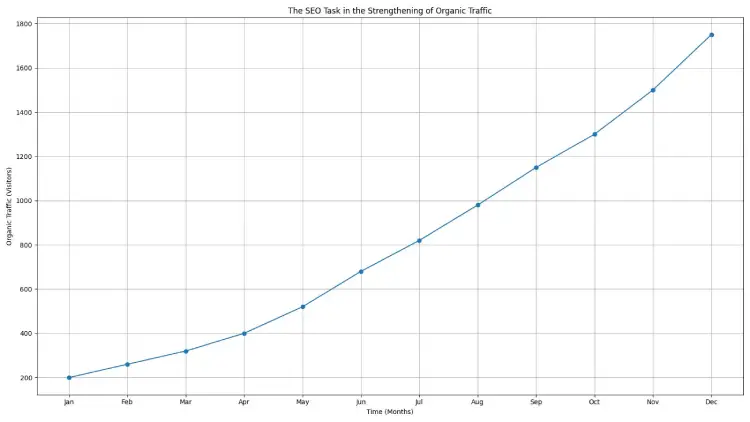
The SEO Task in the Strengthening of Organic Traffic
Organic traffic growth revolves around Search Engine Optimisation (SEO). On the one hand, some individuals, confusing organic traffic with SEO, make a distinction between the two terms; the latter is associated with the former. SEO refers to the number of strategies and techniques implemented to enhance the visibility of a particular site in search engine results, whereas organic traffic refers to the actual visitors that visit your site by way of these search results.
SEO as such can be divided into four categories:
- On-Page SEO: Page optimization involves optimizing web pages (headings, meta descriptions, URLs, and the use of keywords) of the web page.
- Off-Page SEO: Creation of backlinks, enhancement of social stickers, and enhancement of authority to the site.
- Technical SEO: Making your site crawlable, fast, mobile-friendly, and well-organized.
- Local SEO: Search-engine optimization of your website, with Google Maps and local SEO-specific search terms.
The websites can achieve much growth of organic traffic in the long-term by working on all four pillars of SEO. Inserting the three Cs of SEO, namely, content, code, and credibility, is also important. High-quality content, clean coding, and good links are all assets of a high search ranking.
Want to boost your organic traffic with expert SEO strategies? At Techishweb, we provide professional SEO services, including on-page, off-page, technical, and local SEO to help your website rank higher and grow faster.
Production of Quality Content
The basis of organic traffic is its content. Google and the other search engines give precedence to websites with relevant, valuable, and engaging information. Quality content consists of blog posts, videos, infographics, tutorials, and case studies that help the user address his or her question to the fullest extent.
The important considerations to take into account when creating content are:
- Evergreen Content: It is defined as content that is always relevant and keeps drawing people.
- User Intent: Identify what the audience is searching for and produce it in line with the searches.
- Keyword Optimization: It goes without saying that primary and secondary keywords should be used to enhance visibility.
As an example, a step-by-step instructional resource on the topic of, say, how to increase organic traffic, can get a thousand readers per month, provided that it is optimally structured. In a similar manner, a tutorial including screenshots and videos as explanations will increase the level of engagement and provide a desire to share, which also helps to create backlinks that subsequently optimize the SEO.
The Backlink Building Authority
The ability to get backlinks is among the critical aspects of organic traffic. A backlink on a reputable site will mean to the search engines that your content is credible and worth attention.
To boost the number of backlinks, emphasize:
- Posting as a guest on blogs related to the industry.
- Working with influencers and thought leaders.
- Developing an infographic, eBook, or case study that can be shared.
The measure of organic growth is usually your power that advances more in the virtual area, and the measure of this force is the backlink, which is the visible indicator of power. The two examples of organic growth correlate to the enhancement of the traffic to the webpage via SEO and raising of the number of subscribers on social media by delivering high-quality content regularly.

Using Social Media and Involvement in Community
Social media traffic does not necessarily constitute a part of the number of organic search traffic, although it is important in organic growth. Posting and building a blog presence on social networks, such as LinkedIn, Twitter, and Facebook, brings up awareness, referral traffic, and backlinks to other websites.
Agreements with communities on Reddit, Quora, and industry forums can also be used to enhance the website’s authority and bring visitors on board. Indirectly, social signals, likes, shares, comments, etc., work on SEO and contribute to the further growth of your site over time.
Enhancement of User Experience (UX)
Google awards websites that have a superb user experience. The enhancement of UX is thus of the essence when it comes to organic traffic.
Key aspects include:
- Page Speed: Rapid loading pages minimize bounce rates as well as enhance rankings.
- Mobile-Friendliness: The majority of searches would be done on mobile devices, hence responsive design is important.
- Navigation: Visual clear menus, internal links, and well-programmed pages keep the users busy.
- Accessibility: Usability would be improved by the use of Alt texts, legible fonts, and contrast ratios.
On the websites that are UX-oriented, there is a greater potential for organic growth since visitors will spend more time, interact more, and come back regularly.
Monitoring and Measuring Organic Growth
In order to measure the performance of organic traffic strategies, one should monitor the relevant measures.
Some of the key performance indicators (KPIs) are:
- Total organic visits: This is the number of users who have come through the search engines.
- Rankings Keyword Ranking: The ranking of targeted keywords in search results.
- Conversion Rates: Leads, subscriptions, or sales made out of organic visitors.
- Bounce Rate and Time on Page: Signs of content interaction.
Organic growth is calculated by comparing the traffic over a set time. A simple formula is:
Organic Growth (%) = [(Current Organic Traffic- Previous Organic Traffic)/ Previous Organic Traffic ) × 100.
The measure aids in tracking the developments and extracting the aspects that require enhancement.
Popular Demands of Organic Traffic Increase
Several websites see their organic traffic rise and fall, or even reduce because of:
- Search engine algorithm updates.
- More competition over specific keywords.
- Old irrelevant material.
- Problems with technology, such as defective links or slowness.
The solutions to these obstacles include being constantly up to date with content, conducting long-term SEO checkups, and working on developing valuable materials for your audience.
Plans to grow Organic Traffic
There is a need of combination of tactics in achieving a stable growth in organic traffic:
Keyword Research Preparing Keyword Research: Find high-volume, low-competition Keywords in your niche.
- Content Marketing: Post interesting, shareable, and informative content regularly.
- Optimization of an On-Page SEO: Make use of appropriate headings, meta descriptions, and structured data.
- Link Building: Authority websites Backlinks.
- Technical SEO: A fast-loading, mobile-friendly site with a secure website is definitely required.
- Local SEO: Optimize local search results in case you have a business that has a defined area.
- Social Media Integration: Market content via social management to create content and referrals.
It is also possible to go to the point of 1,000 visitors a day by following such strategies, as long as the content is optimized and promoted successfully.
Cases and Advantages of Organic Growth
Examples of organic growth are:
- A blog that is being searched by search engines as a result of optimized articles.
- The new subscribers to a company on social media increase organically due to the engaging content shared on the social media platform.
The advantages of the organic traffic development are great:
- Long-term traffic sustainability.
- Saving on costs as opposed to paid campaigns.
- More trust and credibility from the users.
- Higher interaction and turnover rates.
The Difference between Organic and Direct Traffic
Organic traffic is attained through search engines, whereas direct traffic comprises the visitors who enter your URL into the browser or through bookmarks. The two types are significant to each other, just that organic traffic is a measure of the implementation of the right SEO and content marketing strategies, and direct traffic is usually a measure of brand awareness and loyalty.
Digital marketing and its connection with organic traffic
The improvement of organic traffic is also shared with the increased digital marketing plans. Digital marketing can take various forms that would facilitate organic growth:
- Types of content: Marketing Blog posts, videos, and infographics.
- Social Media Marketing -Oh, talking to people and contacting them.
- Email Marketing -Developing dynamic relations and developing leads
- Search Engine Optimization (SEO) -Enhancing search performance.
- Organic growth is supplemented by other types of marketing, e.g., influencer marketing, paid, and affiliate marketing; however, they are not measured as organic sources of traffic.
The 4 Cs of marketing, which include customer, costs, convenience, and communication applies to the content strategies that have facilitated organic traffic. And then there are such frameworks as the 3-3-3 rule in marketing (3 types of content, 3 target platforms, 3 times engagement) to ensure the steady growth of the process organically.

SEO Pro Advanced Traffic growth
In order to get the full organic traffic growth, it is important to learn the concepts of advanced SEO and incorporate them into your overall strategy. These are not only strategies of enhancing the ranking of the search engines but also serve to maintain long-term growth and the users.
Key Advanced SEO Concepts:
The 5 critical concepts of SEO:
SEO is a complex discipline, and with these five areas, there would be a solid base by concentrating on them:
- Keyword Research: Find out your relevant keywords that your audience is searching for and target your short-tail and long-tail keywords.
- On-Page Optimization: Optimize the titles of pages, the meta-description, the headings of the pages, the URLs, and the pages to ensure that the content meets the search intentions.
- Off-Page Optimization: Develop good-quality backlinks and social signaling to make the site credible and authoritative.
- Technical SEO: Make certain that your site is fast, mobile-optimized, and designed in such a manner that it can be easily crawled by search engines.
- Analytics: Periodically monitor the performance parameters to gauge traffic, engagement, and conversions so that they can make informed changes.
3-Pack SEO:
Local SEO is a crucial factor in the development of organic traffic for location-specific businesses. The 3-Pack is the highest three search results on Google Maps.
The optimization of this includes:
- Creating as well as optimizing a Google Business Profile.
- Motivating customer positive reviews.
- Increasing visibility with the help of local keywords and structured data.
Digital Marketing: 7 Pillars:
The comprehensive view on organizing organic traffic development presupposes the combination of several digital marketing sources:
- SEO
- Content Marketing
- Social Media Marketing
- Email Marketing
- Analytics
- Paid Media
- Mobile Marketing
By exploiting all these pillars, you not only expect that your website gains visitors, but also that they are converted.
7 Types of Marketing:
Developing knowledge of marketing options helps extend your attention to something that is beyond SEO:
Digital Marketing: Online advertisement by use of search engines, social media, and websites.
Traditional Marketing: Offline advertising in the use of print, radio, and television.
Inbound Marketing: Of attracting customers to you by enticing them with good content instead of pounding messages down their throats.
Outbound Marketing: A proactive effort to contact customers using advertisements or email.
Content Marketing: To capture and inform the audience, valuable content should be created and delivered.
Social Marketing: Using social networks to develop consciousness and community.
Experimental Marketing: This is marketing that engages the customer with an experience where there is an emotional attachment.
4 V’s of Marketing:
The implementation of the following principles reinforces the organic traffic and general brand strategy:
- Value: Produce interesting, useful content that addresses the problems of the users.
- Variety: Provide various types of content: blogs, videos, infographics, and podcasts, to attract various groups of viewers.
- Volume: Have a steady production of content to ensure that your website is active and visible.
- Visibility: Make the content visible by using the means of SEO, promotion, and social media.
These sophisticated SEO and marketing ideas will be included so as to have a holistic solution to the organic traffic development. Through the integration of good search engine principles and online marketing techniques coupled with local optimization, websites will be able to grow sustainably in the long-run and be ahead of the pack.
How to maintain growth in organic traffic
The maintenance of the organic traffic growth needs constant efforts and regular strategies. Sites that expand without maintenance tend to decline in traffic over time. By targeting major areas, your organic traffic will be maintained and able to grow.
Key Strategies:
Frequent Content Creation:
- Post helpful blog posts, guidelines, or videos regularly.
- A content calendar can be used to schedule and generate a continuous stream of new content.
- To remain relevant, you should target the areas that your audience is actively seeking.
Content Refreshing:
- Revised old posts with new statistics, experiences, or cases.
- Make the text easier to read through the use of headings, bullets, or images.
- Add new internal links to improve the navigation and the SEO.
Link Maintenance:
- Find and eliminate dead links.
- Replace the old-fashioned references with the sources of authority.
- Keep on creating quality backlinks to enhance credibility.
Performance Monitoring:
- Track the organic traffic, bounce rates, and conversions with the help of the analytics tools.
- Measuring keyword ranks and discovering successful pages.
- Revise priorities according to the data to achieve maximum growth.
A steady, sustainable, and scalable growth in organic traffic to your website will be achieved by taking these strategies on a regular basis.

Conclusion
The strength of organic traffic should be used to develop viable visitors to the site in a cost-saving manner. With a mix of SEO techniques, high-quality content, enhancement of user experience, backlink development, and digital marketing strategy, websites are likely to attain a constant arrival of traffic and interactions. Not just the organic traffic promotes SEO, but it also revitalizes credibility, conversions, and long-term development.
The cost of organic traffic development is patience and constant work, yet rewards are high: the ability to generate long-term traffic and improve brand power, business goals, and general internet success.
Frequently Asked Questions
1. What is organic traffic?
Organic traffic involves people who arrive naturally at your site by search engines or via recommendations of friends, and without any advertisement.
2. What do I do to generate higher organic traffic?
Produce quality content, optimise search engine, generate backlinks, enhance user experience, and market socially.
3. What is the importance of organic traffic?
It is cheap, it is sustainable, it develops credibility, and it provokes long-term growth and conversions.
4. What is organic traffic growth?
Monitor visits, ranking of the keywords, conversions, and bounce rates using analytics. Calculate growth with:
((Current Traffic-Previous Traffic)/Previous Traffic) x100.