


JavaScript is the future of the web in 2025, but it will not be optimized correctly, which can hinder the search, rendering, and indexing of JavaScript-based websites by search engines. JavaScript SEO aims at guaranteeing full access to dynamic content, metadata, links, and structured data by search engines. Server-side rendering, clever internal links, optimization, the significance of dependencies, and good technical underpinnings make JavaScript websites rank equally well to traditional HTML websites. It is a tutorial that covers all the information (rendering strategies and structures, SEO, keyword density, etc.) as well as a career insight, and how to do it in a practical implementation in one aid.
What Is JavaScript SEO?
JavaScript SEO is the act of ensuring that websites that have been created using JavaScript frameworks cause search engines to crawl, render, perceive, and index the content within them correctly.
JavaScript is frequently used in modern web pages to create online content through dynamic generation in the browser. As an alternative to delivering a complete HTML file, the user (and search engines) can be delivered a basic HTML file, which loads JavaScript, which then builds the page.
Though search engines such as Google are able to run JavaScript, this rendering may create delays and indexing problems. That is why JavaScript SEO has taken the form of a specific kind of technical SEO.
In simple terms:
Conventional SEO presupposes the content on the original HTML.
JavaScript SEO makes sure that the search engines are able to get the content produced by the scripts.
JavaScript is also one of the most used programming languages in the world as we enter the year 2025. It is applied in frontend, backend (through Node.js), mobile, desktop applications, and even AI tooling. JavaScript SEO has never been as significant as it is today.
The reasons why JavaScript can be a problem in SEO
The steps that search engines use include:
- Crawling
- Rendering
- Indexing
Crawling and indexing are fast with the use of static HTML pages since the content is instantaneously visible. JavaScript-intensive sites introduce another layer, which is the rendering.
In case of inability to render or lateness:
- Information might not be shown on the search.
- Internal linkages might not be identified.
- Metadata could be unprocessed.
- Organized information can be disregarded.
At Google, there is a two-wave system of indexing. During the first wave, it does an indexing of the raw HTML. In the second, it translates JavaScript. This loophole may translate to a loss in ranking temporarily.
SEO-wise, it implies that JavaScript has to be deployed in a manner that is friendly to search engines.
Web JavaScript Search Engine Problems
1. No Server-Side Rendering
Client-side rendering implies that the page is constructed on the client-side by the browser. When a search engine crawler fails to run the scripts correctly, it might encounter an almost blank web page.
2. Broken Internal Links
JavaScript event-based links, rather than the normal links, will prevent crawling. This should be well structured in HTML.
3. Missing or Dynamic Metadata
Title tags andmetab descriptions put in via injection will not always be indexed.
4. Unlimited Scroll Pagination-Free.
Infinity scroll enhances the user interface, but fails to show crawlers unless there is pagination at the URL.
5. Performance Problems
New JavaScript bundles boost load time, which is damaging to Core Web Vitals and standings.
JavaScript SEO Solutions
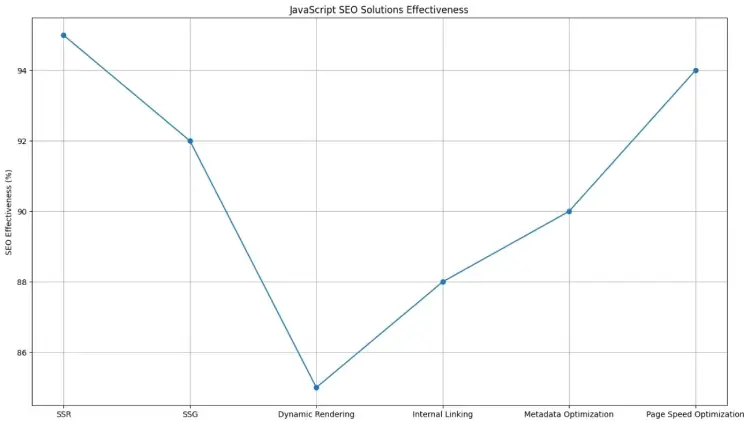
1. With Server- Side Rendering (SSR)
Server-side rendering is done on the server side, and then it is sent to the browser selling various representations of that data.
The popular frameworks, which support SSR, are:
- Next.js
- Nuxt.js
- Angular Universal
SSRI enhances speed and crawlability. SSR is regarded as one of the most appropriate solutions to JavaScript SEO with regard to the majority of contemporary projects.
2. Static Site Generation (SSG)
HTML files are built at deployment at SSG. These files are offered immediately and are also very search engine-friendly.
SSG is excellent for:
- Blogs
- Corporate websites
- Documentation portals
It eliminates the major part of rendering issues.
3. Dynamic Rendering
Dynamic rendering is the case when pre-rendered content is served to the search engine when a user receives client-rendered pages. This is applicable when complex applications are needed, yet it should be taken with caution.
4. Optimize Internal Linking
It should have correct HTML anchor tags all the time:
- <a href=”/services”>Services</a>
- You should not use JavaScript navigation handlers only.
5. Get Decent Metadata Rendition.
Servers should be visible on critical tags:
- Title tag
- Meta description
- Canonical tag
- Open Graph tags
Google Search Console is one of the testing tools that can be used to check rendered output.
6. Improve Page Speed
JavaScript-intensive websites have to focus on performance:
- Code splitting
- Tree shaking
- Lazy loading
- CDN usage
- Image optimization
Technical SEO is one of the main pillars of ranking that involves the use of performance.
Struggling with JavaScript SEO? Let TechishWeb handle SSR, SSG, and speed fixes for top rankings.
How to Test JavaScript SEO
- JavaScript SEO cannot work without testing.
- Compare Source vs. Rendered HTML
- When wasting appears in Inspect Element and not in View page source, then it is versioned by the clients.
Use URL Inspection Tools
- Google Search Console can be used to monitor the way a page is rendered by Google.
Monitor Core Web Vitals
- Rankings are impacted by speed and interaction metrics.
The 4 Types of SEO
The concept of SEO in general allows JavaScript SEO to be put into perspective. There are four main types:
- Technical SEO- Infrastructure, crawling, indexing, and site speed.
- On-Page SEO Content, keywords, headings, structure.
- Off-Page SEO Backlinks, authority.
- Local optimization Local optimization Localization of search.
JavaScript SEO is mainly considered to be a part of technical SEO, but it also has an effect on the on-page performance.
The Three Types of SEO
SEO can be generally simplified into three broad categories:
- Technical
- On-page
- Off-page
The three will have to collaborate to achieve high rankings.
The 4 Pillars of SEO
The success of SEO is based on four pillars:
- Technical foundation
- High-quality content
- Authority and backlinks
- User experience
JavaScript search has a direct influence on the first and fourth pillars.
The 80/20 Rule in SEO
The 80/ 20 rule holds that a fifth of efforts produce ninety percent of outcomes.
In SEO, that often means:
- Focus on the high-intent keywords.
- Repairing serious technical problems.
- Improving page speed
- Enhancing the internal connection.
- In the case of JavaScript optimization, minor fixing of rendering can generate ratio changes by a great extent.
The 3 C’s of SEO
The 3 C’s commonly refer to:
- Content
- Code
- Credibility
JavaScript SEO focuses primarily on the aspects of the Code in line with promoting content discovery.
The 4 Stages of SEO
SEO usually follows the following steps:
- Research
- Implementation
- Optimization
- Monitoring
JavaScript SEO is most applicable in implementation and optimization.
Strategy and Density of Keyword
A balanced key strategy is necessary.
For long-form content:
- Overall, 1-2 percent of the keywords should be safe.
- Between 1020 mentions in 1000 words is normal, depending on the situation.
- Excessive optimization may result in punishment. Natural usage is key.
The keywords are of four types:
- Informational
- Navigational
- Transactional
- Commercial
Good JavaScript SEO has all the content of the keywords being cited as crawlable.
What Type of SEO Is Best?
No single type is “best.” The most effective one is integrated SEO. The health without content will not rank. There will be no crawlable ccontentranking.
In the case of JavaScript websites, technical perfection of SEO is inadmissible.
How to Do SEO Yourself
There are multiple ways you can conduct SEO without any assistance:
- Carrying out keyword research.
- Maximization of titles and headings.
- Improving page speed
- Fixing crawl errors
- Building internal links
- Earning backlinks
Such free tools as Google Search Console and Google Analytics can be helpful.
You do not always have to spend on SEO as long as you are ready to take the time and learning.
Can Beginners Do SEO?
Yes. SEO is learnable. Most professionals begin as non-technical people.
On the same note, there is no such thing as the age of starting to code where it is too late. A lot of the successful developers start late and establish good careers.
JavaScript in 2025 and Career Overview
JavaScript publication remains pervasive in 2025:
- Web development
- Backend services
- Mobile apps
- Desktop apps
- AI tooling
Some of the mundane uses of JavaScript would be:
- Frontend developer
- Full-stack developer
- Backend developer
- UI engineer
Incomes depend on locality, yet JavaScript developers usually receive competitive incomes in the five-figure to six-figure pay ranges in the developed marketplace.
Is C++ or JavaScript Better?
They are used to serve various purposes:
- C++ is very good in performance critical applications and systems programming.
- The Java script overrules the web development.
- JavaScript is more applicable to SEO and web-related professions.
Can ChatGPT Help With SEO?
AI tools can:
- Generate keyword ideas
- Draft content
- Suggest meta descriptions
- Perform basic SEO audits
- Analyze structure
Strategy and quality control, however, cannot be done without human control.

What JavaScript Framework is the best for supporting SEO?
Structures that endorse SSR or SSG tend to be the best.
For example:
- Next.js is highly acclaimed in relation to SEO flexibility.
- Nuxt.js is subtle with a great solution to server-rendering.
- Depending on the requirements of a project, the most appropriate selection is possible.
JavaScript Dictionary-JavaScript Syntax
The following are some of the typical questions posed by beginners:
JavaScript has the following modulus operator (remainder) in JavaScript.
- i = i +1
- by one.
- The use of the dollar sign in variable names is just a valid character, commonly used by libraries.
The knowledge of core syntax prevents the occurrence of rendering errors that affect the JavaScript SEO.
What are the 4 different types of keywords
As mentioned earlier:
- Informational
- Navigational
- Transactional
- Commercial
The sound JavaScript SEO will make all the keyword-driven pages reachable and indexable.
The Golden Rule of SEO
The golden rule of SEO is easy: first, write content to attract the audience, and then optimize for search engines.
Numerous websites spend excessive time on keywords, backlinks, or technologies, and forget about their intended audience. Search engines also give value to content that serves the real intent of the user. Real value cannot be substituted for an amount of optimization.
Key Points:
User First: Answer the questions your audience might have and give valuable, clear, and interactive content. Ensure that it is readable, pleasing to the eyes, and user-friendly.
SEO Supports Not Replaces: Naturally use keywords, better use of headings, metadata, and structure,e and also to have fast and mobile-friendly pages. Technical SEO must not prevail over content, but rather add to it by increasing usability.
Balance is important: This has to be balanced and not over-optimized or with too many keywords. The tool of SEO is to bridge your valuable content to the appropriate audience.
Continuous Improvement: Keep things fresh, keep track of activity, and keep on evaluating your strategy based on the analytics and user feedback
Takeaway
Prioritize real value first. As soon as users are satisfied with your content, search engines track in your footsteps, providing your site with better visibility, better rankings, and thus greater authority.
What is a Well-known Tool, which is used in SEO?
Commonly used tools include:
- Google Search Console
- Google Analytics
- Ahrefs
- SEMrush
Monitoring performance, backlinks, and indexing are all assisted with these tools.
How toApproachh 100 Percent SEO Optimization
It is impossible to get an ideal SEO rating, as search engine competition and people’s behavior are constantly developing. Rather, focus on continuous technical, content, and authority as well as on user experience signals optimization. This is a roadmap that can get one mostly near a complete SEO performance.
1. Clean Technical Structure
A good technical base will enable the search engine to be able to crawl and index your site effectively.
Key elements:
- Making sense, descriptive URLs, and an accurate sitemap.
- Optimized robots and Canonical tags.
- None of the broken links or replicating material.
- Mobile responsiveness and security of HTTPS.
Crawlable navigation
JavaScript websites: Server-side render or pre-rendered documents, visible metadata, and search model links. Google Search Console can be used to identify errors.
2. Strong Internal Linking
In-house links are helping to spread power and lead search engines:
- Link the key pages with the high-ranking ones.
- Use descriptive anchor text.
- Create topic clusters
- Do not go more than 2-3 clicks offthe home page.
- Avoid orphan pages
3. Fast Load Times
The speed influences the rank and the experience.
Optimize by:
Optimizing images, compressing CSS/JS.
Lazy loading media
- Cutting down on unutilized JavaScript and code-splitting.
- The use of a CDN and optimization of server performance.
- The improvement of Core Web Vitals (LCP, CLS, INP).
4. High-Quality Content
The key ranking factor is still content.
Focus on:
- Correlation between the search intent and detailed responses.
- Original, no plagiarism writing, well-structured headings.
- The natural use of keywords and readability with ease.
Frequent updating of the content, introduction of FAQs, multimedia, and long-form content when it is necessary.
5. Authoritative Backlinks
Votes of confidence Backlinks:
Post original research or Big Data.
Blog on respected websites.
Develop networks and offer valuable resources.
Bring out the best rather than the best in large numbers, and not spamming.
6. Proper Schema Markup
Organized information enhances searching knowledge and eligibility of the rich results:
- Some typical examples include Article, FAQ, Product, Organization, and Local Business.
- Render schema in the HTML markup in the case of JS sites.
7. Effective JavaScript SEO
For JS-heavy websites:
- Proper rendering should be with the usage of SSR or SSG.
- Metadata and links: make sure that they are crawlable.
- Index and test output regularly.
8. Continuous Monitoring
SEO: SEO should be an ongoing concern:
- Tracker ranking, traffic, CTR, indexing coverage, and Core Web Vitals.
- Audit links and pages that are not performing.
- Make use of such tools as Google Search Console, Analytics, and Ahrefs.
9. Strong User Experience (UX)
Enhance signs of satisfaction by:
- Intuitive and mobile responsiveness.
- Legible fonts, rational design, friendly design.
- Categorical call to action and less obtrusive popups.
10. Contenticity and Topical Authority.
Build authority by:
- Bigger and more significant content clusters and links.
- Lessons for beginners to masters.
- Exercising stable competence.
11. Regular SEO Audits
Periodically check your site to:
- Correction of broken links, copying content, and expired pages.
- Improve underperforming content.
- Enhance poor internal relationships.
The Reality of 100% SEO
The score on a perfect tool does not ensure ranking.
Focus on:
- Constant optimization and strategic keyword targeting.
- Regular publication, ethical relationship creation, and technical brilliance.
Strong JavaScript SEO
Perseverance, as opposed to perfection, is the success of long-term SEO.

Final Thoughts
JavaScript is not being made obsolete. Later on in 2025, it will be among the most powerful and versatile programming languages in the world. At a very high price, however, comes technical complexity.
JavaScript SEO works so that dynamic, interactive web pages can be completely visible to search engines. With smart usage of keywords, server-side rendering, performance optimization, and a powerful technical background, sustainable organic growth will be possible.
SEO has ceased to be about keywords. It has to do with accessibility, usability, credibility, and technical excellence.
JavaScript-driven sites can be as powerful — even stronger than traditional sites when properly put into use.
And this is the real strength of SEO in the present day.
Frequently Asked Questions
1:What is JavaScript SEO?
JavaScript SEO refers to the act of making websites based on JavaScript libraries to be searchable, render, and index properly by search engines. It is an assurance that the dynamic and interactive sites will rank well, just as other traditional HTML sites.
2: What are the commonly used JavaScript SEO problems?
Typical issues include:
Client-side rendering (CSR), which conceals the contents from the crawlers.
- JavaScript-initiated broken internal links.
- Injections of metadata (title, description) are done too late.
- Interminable scroll, which is pageless.
- High JS bundles, which result in slow page loading.
3: What are the best practices in optimizing a JavaScript-based site in search engines?
Key strategies:
Pre-render the content with the use of server-side rendering (SSR) or the use of statical sight generation (SSG).
- Make sure that the HTML source contains metadata.
- Maximize internal connectivity through the correct use of a tag.
- Enhance the laziness of loading, code division, and CDN.
- may be tested by using a tool such as Google Search Console.
4: Are beginners able to apply JavaScript SEO as they are?
Yes. Novices may begin by optimizing by including keywords, headings, metadata, page speed, and internal links. Google search tools such as Google Search Console and Google Analytics can simplify the process of checking the indexing and performance even without profound technical knowledge.