


SEO automation applications facilitate the application of tools, software, and AI usage in order to automate repetitive or routine SEO functions such as keyword research, rank tracking, technical audits, and backlink monitoring and reporting. It assists marketers in saving time, becoming more precise and increasing their optimisation outputs. SEO automation is a necessary element of modern digital marketing as it enables professionals to concentrate on the strategy, the quality of their content, and the use of the user experience rather than routine tasks.
What is SEO Automation?
SEO automation In search engine optimisation, the term SEO automation refers to the use of tools, software and artificial intelligence to perform automated SEO tasks like keyword research, site audit, backlink monitoring, competitor analysis and rank tracking.
Previously, such tasks were done manually by the experts of SEO, and it was time-consuming and laborious. It is also possible to do searches efficiently with large quantities of search information using modern automation tools that enable marketers to find problems, such as broken links, duplicate content, slow page speed, or similar, within minutes.
Although automation of SEO contributes to efficiency and time-saving, it is not devoid of human knowledge to process data and apply effective strategies.
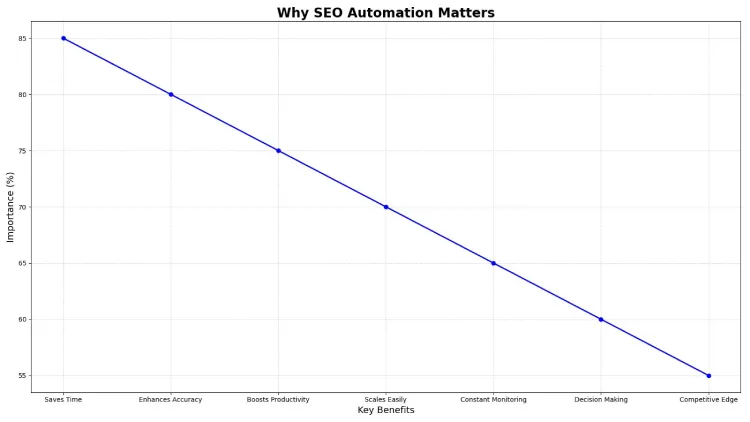
Why SEO Automation Matters
SEO has been getting increasingly complicated over the years as search engines have taken into account numerous ranking factors, including the quality of content, backlinks, user experience, and engagement. All these things are hard to manage by hand, particularly on large websites. These processes can be made easier and more efficient with the help of SEO automation.
Important reasons that make SEO automation important include:
- Saves Time: Automated repetitive functions such as rank tracking, reporting and audits may be automated.
- Enhances precision: With less error in comparison with manual labour, automated tools gather and process big data volumes more correctly.
- Maximises Productivity: Marketers have the ability to work more on strategy and content, rather than routine tasks.
- Scales Simply: Businesses are able to control and idealise thousands of web pages simultaneously.
- Constant Check: Tools identify problems such as broken links, indexing problems, or a drop in ranking.
- Improved decision-making: The automated reporting can be used to give information that marketers can utilise in creating sound strategies of SEO.
- Competitive Advantage: Bloggers, agencies, and businesses will be able to control the SEO and concentrate on growth.
Through automation tools, marketers are able to undertake complex jobs in SEO with reduced time and ensure that all their utilised sites are constantly optimised.
Examples of Tasks that can be automated
Automation of repetitive and data-intensive tasks is one of the greatest benefits of automation in SEO. Companies have several SEO procedures that require them to gather information from search engines, metrics, and reports. These processes are made easier with the help of automation solutions.
Ready to Supercharge Your SEO?
At TechishWeb, we don’t just talk SEO automation — we implement it! From keyword research and technical audits to backlink tracking and full SEO strategy, our team ensures your website performs at its best. Get your SEO service today and let us help you save time, boost rankings, and grow your online presence.
Keyword Research
SEO is based on keyword research. It entails determining the words and phrases that search engine users are typing into the search engines. The automation tools process the search trends and provide suggestions on keywords along with the search volume, level of competition, and difficulty of ranking.
Indicatively, Google Keyword Planner, among others, offers suggestions of keywords and performance estimates, which provide marketers with a choice of the most suitable keywords to use in their content.
Keyword tools that are automated can also offer the capability to cluster related keywords together, hence planning topics of blogs and optimising content will be easier.
Rank Tracking
Another crucial provision in analysing the performance of SEO is to track the keyword ranking. The automation tools follow the ranking rather than the manual search and record ranking.
These have been used to track the daily ranking progress, historical data on the performance, and generate reports that demonstrate whether the optimisation processes are successful.
Site Audits
Search rankings can be affected adversely by technical problems. Website audit software automates the scanning of websites to identify issues such as dead links, redundancy, missing alt tags, and slow web pages.
One of the most famous ones is Screaming Frog SEO Spider, a website crawler that can find technical issues with SEO that can impact search visibility.
Backlink Monitoring
One of the consideration factors of rank is backlinks. Tools used in automation monitor any new backlinks, examine link quality and also indicate to the user whenever backlinks are lost.
Some of the tools, such as Ahrefs,s offer in-depth analysis of backlinks and competitor link information.
Reporting
SEO reporting may involve data breakdowns on various platforms. The automation tools make a full set of reports automatically, which makes it both time-saving and consistent with regard to monitoring.
The reports can give rankings of keywords, trends in organic traffic, backlink development, and technical performance.
Top SEO Automation Tools
Most digital marketers use special tools to automate SEO tasks. The following platforms offer sophisticated capabilities in keyword research, content optimization and analysis of sites.
SEMrush
SEMrush is a digital marketing platform among the most popular. It offers automatic keyword research, website audits, backlink tracking and competitor analysis. It is used by marketers to determine opportunities in ranking and track the performance of websites.
Ahrefs
Ahrefs is greatly reputed because of its analysis of backlinks. It also provides site audits, competitor analysis, and keyword research facilities.
Moz Pro
Moz Pro allows marketers to track search positions, evaluate backlinks and conduct automated calculations about websites. Learners who are new to it especially like it due to its easy-to-use user interface.
Surfer SEO
Surfer SEO emphasises content optimisation. It examines the leading pages and gives suggestions on how to use keywords, headings, and the structure of the content.
Google Search Console
Google Search Console is a free tool that tracks the indexing, the performance of the search and other technical problems of the site.
SEO professionals and agencies are also fond of these tools in order to manage repetitive processes and enhance the performance of the websites.

Benefits of SEO Automation
SEO automation is beneficial in more than just time savings. It assists in improving efficiency, data analysis, and the overall performance of marketing as it enables the management of marketers to ease optimisation functions.
The main advantages of automating the process of SEO are:
- Quicker Workflow: Automation technologies can process a huge amount of data in a short period, and can give insight without human analysis.
- Enhanced Data Analysis: Analytics measure and systematise data on the work of the SEO, and it is now easier to comprehend the results of the work of the websites.
- Better Strategy: The automated competitor and keyword research provides the discovery of new ranking opportunities.
- Constant Scanning: Applications can automatically check web resources to observe such complications as broken links or a drop in rankings.
- Content Optimisation: Page analysis can be used to offer recommendations regarding how pages should be improved in terms of ranking, structure and readability.
- Scalable Search Engine Optimisation: Website optimisation can be conducted effectively in large websites with hundreds of pages or thousands of pages.
- Time and Resource Savings: Marketers will be able to work on the strategy, content production, and user experience rather than on repetitive work.
With the aid of SEO automation tools, the business organisation will be able to sustain the optimisation and increase the likelihood of a higher ranking in the search engines.
SEO Automation Problems
Despite the numerous advantages of SEO automation, it has certain limitations which would be relevant to marketers should be aware of.
The typical obstacles of automation in SEO are:
- Too much Dependence on Tools: Automated tools make suggestions generated by algorithms, but they do not necessarily capture the user’s intent or the brand strategy. Expert knowledge on behalf of human beings is still required.
- Expenditure on Tools: Some premium-level automation tools in the field of SEO are not Free and demand a subscription fee that can be costly to the beginner or small enterprises.
- Learning Curve: There are also simple-to-use SEO tools that have complicated dashboards and functions, which, when untrained, are hard to operate.
- Weak Creativity: The automation has no power to substitute for creative ideas, narrative and high-grade content development.
- Data Overload: Because automated tools are able to create huge volumes of data, this may overwhelm the recipient marketer when he is not aware of how to interpret the data.
- Reliance on Technology: Sometimes, there may be technical problems or tool malfunctions that influence the correctness of the reports or analysis.
In spite of such difficulties, automation in the field of SEO is an effective tool of efficiency enhancement in the surplus of human knowledge and planning.
Best Practices of SEO Automation
SEO automation should be implemented strategically and not fully so as to achieve the best results. The automation tools are useful, although human analysis and planning still play a role in successful SEO.
Good search engine optimisation automation practices are:
- Automate to Reinforce Strategy: Automation cannot substitute your SEO strategy, but should complement it. The insight should be analysed and used by the marketers based on their objectives.
- Read Reports on a regular basis: Because of automated tools, the volume of data generated is very high; it is important to look through reports on a regular basis to be able to find opportunities and challenges.
- Integrate Multiple Tools: A number of tools are focused on specific aspects of SEO, e.g. keyword research, backlink analysis, or technical audits. Several tools can be used to gain a more appropriate insight.
- Relax. Your concentration on High-Quality Content: Despite automation, search engines are after valuable,e helpful and user-friendly content, which search engines rank.
- Keep Up to Date on changes in Algorithms: Search engines keep changing their algorithms, and as such,h a marketer needs to change their strategies accordingly.
- Monitor Performance of Website: Diligently test rankings, traffic, and technical performance to understand that the automation tools are functioning normally.
- Blending Human and Automated nuances: To achieve an effective SEO, human ingenuity, experience and judgement are critical.
Through these best practices, the businesses can have an effective use of SEO automation without compromising on the best SEO strategies and future growth.
The Future of SEO Automation
AI and machine learning are some of the key forces that have seen SEO automation evolve at a rapid rate. The technologies are changing the manner in which marketers are optimising their search engines, and automation is becoming smarter, faster and more effective.
The future of SEO automation is determined by such key trends as:
- AI-Powered Insights: Current AI technology can examine search intent, forecast keyword trends and content concepts and assist marketers to create more effective plans.
- Automated SEO Audits: AI tools can conduct thorough technical audits, discover vulnerabilities, and give corrective advice more quickly than typical artificially created systems.
- Content Optimisation Support: AI analyses the most-ranked pages in order to make proposals on how to improve readability, structure, headings, and keywords.
- Keyword Clustering and Analysis: The automation tools are able to cluster the related keywords and determine the opportunity to gain a better search position.
- Data Pattern Recognition: AI is able to analyse large amounts of data, pointing out trends, competitor actions, and improvement methods that humans would miss.
- Improved Productivity: Automation will allow SEO specialists to pay more attention to creative approaches, the user experience, and quality content development.
- Combination with Marketing Strategy: Future tools will be enhanced in terms of integrating SEO with greater digital marketing factors, such as content marketing, social media, and PPC initiatives.
- Change AdaptationAI: Based tools will tend to adapt fast to any changes in the algorithm of search engines, allowing websites to retain their positions.
- Scalability: automation will enable companies to have large sites with thousands of pages and to manage and achieve efficiencies.
- Sustainable SEO Skilling Requirement: Although the AI improves the efficiency, human SEO knowledge will be significant to understand the insights, make strategic choices, and develop high-interest content.
Altogether, the future of SEO automation lies in the integration of AI intelligence and a human approach to gain higher search positions, quicker decision making and more effective marketing processes.

Conclusion
SEO automation has revolutionised the manner in which marketers can go about optimising search engine optimisation. Technical audits, backlink monitoring, and reporting, along with other repetitive activities associated with the advancement of an SEO strategy, can be automated to enable the business to manage its activities more effectively.
By using automation tools, marketers can easily analyse large volumes of data in a short amount of time and also find opportunities and optimise the performance of a website. Nevertheless, effective SEO needs creativity, strategic ideas and quality of content in human hands.
Due to the constantly developing artificial intelligence, automation will enter the digital marketing field even more significantly. Companies that adopt such technologies with good content and marketing concepts will have an advantage in achieving success in the competitive world of Search engine optimisation.
Ultimately, automation of SEO does not mean eliminating human sense, but rather improving it. Once applied properly, it can save time, increase decision-making, and assist websites to gain long term success in search ranking.
Frequently Asked Questions
1. Automation in SEO: Is it possible to substitute human beings?
No, there is no way that SEO automation will exclude human expertise. Although repetitive processes such as keyword research, rank tracking, and technical audits are executed by tools, strategic planning, creativity, and content planning are all critical aspects of successful SEO made up of human effort.
2. What are the SEO tasks that can be automated?
The tasks that can be handled by automation include the process of conducting research on keywords, keeping track of ranks, technical audits, monitoring of backlinks, competitor analysis, and reporting. These are time-saving tools, which minimize the error, and assist in managing huge websites.
3. What are the benefits of AI tools in terms of automation of SEO?
Artificial intelligence-based tools can scan trends in search, deploy keyword prospects, conduct audits, and detect trends in the information that even humans can overlook. This enables marketers to be more strategically oriented,content-orientedd and concerned with overall optimisation.
4. Would SEO automation be appropriate for beginners and small businesses?
Indeed, small businesses and beginners have had an advantage of automation by simplifying complicated SEO processes and enhancing performance. Nevertheless, there is a need to apply powerful strategies using human control and education.