
The future of the digital marketing environment is Artificial Intelligence (AI) SEO that integrates automation, fact-driven insights, and predictive analytics. The tools automate the process of keyword research, content optimisation, technical audit and rank tracking. With AI, the marketer is able to increase efficiency, accuracy and general web performance and remain top of the competition in the constantly changing SEO world. The AI-driven technologies, such as ChatGPT, Surfer SEO, and Ahrefs, are becoming more and more part of the contemporary SEO strategy.
What Are AI SEO Tools?
AI SEO tools refer to smart websites that apply artificial intelligence and machine learning to search engine optimisation of websites. They are automating such functions as keyword research, content optimisation, technical audit, and competitor analysis and save time and enhance accuracy. These tools allow businesses to rise in visibility, reach the correct audience, and remain competitive in the changing digital space by conforming to the AI-based search engine algorithms.
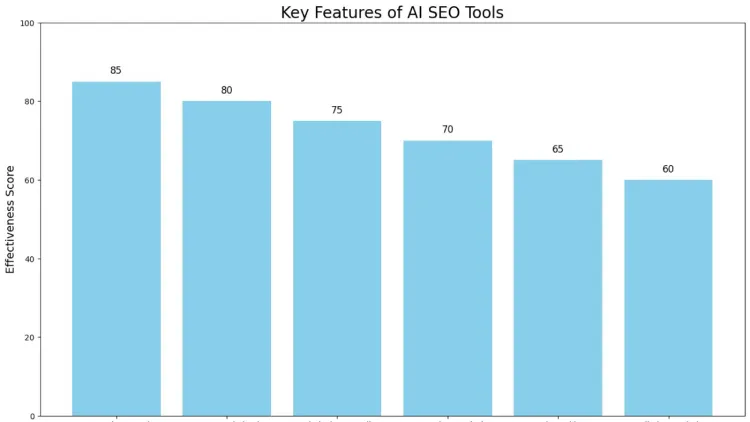
Key Features of AI SEO Tools
The features of AI SEO tools are far-ranging, and each one serves a specific purpose, namely, to respond to a particular aspect of search engine optimisation.
The most essential of them are:
Research on Keywords and Recommendations
Keywords search can be considered as one of the most time-consuming elements of SEO. With AI SEO tools being analysed, they make this process much easier as they analyse search volume, competition, and user intent. They will be able to propose long tail keywords, semantic variations and trending phrases that would most probably produce the high quality traffic. AI is able to report on things that a traditional tool may not with as opposed to a human analyst.
Content Optimization
AI search engines can analyse your content in terms of such variables as readability, the level of keywords, and meta description. They also have the ability to recommend optimisations, e.g. including keywords and headings that may need better layout to make the search more visible. Such tools as Surfer SEO and Frase AI even produce content options, aligned with search intent, that will result in your pages ranking higher in the search results.
Technical SEO Audits
Technical SEO is aimed at enhancing the back-end, as it is the part of the webpage that is crawled and indexed easily and expeditiously. The AI tools of SEO have the ability to identify the problems on their own (slow page speed, broken links, duplicated content, misused structured data). Technical SEO is more easily and efficiently handled by the AI tools through prioritisation of these issues with respect to impact on the rankings.
Competitor Analysis
SEO will be impossible without understanding the competition. AI SEO tools examine the competitive sites to unveil the keywords that the companies rank, their backlink profile, and content strategies. This enables marketers to see where there are gaps and opportunities, and create data-driven strategies that will generate competitor-beating results.
Rank Tracking
It is necessary to monitor the effectiveness of your SEO activities on a regular basis. Specific keywords: AI SEO tools will be able to track the ranking and assess how organic traffic is increasing, as well as predict trends. It facilitates the ability of marketers to proactively make informed decisions and modify strategies as opposed to acting at the time when traffic declines.
Predictive Analytics
Certain high AI SEO tools have the prediction capacity of searching trends before they become common. The tools can predict what keywords or topics will trend, utilising AI, enabling companies to produce content that attracts traffic before other companies do. Forecasting effects provides marketers with a competitive edge in the niche market.
The Pillars of Modern SEO
Effective SEO programs are based on four keywords:
- Technical SEO: Optimising the structure of the websites and their speed and crawlability.
- On-Page SEO: The relevancy of the content, along with its richness in terms of keywords and the correct arrangement.
- Off-Page SEO: Creating backlinks, social signals and online authority.
- Content: Producing quality, compelling, and nourishing material that serves the user’s purpose.The pros of AI SEO Tools.
Artificial Intelligence (AI) SEO tools have a number of benefits to business and marketers.
- Efficiency: They automate processes such as keyword research, content audits and rank tracking to clear up some time to concentrate on strategy and creativity.
- Precision: AI intelligence can be used to minimise human error since it can scan and review a large amount of data in seconds and accurately detect problems such as dead links or missing metadata labels.
- Scalability: These tools are scalable to various websites simultaneously, thus they can be used by both small businesses and bigger agencies.
- Competitive Edge: Predictive analytics and trend forecasting are used to enable marketers to be ahead of the crowd by determining high-potential keywords and content opportunities.
- Cost-Effectiveness: AI will save the company on the costs of employing large teams of people to handle SEO and will provide accurate, actionable insights.
Furthermore, artificial intelligence search engines boost the creativity of humans. At the same time, AI offers data-based suggestions, the marketer may use the information and context and implement strategies of judgment and branding to optimise campaigns and develop stimulating content.
Popular AI SEO Tools in 2026
Several AI SEO tools have already become popular in the industry, each having its strengths:
- Surfer SEO – It is a great tool that can be used to optimise content and analyse on-page SEO.
- Frase AI – It involves using AI to create content and optimise it for search purposes.
- SEMrush- Complete set of key solutions for keyword research of the keywords and analysis, and a technical audit of the SEO.
- Worldwide famous – Ahrefs is characterised by an effective backlink analysis and the monitoring of SEO.
- Moz Pro- Provides AI recommendations on on-page optimisation, keyword tracking, and audit of the webpage.
- ChatGPT- It is not an ordinary SEO tool, but it helps to create content, come up with a keyword-rich text, a meta description, and frequently asked questions.
- MarketMuse –Application of AI to identify content gaps and offer topic suggestions.
These enablements usually work with CMS, analytics software, as well as marketing dashboards and form a smooth flow of SEO professionals.
Giving the Right AI SEO Tool
The choice of an appropriate AI SEO tool will rely on what you expect.
To optimise the content: Surfer SEO and Frase AI are work tools that assist in the optimisation of content by examining the best ranking pages and providing what to place in the opening section, and the keywords and similar ones.
- In the case of Technical SEO, Tools such as SEMrush, Moz Pro offer detailed audits, identifying such problems as broken links, slow page-speed, and crawling errors to make sure your site is favourable to search engines.
- In the case of Backlink Analysis, Ahrefs is best suited in terms of backlink monitoring, competitive analysis, and link-building opportunities.
- To the Overall SEO Management: The all-in-one packages that would provide content optimisation, keyword search and research, technical search and rank tracking are excellent for the business in need of a complete solution.
The other things to look at are the size of the team, the budget, ease of use and compatibility with your already existing tools. The selection of the appropriate AI SEO tool is sure to make your SEO efforts effective, precise and consistent with your business goals.

How AI is Transforming SEO
AI has been changing SEO by automating tasks such as keyword research, content audits and competitor analysis. Natural language processing (NLP) assists tools in comprehending the purpose of search, and machine learning constantly delivers advanced strategies. It can also be used to achieve predictive SEO, whereby AI forecasts the trending keywords and topics before the marketer, thus being able to fend off competition.
AI SEO supports all these pillars through automation during auditing, proposing some improvements on the keywords, as well as finding opportunities for backlinks. It is now easier to sustain a comprehensive SEO policy without ignoring important aspects.
The Role of ChatGPT in SEO
Language models are language synthesis searches, such as ChatGPT, which are highly powered by AI and can be used to perform SEO. They are able to create content, create meta descriptions, create FAQs, and even propose search-optimised headings. ChatGPT does not qualify as a complete SEO tool but has the potential to create keyword-heavy content that is both written by humans, thus invaluable to content-driven approaches.
It is crucial to mention, though, that ChatGPT is optimally effective when used in line with the conventional SEO tools. It is incapable of analysing website analytics, tracking rankings and auditing technical SEO, in which case dedicated AI SEO platforms still hold the lead.
AI and the Future of SEO Jobs
AAI is also revolutionising SEO, but there is little chance that it will succeed in unseating human professionals completely.
Key points include:
- Roles That Will Prosper: They pose a challenge because positions that demand strategic and creative thinking, as well as relationship-building, such as content strategists, SEO managers, and digital marketing consultants, are still necessary.
- AI as an assistant: AI applications will computerise the mundane parts of their duties, such as keyword research, audits, and performance monitoring, and allow the SEO specialist to work on more profitable activities.
- New Opportunities: The use of AI is establishing the posts of AI data analysts, prompt engineers, and AI content strategists.
Flexibility: The professionals able to adopt AI-supported processes and update their skills will remain topical and relevant in the digital marketing environment, which is changing.
Boost your SEO with AI and expert strategies! TechishWeb offers professional SEO services to improve your rankings and traffic. Get started today!
Types of AI Relevant to SEO
There are several AI that are helpful in SEO specifically:
- Narrow AI: These are targeted at particular functions such as analysing keywords, content optimisation, and ranking.
- Machine Learning (ML): Assists AI with the learning of data and enhancing the predictions of trends, rankings, and user behaviour.
- Natural Language Processing (NLP): Interprets and writes the human language, which helps in the content creation and optimisation of voice search.
- Deep Learning: Applies neural networks to analyse big data, which is applicable in search engine algorithms and ranking decisions.
- General AI: It remains theoretical,l but it is AI which can do any intellectually demanding activity like any human being.
There are other fields, such as reinforcement learning and cognitive computing,g but they are not applied to SEO directly. Knowledge of such types can guide marketers to better use AI SEO tools.
Types of SEO AI Tools
Use of AI tools in the field of SEO can be divided into categories according to their main role:
- Search Engine Optimisation Tools: Surfer SEO, Frase AI.
- SEMrush, Ahrefs Keyword Research Tools.
- SEO Toolset Technologies, Moz Pro, SEMrush.
- Openlink Analysis Software, Ahrefs, Majestic.
- Predictive SEO Tools Finder: MarketMuse, BrightEdge.
These categories assist the marketer in identifying the appropriate tool to use for certain aspects of SEO.
AI-Language Optimised SEO Strategies
AI SEO applications assist companies in enhancing their SEO techniques by increasing their effectiveness and basing them on data.
The major AI-based methods of improving SEO are:
- Content Optimisation: Writing semantically relevant content by generating content that mmeetsthe search intent using keywords, indicating headings and related keywords as well as semantic keywords.
- Technical SEO Audits: Diagnosing the problems and addressing them, such as broken links, slow loading speed, and duplication of content,t to achieve improved performance of search engines.
- Competitor Analysis: A review of the competitors in terms of keywords, their content and backlinks to determine the potential and shortcomings.
- Predictive SEO: Making content in advance by predicting trending topics and keywords and earning traffic before it takes off.
- On-Page Optimisation: Enhancing the visibility and the involvement of the pages through refined meta tags, headings and internal links and greater legibility.
With the use of AI in the workflows of SEO, businesses will be able to develop more specific, efficient, and scalable plans that are time-saving and optimise search positioning and performance online.
Choosing Between AI Tools
Not all AI tools are equal. On the one hand, ChatGPT wins in terms of content-making, and, on the other hand, systems such as SEMrush, Ahrefs or Surfer SEO are more effective in terms of analytics, auditing, and optimisation.
A combination of tools that fit the received tools is the best:
- Ideation and content generation: Use ChatGPT.
- On-page optimisation should be used with Surfer SEO or MarketMuse.
- Analytics, backlinks and competition INTSEMrush or Ahrefs.
- It will guarantee a complete coverage of SEO and use the strengths of each AI tool.
The Future of SEO with AI
SEO will keep being revolutionised by AI. AI is now utilised by search engines to prioritise the content based on intent, context, and quality, and not on keywords alone. The AI-based SEO tools are bound to increase in their development to support these algorithms and give a more profound insight and prognosis to the marketer.
Human knowledge is essential, even at a time when AI is increasing in its role. AI is not able to recreate creativity, strategy, and observation of how the audience behaves. The future is in the success of cooperation: marketers cooperating with AI tools to enhance efficiency, accuracy, and influence.

Conclusion
AI SEO tools have lost their status as a choice and have become crucial in the current state of digital marketing. These tools enable the automation of the SEO processes and enhance outcomes, which are achieved by integrating automation, predictive analytics, and content optimisation. Although AI is improving, human marketers will still lead the pack, setting the strategies, drawing insights, and making sure that the content is relevant to audiences.
It is one of the surest ways to make sure that your business remains competitive in the current times, keeps up with changing search engine algorithms, and secures high-quality organic traffic in the years to come by investing in AI SEO tools now.
With or without experience in the digital marketing field, the best thing to do is to go with AI in SEO, as this will provide the best means of future-proofing your online existence.
Frequently Asked Questions
1: What are AI SEO tools?
AI SEO tools involve artificial intelligence in automating their activities, such as; key-word research, optimising the content, technical audits, and rank tracking to enhance the visibility of websites.
2: Will AI eliminate the needs of SEO experts?
No. AI can help to complete routine tasks, but still, some jobs that need creativity, strategy, and decision-making, such as SEO managers and content strategists, are necessary.
3: What are the most qualified AI tools to use for SEO?
Frase AI and Surfer SEO are the best on-page optimisation content chatbots, SEM Rush or Ahrefs are best for analytics and competitor analysis, and ChatGPT is the best content.
4: What will the future of SEO be?
AI will further streamline the SEO process and make it more predictable and data-focused, although human creativity and tact in strategy will remain the key to success.