

The optimization of AI search is changing the concept of SEO as artificial intelligence is used to process information in order to forecast trends and provide users with a personalized search. It automates search engine optimization, makes the websites rank better, helps the websites provide a better user experience, and saves time and resources. Companies that use AI are able to generate high-quality content, voice, and semantic search, and anticipate the future based on predictive expertise.
What is AI Search Optimization
AI search optimization is the application of artificial intelligence in enhancing the search engine rankings and the SEO of the place of stay. It assists companies in examining user behavior, seeking procedure and content performance as a measure of smarter optimization choices.
The AI search optimization is more accurate and efficient than traditional SEO, which does not use data and automation to enhance its accuracy and efficiency. It assists in determining the appropriate keywords, content optimization, and optimization of the entire website.
Key aspects include:
- Robotization of SEO processes, such as the key-word research, meta-tagging, and analysis of the content.
- Examining user behaviour with a view to enhancing engagement and content performance.
- Providing personalized output in accordance with user preference and search objective.
- The AI search optimization will enable websites to be ranked highly, draw specific traffic, and remain competitive in the competitive search engines.
Major Elements of AI Search Visibility
AI search optimization is a combination of different technologies and methods that mutually supplement each other to increase the visibility of websites. Knowledge of such components can enable companies to strategically and effectively embrace AI.
Artificial Intelligence (AI) Keyword Research
Proper identification of keywords has always been the support of SEO. The search volume and the rivalry measures usually make traditional keyword research time-consuming and limited. It is possible to go beyond this and use AI-powered tools that analyze search intent, popular topics, and user activity.
- Predictive forms: AI has the ability to predict which keywords will gain additional popularity in the nearest future.
- Competitive keywords: AI devices discover weaknesses in the strategies of competitors and offer unexploited prospects.
- Long-tail keyword optimization: Using AI, it becomes possible to identify the most specific keyword phrases that have more chances to convert.
Content Optimization
The internet is king of the content, but not everypiece of content is equal. AI search engine optimization helps to enhance the quality of content through the proposal of relevant topics, enhanced readability, and the organization of articles into better forms of engagement.
- Topic modeling AI discovery: AI determines the subjects that your audience wants to know the most about.
- SEO compatible formatting: Tools would suggest adequate headings, bullet points, andmetadatas.
- Content gap analysis: AI shows your weaknesses when it comes to where your site is falling short in comparison to other sites.
Voice and Semantic Search
As smart assistants and voice search become a reality, the search optimization process of AI now focuses on natural language processing (NLP) and semantic search. This is so that your content will be able to respond to conversational language queries.
- Voice search optimization: AI will be used to rank content based on smartphone, smart speaker, and AI assistant queries.
- Connection to a purpose: AI does not prioritize keywords of user search, but it interprets the context.
- Integrating semantic keywords: Artificial intelligence uses the related keywordsand synonyms to optimize content and inincreasehe likelihood of ranking across a variety of queries.
Predictive Analytics
Predictive analytics is one of the strongest technologies of AI search optimization. AI anticipates trends, actions of users, and upcoming subjects, and becomes foreseeable before it goes mainstream.
- Predicting trends: The businesses will have the ability to generate predictive content to address search demand.
- Conversion prediction: Artificial intelligence can predict which content or landing pages can be used to generate sales or leads.
- Behavioral analysis: AI divides the users into different segments in accordance withtheir activity that makes it highly targeted in terms of optimization.
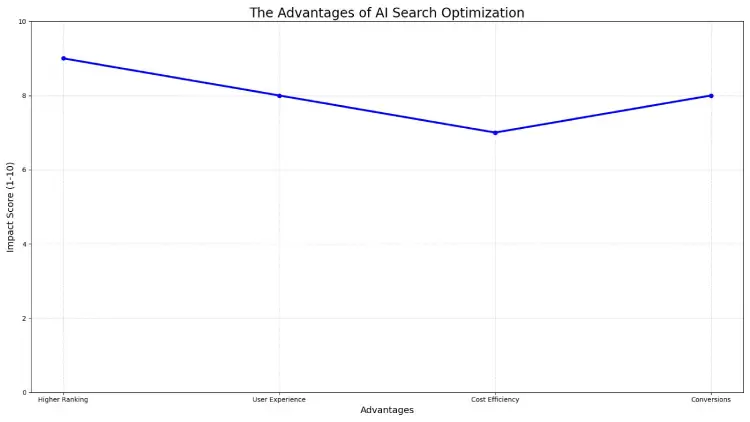
The Advantages of AI Search Optimization
By taking up AI search optimization, businesses may provide significant benefits in terms of visibility and efficiency of business requirements.
Better Ranking in search engine
AI works with big data and establishes the most useful optimization policies for a higher ranking. These are content relevance, use of keywords, page speed,backlinkss and user engagement metrics.
- Rapid indexing: AI can be used to crawl and index new material, assisting search engines.
- Improved optimization recommendations: AI points to both on-page and off-page influences of ranking.
- Constant performance: With AI, it is possible to adjust to updates in the algorithm and maintain the growth of SEO.
Enhanced User Experience
An important ranking factor is that of user satisfaction. AI search optimization assesses the interaction between your site and the user and performs necessary optimization to arouse more interest in the customer.
- Individualized content delivery: AI proposes the content that the user is interested in.
- Optimization of navigation: AI does propose the process of site structure and internal connectivity.
- Change monitoring: Engagement monitoring tools will monitor bounces, session length, and click paths in order to optimize UX.
Time and Cost Efficiency
The conventional search engine optimization is a meticulous process that depends on a lot of manual research work, data analysis, and production. The repetitive tasks are automated through Artificial Intelligence search optimization, and save businesses a lot of time and resources.
- Automated reporting: AI gets you the actionable SEO reports.
- Recommendations: AI will offer pre-generated recommendations on blog posts, landing pages, and social media.
- Less reliance on human labor: Companies can be able to expand their SEO process with ease without involving human resources to a great extent.
Higher Conversion Rates
AI will make sure that your content is delivered to the correct audience with the correct message, and it will lead to more conversions.
- Targeted campaigns: AI will define the groups of users who are the most promising.
- Designer landing pages: AI proposes design and content enhancements to improve the conversion.
- Informed decision-making: It is possible to make informed decisions regarding investment in SEO based on AI recommendations.
AI Tools Transforming SEO
AI has changed the nature of SEO modules and made it easier to create effective AI search optimization strategies in businesses. Such AI-based tools are automated; they can analyze data and give actionable insightsthat helps websites to rank higher and attract people better.
Surfer SEO
- On-page SEO and content organization AI-based analyzer of the content.
- Maximizes headings, placement of keywords, and readability.
- Does content analysis against the competition and points out areas of weakness to be improved.
Clearscope
- Gives suggestions of keywords and semantic analysis of content.
- Proposes terms similarity to enhance content.
- Checks the quality of the scores and detects that subtopics are missing.
ChatGPT and AI Content Creators
- Produces hhigh-qualityand search engine optimized content fast.
- Gives topics of the blog posts, writing, and headings that been optimized.
- Facilitates the production of multilingual content to cover the entire world.
MarketMuse
- Emphasizes content strategy and long-term SEO planning.
- Determines gaps in content and valuable issues.
- Ratings content quality and indicates how to improve dominance ranking.
SEMrush with AI Features
- Provides AI-powered suggestions of keywords and fashionable keywords.
- Conducts automatic site auditstoo identify issues with SEO.
- Gives competitor knowledge and optimization advice.
Why These Tools Matter
- Make AI search optimization available to small businesses with no or little SEO practices.
- Automate the tedious SEO activities.
- Give the evidence-based information to influence the content and technical improvement.
- Assist in better ranking, user interaction, and general online presence.
Will you like to improve the SEO of your Website using AI
At TechishWeb, we not only have information about the optimization of search with AI, but wealso do it with your company. Our team is AI-based, helps your site reach higher places, attracts more people, and accomplishes your goals through a complete approach to SEO.

AI Search Optimization Best Practices
To fully leverage the opportunities ofAIs as a tool to optimize search, companies need to utilize AI findings and human knowledge and use a strategic approach.
Join Artificial Intelligence and Human Supervision
AI offers some very useful insights, but human creative thinking and judgment are needed.
- Content editing: A human being makes sure there is good content based on the voice of the brand, truly authentic and interesting.
- Decision-making: AI makes suggestions that are followed, but not mandatory.
- Quality control: Human verification is used to avoid mistakes and ensure the relevanceof the content.
Focus on User Intent
The optimization of the keywords is not enough anymore. The AI search optimization focuses on the interpretation of user search intentions.
- Ask questions efficiently: AI can detect frequently asked questions and give answers to the content.
- Segment audience: Target various groups with different users according to their intent to search.
- Maximize conversions: Keep the content consistent with the user experience between discovery and purchase.
Assess Performance Periodically
Artificial intelligence is not a static concept, and search engines are created continuously to improve their search engines. Constant checking is to make sure that your SEO plans are still relevant.
- Track KPIs: Track such metrics as organic traffic, bounce rate, and dwell time.
- Update plans: Rebates on the basis of performance.
- A/B testing: Test alternative strategies to determine the most effective ways of optimization.
Database Multiple Content Formats Optimization
There is no restriction to the text type of AI search optimization, which even optimizes images, video,o and voice search.
- Image optimization: AI analyzes images with alt text, captions, and descriptions that optimize the images to enhance their SEO.
- Video SEO: AI recognizes keywords, nd creates transcripts, and recommends optimization of the thumbnails.
- Preparedness to voice search: AI guarantees the organization of the content in a way that can be passed through the natural language search.
The Future of AI in SEO
The future of AI search optimization is simply a brilliant one, and every day, more innovations change the manner in which websites, search engines, and users interrelate. The earlier a business adopts AI, the greater competitive advantage they will have because it will enhance search presence, create customized experiencesforo customers, and predict future trends.
Advanced Personalization
Intelligent search experiences will be driven by AI, which will be able to offer hyper-personalised results based on current behaviour, customer preference, and browsing behaviour. Such a high degree of individualization will reinvent theconcept of connection between websites and their audiences and enhance engagement rates.
- Context-sensitive output: AI will provide dynamically changing content depending on the location, the device of the user, history, and even recent requirements. Using the example of a user who searches for the best workout apps using a mobile device, the results may differ compared to a user who does the same search using a desktop at home.
- Recommendations: Through analysis, plus past behavior and preferences, AI has the capacity to predict what users need, indicating what these users will watch, buy, or purchase even before the user or computer enters a query. This is a positive step that will be integrated into search optimization.
- Greater user involvement: In line with tailor-made content, the user satisfaction, dwelling time, and brand commitment are maximized. Manipulating websites that provide personalized, relevant experiences have higherchances of keeping the visitors and turning them into customers.
- Adaptive content delivery: Future AI applications will personalize the presentation of content, including recommended articles, videos,s oproductts listings in real-time to achieve maximum engagement.
AI-Driven Search Engines
Google itself is becoming more of a smart engine, applying AI in its rankings. This change will compel companies to match their AI optimization in searching with AI-based evaluation.
- Dynamic ranking: In contrast with the existing system of static ranking, AI-based software will keep assessing content relevance and user interaction and update search placement as the user browses the web. Good performing pages can gain a swift ranking up, whereas poor performing pages are re-organized.
- Content knowledge: The AI will not only check semantic meaning, context, and intent but also keywords. This will ensure that the search engines give priority to the content, which actually responds to the queries of the user, which will make websites with expertise, authority,y and reliability be promoted.
- Even smarter indexing: AI will understand the content around it and the reason why it is being indexed, and how it should be classified and reported in the search results. To illustrate, a blog article about the topic of AI search optimization is possible to be indexed differently between a long-form blog post and a tutorial video about the topic based on user intent.
- Multimedia integration: AI-based search engines will progressively explore videos, podcasts, image and interactivity to establish relevance, so the multimedia optimization process gains even more significance.
Smarter Predictive SEO
AI search optimization is to be built on predictive analytics. The companies will manage to predict their user trends, future optimal content placement before demand, and rank higher than the competition in search results.
Trend identification at an early stage: AI tools will be used to track the emergence of new topics, search queries, and competitor actions to be able to detect them before their mainstreaming. This enables businesses to generate content in an active way as opposed to a reactionary manner.
Audience insights Predictive models will divide the users into segments based on their projected behaviors to help businesses focus on the type of content they want to produce.
As an example
AI is able to detect the segments that are most likely to respond to seasonal campaigns or trending items.
Competitive advantage: Firms that use predictive search optimization using AI can report highly-demanded content first before the competitors and remain at the top of their niche.
Resource optimization: Predictive SEO is also efficient in allocating resources to marketing. It will help businesses to know what content they can create to drive traffic or conversions, which will allow them to invest their energy in areas where they can make the most impact.
Elements of AI Incorporation in SEO Activities
- In the future, AI search optimization will not be confined to the generation of content or ranking modifications. It will be incorporated in nearly all areas of SEO, such as:
- Technical SEO: AI will automatically rectify the errors, such as broken links, content duplications, slow pages, and crawling errors.
- Optimization of voice search: As smart assistants continue to gain popularity, AI will optimize the content based on the natural language search and conversation-style search results.
- Multilingual SEO: AI will assist in the creation of optimized information that can be displayed to international audiences that is translated and localized without the loss of SEO importance.
- Behavioral analytics: With the help of AI, the engagement of users, heatmaps, paths to clicks, and dwell time will be monitored to improve optimization measures on a regular schedule.
Getting ready for the AI-Driven SEO Future. To remain salient in the AI-driven search environment, companies ought to:
- Invest in AI tools: COVID-19 Use AI-based SEO engines to track trends, optimize, and automate the routine activities.
- Put the user intent first: Do not only use keywords to pass through the filters, but make content that is relevant and useful to users.
- Diversify content types: Add videos, interactive guides, podcasts, and infographics so that AI-driven content analysis can be met.
- Keep up with AI changes: The search algorithms are changing fast. Business professionals need to constantly update their strategies in line with AI changes.
By adopting AI search optimization in the present, companies can be ready to enter a time when search will be dynamic, predictive, and highly personalized. The ones who utilize AI successfully are not only going to rise in the search results but will also offer better experiences that will encourage the user to become long-term and loyal.

Conclusion
The optimization of AI search is no longer an option, but it is an urgent move to a business partnership that aims at long-term online growth. Since AIs will be used in SEO, they will allow companies to:
Automatize and automate standard SEO
- Enhance search engine performance using analytics.
- Provide high-quality personal and interactive user experiences.
- Foresight with predictive analytics.
- All content can be optimized to various formats, such as voice and video.
Incorporation of AI search optimization in the present day will mean that your business will not fall behind in the future. The key to success in an extremely competitive digital environment is using AI knowledge and blending it with creativity and strategic management.
Begin adopting AI-assisted SEO in order not only to maximize visibility but also maximize conversions, build a strong brand, and future-proof the digital aspect of the marketing work.
Frequently Asked Questions
1: What is AI search optimization?
Answer:
AI optimization involves artificial intelligence to enhance the appearance of a site and its ranking on search engines. It functions as an automated way of doing SEO, and it evaluates user traffic, anticipates trends, and provides enhanced content to maximize performance and participation.
2: How does AI help improve SEO?
Answer:
AI helps SEO by:
Automating meta tags, content analysis, and keyword research.
Learning what the users want and do to target the content better.
Voice and semantic search optimization.
Anticipating trends to enable businesses to post content even before their competitors.
3: What are AI SEO tools that are popular?
Answer:
Popular AI SEO tools include:
Surfer SEO -Content analysis and on-page optimization.
Clearscope Recommendations on semantic keys.
ChatGPT – AI-generated content that is SEO friendly.
MarketMuse Content strategy and gap analysis.
SEMrush- AI-based audits, key suggestions, and rival intelligence.
4: What is the relevance of AI to the future of SEO?
Answer:
The future of SEO is under the influence of AI that facilitates hyper-personalization, predictive analytics, and intelligent search results. The implementation of AI search optimization allows businesses to be more relevant in terms of content, predict trends, and increase user engagement and conversions, which will help these businesses stay on par.