
On-page SEO services are needed for a website that may want to be ranked better on a search engine, capture larger organic traffic, and offer a positive user experience. These services are aimed at content optimization, meta tags, URLs, pictures, and technical aspects optimization of the site. On-page SEO could help the business increase its visibility, increase conversions, and save time as opposed to attempting to work on its own with SEO. Although certain elements of SEO are free, results can be achieved within a shorter timeframe and more efficiently when an expert is hired.
What Are On-Page SEO Services?
On-page SEO services entail the optimization of single pages of a website to have a better position or gain more worthwhile traffic through search engines. Contrary to off-page SEO, where things depend on outside influences such as the use of backlinks and social signals, on-page SEO depends on the factors that you can influence on your site.
On-page SEO services are some of the key aspects,s such as:
- Keyword Optimization: Finding the right keywords, those that are relevant and have a big flow of people to the site, and optimally positioning them in titles, headings, and content.
- Content Structuring: Division of content into headers, sub-headers, and bullet points to make the content easier to read.
- Meta Tags Optimization: This will involve the writing of unique meta titles and descriptions to gain a higher amount of click-through rates.
- Internal Linking: This relates to connecting the related pages to your site as a means of distributing the link equity and improving the navigation.
- URL Structure: The URL must be clean and descriptive to be easier to read by users and be searchable.
- Image Optimization: Reducing the size of images, including alt text, and making sure that they do not slow down the page speed.
As an example, a business running a fitness blog would have an on-page SEO service that would make sure your post involving the best ab exercises targets the right keywords, has headings optimized, has internal links to other relevant posts, and corrects text for any image.
What is the cost of on-page SEO Services?
Prices of on-page SEO services vary based on the work complexity, the number of pages in your website, and the size of your website.
- Small Sites (5-10 Pages): 100-500, which will also include rudimentary research on keywords, meta tags, and content modifications.
- Medium Websites (20-50 pages): $500-1500 of the fee is inclusive of optimization of content, site architecture, and whole keyword initiative.
- Headquartered Websites (50+ Pages): $1500-5000 and above, including technical, content-development, and careful planning of the SEO.
Though the DIY technique of SEO does exist, it is time-consuming, and it can also result in quicker and more credible outcomes with the help of professionals.
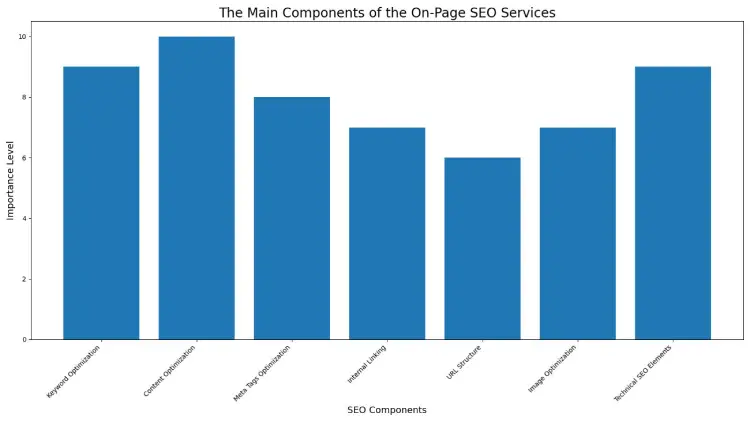
The main components of the on-page SEO services
Search engine optimization: Keyword Research and Placement.
Keywords Researching keywords well will ensure your content addresses the phrases that are taken up by people actively.
Professionals choose a combination of both short-tail and long-tail keywords, and it goes naturally in:
- Page titles
- Headings
- Meta descriptions
- URL slugs
- Image alt attributes
Content Optimization
Quality and interesting content on the page is one of the foundations of on-page SEO.
This includes:
- Relevant and informative text.
- Use of correct headings and subheadings.
- Avoiding duplicate content
- The use of naturally occurring keywords.
Technical SEO Elements
There is also a critical role of technical aspects:
- Speeding up the page- Page optimization, compression of files, and caching.
- Mobile-friendliness, Mobile responsiveness.
- Secure connections ( HTTPS) – Necessary for trust and search ranking.
- Schema markup -Gives search engines more knowledge of what your content is.
Internal Navigation and Linking
It is also good to make your pages connected to be crawled and user-friendly. Properly implemented menus and links that are displayed within contexts can be used to improve SEO.
The Four Pillars of SEO
On-page SEO has been included in the greater SEO plan that has four main pillars that are interdependent on one another to enhance the ranking and increase the organic traffic.
1. Technical SEO
Make sure your site is used effectively by search engines. Pay attention to site design, page load, responsiveness, and HTTPS.
2. On-Page SEO
They optimize each page within the content and meta tags, headings, and internal linkages to ensure that they are searchable and purpose-intended to the user.
3. Off-Page SEO
Gathers authority in building websites with good backlinks and social cues, as well as online references, which is some sort of credibility to the search engines.
4. User Experience (UX)
Improves the interaction with the readability of the content, quick loading, and a feasible design to keep the visitors happy.
Having these four pillars developed a strong SEO platform that enhances visibility, user satisfaction, and traffic growth in the long run.
The Reason Why On-Page SEO Services are worth paying for
By spending money on professional on-page SEO services, one can be sure:
- Faster Results- Specialists are aware of what works, and they do not engage in trial-and-error.
- Comprehensive Strategy: This encompasses all the keywords in the structure of the content.
- The Sustainable Growth- Appropriate optimization can guarantee long-term rankings.
- Self-help approaches may be effective, and they may consume more time, not to mention that errors can cost you rankings.
How to Start On-Page SEO
When you begin doing on-page SEO on your website, you must follow a planned strategy in order to make sure that all of your pages will be optimized to their highest level in search engines andbe user-friendly.
Here’s a step-by-step guide:
1. Conduct a Website Audit
Analyze your current site to know how to improve the site before changing anything.
Check for:
- Technical Problems: Broken links, delayed page loads, or crawl errors.
- Duplication: It must be either the same or very similar content on the pages; it will damage the ranking.
- On-Page: The lack or insufficiency of meta titles, headings, or image alt texts.
A detailed audit will assist in prioritizing things and eliminating the most essential ones initially.
2. Keyword Research
Find valuable, interesting page keywords.
Consider:
- Search Volume and Competition: Target the keywords that have a high potential to drive traffic and can be addressed.
- User Intent: Comprehend the user and filter them by what they are searching for and what they have to offer.
- Long-Tail Keywords: The specific phrase focus can help to draw more qualified traffic and enhance the conversion levels.
3. Optimizing Content
Modify already available information or make new pages search engine friendly:
- Apply natural application of keywords on titles, headings, and body text.
- Separate the contents by subheadings and bullet points to make the content readable.
- Embark on graphics, images, or videos; bring in multimedia to cause interest to the user’s interest.
4. Technical Aspects: Improvement
Make your site up to date on SEO:
- Mobile-Responsiveness: Your website should perform well on any device.
- Page Speed: Image compression, caching, and reduction of code as a means to reduce load time.
- Schema Markup: The structured data will be added in order to make search engines know about your content.
5. Monitoring Performance
Monitor the performance of your SEO activities to gauge the success and change strategies:
- The visit statistics, positioning, and bounces should be tracked with Google Analytics and Search Console.
- Determine the best-performing pages and use the best strategies on other pages.
- Modify keywords and contents after user interaction and search trends.
Useful Tools
Tools such as Ahrefs, SEMRush, Yoast SEO, and Google Search Console make all the processes much easier, including researching and selecting the keywords, conducting technical and performance audits, and so on.
With the help of this hierarchy, even a novice can begin applying very simple on-page SEO and slowly become more visible, increase traffic, and providea better user experience as time passes.
Top On-Page SEO Blunders to Evade
You can be affected by such small mistakes in your rankings.
Avoid: Stuffing or over-optimization Keyword
|human|
- Redundant information on pages.
- Lacking or bad meta descriptions.
- Missing images and links, or broken links to pictures.
- Slowness in loading pages or an unresponsive design.
- These problems should be rectified to enhance rankings and user experience.

Knowing about SEO Concepts and Rules
The 80/20 Rule in SEO
It is said that the 80/20 rule means that you get 80 percent of the results out of 20 percent of your efforts. In the case of SEO, it is common to focus on high-impact pages, keywords, and optimizations that can accomplish the biggest gains.
The Golden Rule of SEO
The golden rule is not complex, and it is to create content that will satisfy the user’s intent. Search engines will reward you with more rankings insofar as your pages solve problems and give value.
The 3-3-3 Rule for Marketing
This marketing principle argues that the user must be exposed to your brand 3 times, content 3 times, and have 3 positive experiences to become a convert. The on-page SEO can help this by ensuring that the content is made accessible, valuable, and easy to navigate.
On- Page SEO Service Tools
On-page SEO tools are the best, and they are:
- Yoast SEO -Content analysis, keyword density, readability, and meta optimization.
- SEMRush -Full-scale audit, findings research, and competitor assessment.
- Ahrefs – Website analysis, tests of backlinks, and tracking of keywords.
- Google Search Control- Watch indexing, mistakes, and search rankings.
- Screaming Frog SEO Spider- Crawl websites due to technical problems.
- The tools are useful in optimizing the SEO process and easing the optimization process.
Tips to Enhance SEO without Spending
Yet with no budget, you can streamline your website by:
- Creating quality content that is keyword-oriented.
- Optimization of meta tags and meta headers.
- Shrinking pictures and enhancing the loading speed.
Ensuring mobile-friendliness
- It should add internal links among the relevant pages.
- It is not costly tools that are paramount; consistency and quality should be prioritized.
You can still do this without having a budget, and these are the measures to enhance your SEO. However, when you need something quicker and expert advice, our team of experts at TechishWeb can offer professional assistance in on-page SEO so that you will be able to optimise your webpage, earn a higher ranking, and attract more traffic.
Self-Education and Self-Teaching
Anyone can learn SEO, as long as she/he practices and read.
- Begin with Online Tutorials and Blogs: The basics of keywords, meta tags, and content optimization can be learned in free and paid courses, guides, and articles.
- Drill Yourself on Your Personal Site or Blog: By experimenting with a personal site, you can practice what you are learning and get to see results firsthand.
- Make and amuse yourself with Helpful Tools: it is easier to establish performance and optimize pages with the help of Google Analytics, Search Console, and such a plug-in as Yoast SEO.
Although it may take under a minute using professional services, the steady practice of DIY may increase traffic and enhance your website in the long run.
Costs and considerations of the website
The SEO plan is frequently influenced by the cost of constructing a website:
- 1-page website A one-page webpage: may cost between $100 and 300.
- Small business websites, 5 pages: cost varies between 200 and 800 dollars.
- 10-20 page site-Medium-sized sites: could range between $500 and $2000 and above.
Maintenance costs range between 10 and 100 dollars per month, according to the hosting, security, and updates.
There are free web page builders, but paid web page builders are more flexible and able to control their SEO.
Types of SEO and Websites
It is also useful to know the various forms of SEO and web setups in order to devise a smarter optimization plan.
Three Types of SEO
- On-Page SEO: Optimizes basic content, meta tags, headings, URLS, and pictures at the location of your website.
- Off-Page SEO: Gathers power by using backlinks, social fees, and contributions over the internet.
- Technical SEO: appears to be concentrated on the structure of the site, its speed, mobile-friendliness, and crawlability.
Three Types of Websites
- Single-Page Websites: One-page websites of portfolios or landing pages. SEO targets a select few subjects.
- Multi-Page Websites: More than one page about various services or content to be able to cover a wider range of keywords.
- E-Commerce Websites: Sites are product-oriented and have several pages that are search engine and buyer-oriented.
Small vs. Large Websites
- Small websites: 3 to 10 pages; less tedious and good in terms of covering the keywords.
- Huge websites: 20+ pages; more complicated, yet have higher chances of SEO.
The knowledge of these types can guide you to customize your on-page SEO service,s which can guarantee more exposure and future success.
Difficulties and Shortcomings of SEO
SEO isn’t without challenges:
- Takes time to see results
- Needs continuous updates because of the change of algorithms.
- Intensive work may be needed in rival industries.
- Errors result in either punishment or demotion.
Nevertheless, the disadvantages can usually be overcome by the long-term advantages of the regularization of on-page SEO.
On-Page SEO Service Advanced Tips
In order to remain competitive in search engine results, simple optimization is not a sufficient step. Adopting the use of advanced on-page SEO strategies can assist your online site to attract more visitors and can offer a better user experience.
Make It Featured and Voice Search: learn to provide information drafted to respond to questions using bullet points, lists, and short paragraphs. Target Long-tail keywords and conversational phrases can have an increased opportunity in voice search results.
Enter LSI (Latent Semantic Indexing) Keywords: The inclusion of related terms in your content is natural and makes your content more relevant, comprehensive, and prevents the problem of keyword stuffing. As an example, in addition to on-page SEO services, words such as meta tag optimization or internal linking strategy should be used.
Add Schema Markup: Add structured data to your pages to allow search engines to provide rich results to show things like reviews, frequently asked questions, and stars. Although it does not directly improve positioning, it raises the visibility and the number of clicks.
Perform Periodic SEO Audits: Perform periodic technical audits, broken links, copy content, slow-loading pages, and keyword audits. With a well-maintained site, you are guaranteed of continued rankings and traffic buildup.
Extra Advice: Enhance the internal links, include multimedia text, update old articles, and work on convenient navigation to increase the level of user interaction and minimize the meanness.
The practices will render your site more competitive and your on-page SEO services as effective as possible.

Conclusion
On-page SEO is an important service to businesses and website owners who would like to increase their presence on the online platform, gain targeted traffic, and improve user experience. A good on-page SEO plan is performed in the long-term, regardless of whether it involves professional services or is a DIY project, from optimization of the key-landing pages to technical advancements. Knowing such concepts as the 80/20 rule, the golden rules, and the 4 pillars of SEO will keep your websites ranked at their best with users and the search engines. Not only does quality SEO help in driving traffic, but it also leads to more engagement, conversion, and growth of the business.
Frequently Asked Questions
Question 1: What is on-page SEO?
Response: On-service SEO will maximize the aspects on your webpage, such as text, meta tags, URLs, pictures, and internal links to enhance the ranking of your webpage by the search engine and draw targeted traffic.
FAQ 2: What are the prices of on-page SEO services?
Answer: Prices are dependent on the size and complexity of the site. Depending on services included, small websites (5-10 pages) can cost between 100 and 500 dollars, medium websites (20 or 50 pages) between 500 and 1500 dollars, and large websites (50 or more pages) cost between 1500 and 5000 or more.
FAQ 3: Can I do on-page SEO myself?
Answer: Yes, everyone can learn on-page SEO with the help of tutorials, blogs, and such tools as Google Analytics, search console, and Yoast SEO. Although DIY SEO is costly in terms of time, it may result in considerable savings.
FAQ 4: What are the main advantages related to professional on page seo services?
Response: On-page professional SEO guarantees quicker outcomes, thorough optimization, better user experience, and sustainable growth in the long-term, which saves more time than trial-and-error DIY tactics.