


The AI content optimisation assists the marketers in developing smarter content that will rank higher, attract the user and convert them. It improves the use of search intent and user needs by aligning the content, which enhances the performance of SEO and provides trust, as well as long-term evolution to the marketers and SMBs.
What is AI Content Optimisation?
Artificial intelligence is applied to AI content Optimization, which enhances digital content to spur higher search engine rankings and reach readers. It assists in determining what users are searching, their intent, as well as improving the structure of content, readability and headlines.
Instead of just trying to have the keywords, AI content optimisation is more holistic, as content is not only being generated to satisfy the criteria set by search engines, but it should actually have value to the audience.
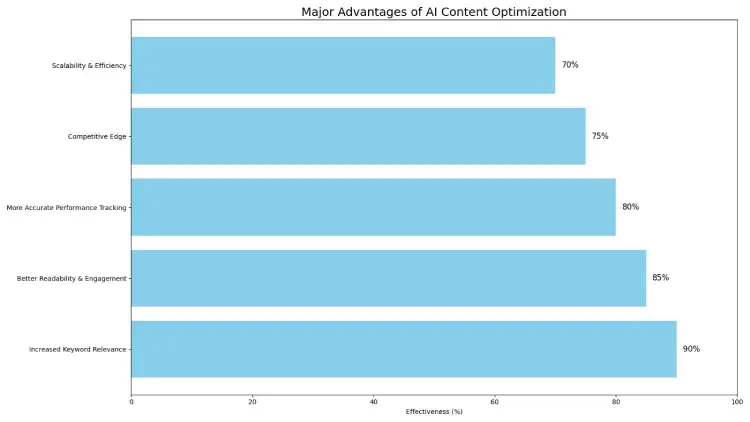
Major advantages of the AI Content Optimisation
The benefits of AI content Optimization can assist a marketer in developing smarter content and making it more effective.
Increased Keyword Relevance: AI uses active end-user searches in both fundamental and long-tail queries to create higher-quality keywords and long-tail phrases natural to your content, as well as to enable your content to discover opportunities in the ranking it can.
Better Readability and Engagement: AI proposes how to make language easier to understand, increase readability, and enhance the scannability of the content. This will make your users spend more time on your page, and bounce rates will be reduced.
More Accurate-performance Tracking: AI-driven analytics display the performing content and the underperforming content, which allows making changes in titles, headings, or content structure promptly.
- Competitive Edge: Through competitor analysis, AI identifies where people have failed or succeeded, and this enables you to distinguish your approach and come up with more significant and authoritative content.
- Scalability & Efficiency: AI takes over repetitive work, such askeywordd research, metadata ccreation content audits, etc., allowing your team to concentrate on strategy and creative work as you increase content creation.
The AI Revolution in Content Marketing.
AI is transforming content marketing, enabling marketers to predict the needs of the audience instead of making assumptions. Through search ttrends user behaviour, and performance measurement, AI makes content relevant, engaging, and effective.
Personalisation: AI will be able to target certain segments of the audience, or even individual users, making the content more engaging and loyal.
Smarter Visuals: AI proposes the most effective pictures, structures, and formats to attract attention and increase engagement so that the content becomes more interesting and presentable.
Data-Driven Decisions: AI insights can guide marketers on how to make changes to their existing posts, use the hot topics to target, and recycle the old content to deliver maximum value.
The outcome is more strategic, user-friendly content marketing that is easy to optimise for search engines, forming smarter campaigns that result in improved engagement and quantifiable outcomes.
Actionable Procedures for ideas on AI content Optimisation through AI
The best implementation of AI content Optimization is when it is done in a sequential manner. Here’s a practical roadmap:
1. Define Goals & Audience
Have specific goals: to move up the ratings, to decrease the bouncing rate, or to develop leads. Identify the pain points, search behaviour, and preferences of the audience to use AI to ensure your content is based on the actual user needs.
2. Audit Existing Content
Conduct AI-based audits to determine what pages have been performing best, what posts are not doing well, and areas where they can update or delete old information. This assists in prioritising the improvements effectively.
3. Optimise Keywords & Topics
Find appropriate keyword clusters, long tail words and queries. They should be introduced as a part of the presentation used in headings, meta descriptions, and body text so as to increase their visibility and not stuff it with keywords.
4. Enhance Legibility and Organisation.
Simplify the language, tone and flag complex sentences with the help of AI. Divide all text into short paragraphs, make bullet points, and make subheadings easily understandable.
5. OOptimiseMetadata & Headers
Make sure the title tags and meta descriptions are strong, keyword-oriented and portray page content correctly. AI can also propose changes to headlines to increase the rate of clicks.
6. Inserted Supporting Material and Imagery.
Provide optimised pictures and infographics, and in-house links. Include Q&As to set featured snippets and add value. AI will be able to suggest images or links that can enhance interest.
7. Test, Measure & Iterate
Measure such metrics as time on page, rankings, and CTR. AI insights will help you update your content, test via A/B testing, and keep your strategy in a constant shape.
Real-World Example:
Wellness-focused production firm Omniscient Digital made similar progress with Jasper AI in 2021, achieving a 810% increase in organic blog sessions and a 400x increase in product signups (partial revenue is counted in the annual recurring revenue category), resulting in total years of business with the AI-based system amounting to millions of dollars. It demonstrates that the results of the Optimization driven by AI, with the help of regular publishing and decisions supported by the use of data, can be produced in measurable results.
What Does AI Content Optimisation by AI Mean?
The algorithms at Google evolve more quickly than the majority of teams are able to maintain them, and performing them by hand is frequently slow and unreliable. It is no longer sufficient to sprinkle keywords. That is why AI content Optimization is becoming a necessity- 86 per cent of the SEOs utilise AI, and 65 per cent view better outcomes.
1. Speed and Efficiency
It is possible to create meta descriptions, content briefs and updates of hundreds of posts in hours rather than days using AI. Such AI types as ChatGPT or Nightwatch can process huge amounts of data and propose AI content Optimization in a short amount of time, allowing teams to efficiently produce content.
2. Data-Driven Insights
AI reads the current information and uses it to analyse the trends and rankings of the SERPs and performance of the keywords to make practical recommendations. This eliminates the element of guessing as well as makes sure you base your decisions on performance indicators.
3. Smarter Keyword Targeting
AI aids in the detection of long tail keywords, semantic variations, and topic clusters. This enhances topical authority, the purpose of search intent, and prioritisation of keywords that have high conversion potential.
4. Enhanced Creativity
AI is very helpful in terms of creativity as it proposes headlines, intros, content angles, and outlines. It is a brainstorming companion that is available 24/7 to assist writers in coming up with ideas more quickly at no expense to quality.
5. Consistent SEO Maintenance
AI automates such actions as meta tags verification, alt text verification, broken links verification and internal linking verification. It also indicates old materials and detects holes, thus SEO maintenance is proactive but not reactive.
6. Competitive Advantage
With AI automating low-value work, your team is no longer required to be fully engaged with low-impact activities like creating unique content that can be used to drive engagement, conversion, and brand authority.
Simply put: AI assists you to optimise more quickly, make smarter choices, be consistent in SEO, and achieve a competitive advantage, and assists creativity and approach.
Always combine AI with a human strategy.
AI Content Optimisation is a potent force of AI, which cannot grasp your brand voice, the specifics of your audience, or your market placement. Always consider AI as a smart helper: brainstorming, writing content or finding new perspectives is possible with its help, yet it is always important to check its results with your experience.
Practical Advice: Use simple and straightforward brand guides and content tone documents, and drop them into artificial intelligence software, such as ChatGPT. This is useful in getting AI-generated content in harmony with your brand voice, though it saves time and boosts creativity.
Using AI intelligence with human judgment, you make really SEO-beneficial and captivating content.
Bring AI Prompts to Higher Relevance.
- AI is responsive to certain prompts. Add information about the tone, audience, length, and objectives to obtain more significant, interesting information.
- Instruction: Prepare a 100-word introduction of a blog on the topic of AI Content Optimisation. Tone: conversational. Audience: SaaS marketers. Focus on efficiency.”
- Ai is a smarter content assistant in that it assists in preserving brand voice, bettering search engine Optimization, or leads to lowered editing hours through customised prompts.

Examine and measure how your artificial intelligence search engine is used.
It is important to know how your audience will search the AI platforms since search on AI is not the same as conventional search. The queries posed by the users are usually long, conversational, multi-turn queries, which intend to accomplish a task, as opposed to the short and keyword queries that are observed in Google. This bbehaviourcan beanalysedd to understand which questions and topics your content has to answer to be featured in the responses of AI, with the hopes that you will outperform your competitors.
Steps to Research and Assess
- Discover AI Platforms Your Audience Uses.
- Monitor the AI sites that send traffic to your site and those sites that send traffic to competitors.
- Such instances are ChatGPT, Gemini, Perplexity, Bing AI and Google AI Mode.
Analyse Queries and Prompts
- Identify the most popular queries by your audience to locate your products, services or brand.
- Insert both branded (e.g., [ism] good?) and unbranded (e.g., [Best type of product] to satisfy X’s need).
- Customer journey queries above awareness through purchase.
- Evaluate Current Operational Performance.
- Assess your presence in AI responses, i.e., by mentions, appearance of links, and sentiment.
- Make comparisons vis-à-vis competitors in order to locate gaps and opportunities.
- Put Priority on Topics and Queries
- Concentrate on those questions that have a high potential and low visibility relative to the competitors.
- Monitor and improve priorities as artificial intelligence search trends change.
Tools & Tips
- Analytics (GA4): Find the best AI platforms causing traffic.
- Third-party applications (Similarweb): Discover AI platforms and trending prompts related to competitors.
- AI research services (Profound, Sistrix, AI): Things analyse the popularity of queries, mentions of a brand, and sentiment.
Common Mistakes to Avoid
- It is not to ignore the AI referral data or to think that the traditional search behaviour is applicable.
- Targeting the branded queries and ignoring the unbranded ones.
- Failure to focus on competitor visibility and the context of AI-generated mentions.
- Not differentiated because AI platforms need a unique analysis of eachplatform’s behaviour.
Through the study of AI search behaviour and content performance, you are able to streamline your strategy and enhance visibility, as well as develop content that meets actual audience requirements on AI platforms.
Make Depth and Width Searchable by AI.
In order to make your content visible and accessible to AI models and search engines, you need to make it accessible, indexable, and well-structured. Content is obtained by AI crawlers such as GPTBot, ClaudeBot, PerplexityBot, and extended crawlers of Google to use in large language models and AI-generated responses. The content you are creating might not be shown with AI reactions in the case it is blocked, hidden, or rendered poorly, which also limits reach and engagement.
Key Steps for AI Content Optimisation
Allow AI Crawlers
- AMBots must be included in your robots. Fruits and firewalls or CDNs must be added with their IPs.
- Examples of bots: GPTBot, Googlebot, Google-Extended, Bingbot, ClaudeBot, CCBot, PerplexityBot.
- Pre-Rendering or Server- Side Rendering (SSR).
- Do not depend on the use of client-side JavaScript and essential content.
- SSR allows complete access and indexing of your pages by the AI and search crawlers.
Correct Meta Tags
- On high-value pages, use <meta name, robots, content, index, follow.
- Use noindex or do not include nosnippe, which avoids cases when the content is recapped in AI-based summaries.
Canonical Tags
Self-referencing canonical tags denote the authoritative version of the page, which eschews the problem of duplication.
Example: <link rel=canonical href= https:www.yoursite.com technical-seo
Internal Linking
None of the links should be crawlable or not, and the text of the anchor needs to be descriptive to make the AI know what a page is all about.
Make sure you do not use such vague anchors as: click here or JavaScript-based links, which can not be considered as readable by crawlers.
✅ Good:
- Technical SEO/pillar page in HTML.
- Robots are permitted to crawl these bots and are whitelisted.
- Served material.
- Meta robots: index, follow
- Referencing canonical tags within oneself.
- Internal links that can be crawled and have an anchor text that will describe them.
❌ Bad:
Single-page application based on JavaScript.
AI bots blocked
- Meta robots: no taxes, no-follow.
- Canonical tags point to the site root.
- Internal links that are not crawlable or not specific.
Getaway: full crawlability and indexability make your content checkable, searchable and packaged into responses offered by AI, increasing your reach, usage and growing your SEO.
Maximise on Topical Breadth and Depth.
Complex queries can be allocated to quite a few subtopics in the search platforms using AI as a way of providing answers to the query. In order to do a good job, your content must include not only breadth (all the relevant aspects) but also depth (a detailed coverage of every aspect).
How to Structure Content
- Use a Pillar + Cluster Model
- Pillar page: It is a summary of the core of the topic and contains links to cluster pages. Plays the role of a content hub.
- Cluster pages: Explore a particular subtopics into depth, making sure that each page caters to a specific user intent
Internal Linking
- Join pages and go back to the pillar.
- Provide descriptive anchor text to make AI realise semantic relations between pages.
Example
Pillar Paypage: /technical-seo/ – offers a summary of crawlability, indexability, speed of the site, mobile search engine Optimization, and structured output, which are provided through going to respective cluster pages.
Please, refer to Page: /technical-seo/crawlability/ – covers crawlability at length with suggestions and links to other similar subjects such as indexability or robot.txsts.
Why This Works
Relevant to the support of the query fan-out provided by AI and aimed at a range of related intents.
- Gathers topical authority through the comprehensive coverage of all aspects.
- Offers a solid structure of giving users a wider preview and then narrowing down to the finer instructions.
- Mistake: One page with in-depth information about all the points in a superficial way, without any specific URLs or links within the text, as a result, the machine and users can perceive fewer connections and expertise.
Key Lesson: Introduce a comprehensive and thorough approach to content with a structured hub and spoke model and effective internal connectivity to enhance the visibility and interactivity of AI.
Chunk-Level Retrieval AI content Optimisation.
AI search engines can find information on passages or chunks of information and not necessarily on single pages. This implies that the individual parts of your work have to be self-reliant, narrow and clear in their own right. Chunk-level AI content Optimization will help in achieving high use of your content on AI-generated answers and snippets.
Best Practices
Focus on One Idea per Section
- One idea should be communicated in each chunk. It should not be made up of more than one subject in a paragraph.
- Condition Make Passages Semantically Tight.
- Make the content simple and not too long so that someone can comprehend it without any help.
- Stylistic HTML and Use Headings.
- Split up with H2 and H3 headings for every subtopic.
- The clarity and readability are gained through the lists, bullet points, and the use of tables.
Self-Contained Explanations
Shorter and more specific paragraphs (25 sentences) are most effective as a retrieval tool by the AI and as human-readable.
Keep Chunks Concise
In the chunk, student knowledge entails including an example or definition. Do not look over another section on context.
Example
✅ Good:
<h2>What is Technical SEO?</h2>
Technical SEO aims at enhancing the infrastructure of a website so that the search engines can crawl, render and index it successfully. It has internal connection, speed of the site, usability on mobile devices and application of structured data.
❌ Bad:
<h2>Learn SEO</h2>
SEO is broken down into technical SEO, content and link building. Technical SEO is useful for crawlability. Content ensures relevance. Authority is increased through link building. Each of these is a significant part that you will have to discover, learning on the job….
Why Good Works:
- One clear concept
- Self-contained and concise
- Organised using headings, to be able to retrieve easily.
Key Takeaway:
Break down each section into a digestible unit, with straightforward titles, very narrow concentration and organisation. This is better AI Retrieval, it increases the user readability, and it makes it more likely your content can be featurin AI-generatededd answers.
Maximise Multi-Modal Support.
Images, charts, tables, and videos are becoming more and more popular as AI search systems respond to the queries posed by the user. To make visuals useful, comprehensible, and understandable by both AI and humans, it is necessary to optimise content to assist it in multiple modes.
Best Practices
Ensure Crawlability
Deliver images and videos through HTML clean. JS-only lazy-loading should be avoided because it is not rendered by AI crawlers.
- Alt Texts and Captions of Descriptions.
- Insert alternative text: a description of the visual, which makes a connection to the subject matter.
Include descriptions of pictures/videos underneath or adjacent to pictures/videos.
Use Semantic HTML
- Visual images are used in <|human|>. There are figure and figcaption
- Avoid images of tables in their place with machine-readable data in HTML tables.
- Parses semantically to improve the AI parsing of structure lists and others.
KeepVisuals Contextual
Texts around should be covered with visuals. Linear positioning enhances search and artificial intelligence.
Example
✅ Good:
- Overview of SEO Audit Process.
- As is considered, an SEO audit reviews such critical aspects as crawlability, indexability, site speed and backlinks.
- Fig. 4. SEO audit process images.
- Figure 1: SEO audit flow with the five core areas of focus.
- ind Fixed Loan trades flag Pacific Fund by intermediate capital Authority
- trtd>Crawlability
- trtd>robots.txt, sitemap, internal linking
- tr|>td|>td trtd Canonical tags, noindex, HTTP status codes.
❌ Bad:
The audit of the SEO appears below:
Auditing Overview In a similar manner, the summary of the audit will respond to the questions.<|human|>Email img src/images/audit-summary.jpg
The following list includes some of the major accreditation criteria that must be used to evaluate a hospital’s audit reports:
Why Good Works:
- Imagery is browsable and understandable.
- There is meaningful information on alt text and captions.
- The HTML tables enable a table-summarizand tokenization by AI.
- Free-structured and semantic to AI rescues.
One important lesson is that the kind of multi-modal Optimization is to make images, tables, and videos interpretable, comprehensible, and purposeful to AI as well as users, to work better and draw more attention to the AI-driven ranking.
Optimise-Personalisation-Resilient Content.
The search engines that are built on AI tailor the results according to the location of the user, their aim, history, and interaction. To stay relevant:
- Support various intentions: Answer various questions on the same subject.
- localise the content: have examples and schema markup which are local to the region.
- Divide by personas: market to freelancers, newcomers, inside teams and so on.
- Develop authority: Authoritarians with residences, references, and mentioning on reputable sources.
- Increase interactivity: Flashy interactive pages that have quizzes, user comments, and share.
- Good one: SEO Learning Paths to Various Roles: It is multi-purpose, local, persona-focused, authoritative and interactive.
- Bad: Simple landing page selling one course only – one intent, there is no localisation, relatively low authority, and limited interactions.
Monitor Your Content AI Search Performance
Tracking your content in AI search results helps improve visibility, engagement, and competitiveness.
Key Actions:
- Track popular prompts: Understand how users search for your brand, products, or services across AI platforms.
- Monitor brand mentions: Assess inclusion, links, and sentiment on multiple AI systems.
- Benchmark against competitors: Compare mentions, sentiment, and link inclusion to identify gaps.
- Analyse AI-driven traffic: Track engagement, page visits, and conversions separately from traditional search.
- Monitor AI crawling: Check bot access, crawl frequency, URL coverage, and indexing patterns.
Good Example: Track prompts, mentions, sentiment, and links on all major AI platforms; analyse traffic and bot behaviour; compare against competitors.
Bad Example: Monitor only one platform, ignore sentiment or AI-specific traffic, assume AI behaves like traditional search.
Top Sources for Search AI Content Optimisation
Learn from experts to optimise content for AI-driven search and LLMs:
- Francine Monahan: Tips to make content retrievable by LLMs.
- Mike King: How AI Mode works and SEO strategies for the future.
- Duane Forrester: Chunk-based content retrieval vs traditional indexing.
- Jan-Willem Bobbink: NLP-driven SEO and semantic AI content Optimization.
- Chris Green: Importance of structured content, headings, and internal links.
- Amanda King: Aligning content with AI-focused “useful content” signals.
- Andrea Volpini: Query fan-out, chunk Optimization, and AI product page strategies.
Want expert help optimising your content for AI-driven search? At TechishWeb, we offer specialised AI AI AI Content Optimisation services to boost your rankings, engagement, and visibility. Contact us today to get started!”

Final Thoughts
AI content Optimization is key to creating content that ranks, engages, and converts. By combining AI insights with human expertise, you can produce content that is relevant, personalised, and easily discoverable. Optimise for crawlability, chunk-level retrieval, multi-modal content, and personalisation, while monitoring performance to stay ahead of competitors. Treat AI as a smart assistant to enhance creativity and strategy—not replace it—for lasting SEO success.
Frequently Asked Questions
1. What is AI content Optimization?
AI content optimisation uses artificial intelligence to improve digital content so it ranks higher in search engines, matches user intent, and engages readers. It enhances structure, readability, keywords, and overall content value.
2. How does AI improve SEO and content performance?
AI helps identify high-performing keywords, optimise readability, track content metrics, analyse competitors, and suggest visuals. It automates repetitive tasks, making content creation faster, more accurate, and scalable.
3. What are best practices for AI-optimised content?
Focus on crawlability, chunk-level retrieval, multi-modal support (images, tables, videos), personalisation for different audiences, structured content with headings, and monitoring AI performance across platforms.
4. Can AI replace human strategy in content Optimization?
No. AI should be used as a smart assistant to enhance creativity, research, and efficiency. Human expertise is essential to maintain brand voice, context, and strategic decision-making.