

Search Engine Optimisation (SEO) is the method of increasing the ranking of your online store in search engine result pages (SERP) without the cost of advertisements. It assists in inviting focused visitors who will have a high chance of buying your products. Increasing organic traffic, serving more conversions, and enhancing brand credibility, e-commerce SEO boosts product description, site speed, mobile optimisation, and content quality to help grow the brand in the long term.
What is E-commerce SEO?
The technique of improving the appearance and ranking of an online store in search engines such as Google is known as e-commerce SEO. It also aims at optimising the product and category pages, which are very likely to be the most lucrative through the correct use of keywords, a succinct description, and an optimised design of the site.
Compared to paid advertising, e-commerce search engine optimisation is among the low-cost methods of attracting target clients organically, generating traffic, and sales in the long run. It not only increases ranking, but also improves the general shopping experience through the easeof locatinge and purchasing the product.
B2B and B2C E-commerce SEO Difference
Although B2B and B2C types of e-commerce use SEO to generate organic traffic, the two are different. B2C SEO differs by focusing its content on individuals aiming to promote the immediate decision to buy a product, whereas B2B SEO is so-called, and the content targeting the needs of business officials will help the buyer to buy a product, promoting longer purchase cycles.
B2B SEO is lead generation, conversions, and customer lifetime value oriented, whereas B2C is based on traffic, sales, and average order value. Knowing such differences can be used to develop the right SEO strategies that suit each audience.
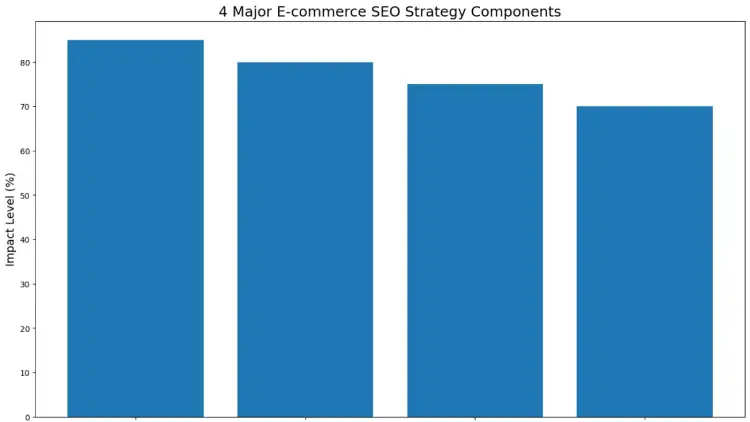
4 Major E-commerce SEO Strategy Components
An effective e-commerce SEO plan requires a combination of various factors, which combine to enhance presence, drive traffic, and generate sales. Although the general aim is to be higher in the search result list, it will be more efficient to work on these four important elements:
- Content: Have highly optimised products and categories content to attract buyers and assist search engines in making sense of your site.
- Technical Set Up: Make sure that your site is fast, secure (HTTPS), mobile-friendly, and crawlable with correct sitemaps and structured data.
- User Experience (UX): navigation, quicker pages, and precise organisation: make the experience easy, faster, and more engaging, ranking, and conversions.
- Link Building: Internal links and backlinks are used to increase credibility and SEO on reputable websites.
When optimised through content, technical configuration, user experience, and building links combined, your e-commerce store stands in a better position of gaining greater search visibility gainingg more organic traffic, and turning the visitors into loyal customers.
At TechishWeb, we don’t just explain SEO—we implement it. From content optimisation and technical SEO to UX improvements and link building, our team helps online stores grow traffic, rankings, and sales.
What are the advantages of E-commerce SEO?
SEO in e-commerce has some of the main advantages that can facilitate your online shop.
- Enhanced user experience: Maximising your website search with the use of the right keywords and better navigation, faster and more mobile will enhance the experience of users and hence the better Google results with a higher ranking.
- Improved Visibility: Increased search performance generates more awareness about your brand, brings more traffic, and can be remarketed to people interested in it.
- Better Quality Of Traffic: Ranking on a desired keyword attracts individuals who are keen about the products being offered by you, thereby increasing the rate of conversion and creating an additional stream of sales.
All in all, e-commerce SEO increases organic traffic, enhances credibility, and lsupports ong-term online store development.
What are the E-commerce SEO Problems?
There are several challenges associated with the optimisation of an e-commerce site in search engines that most businesses fail to consider. Though SEO may be able to push traffic and sales, it needs to be balanced, using good content, technical configuration, and maintenance.
Lack of Quality Content
Most websites are more quality-quantity than quality and reproduce the information provided by the manufacturers, or generate general information. In order to succeed in SEO, the product pages should be unique, brief, and add value through elaborate descriptions, images, and useful information. The content quality is particularly critical when dealing with B2B e-commerce, where the buyers are interested in the detailed information and pieces of advice.
Neglecting Technical SEO
Even effective material cannot do without a good technical basis. The essential technical features are the HTTPS security, the mobile-friendliness, the high-speed of the page loading, the adequate indexation, and thesitemapt XML sitemap XML. Failure to note this may mean that your pages are not crawled, indexed, and ranked by the search engine.
Maintaining SEO Over Time
SEO is an ongoing process. Monitoring of pages and updating of pages should be conducted periodically. The refreshing of content, dealing with keyword cannibalisation, and keeping refreshing titles and descriptions all make your site remain in the search results.
Best Practices E-commerce Search Optimisation:
Before keyword search, define buyer personas so that you can reach the correct audience.
Make special titles, descriptions, and content of pages with useful keywords.
Exchange content eow and then to keep up with the times and to prevent the risk of competing for the keyword.
Technical SEO, holistic strategy, and user experience.
With these challenges tackled and good practices, e-commerce sites would be able to acquire quality traffic, rank better, and have more conversions, establishing loyalty in search engines in the long run.
Get Your Site Secured with HTTPS and Clean Your Site Structure
You need to secure your e-commerce site and to create a well-defined structure of your site to gain the user’s trust and improve the SEO.
Secure Your Site with HTTPS:
With HTTPS, the traffic of both the site and clients is encrypted, securing important data such as credit cards. It also assists in Google ranking. Search for the padlock in the web browser. HTTPS is on by default on most e-commerce sites, yet those ones with HTTP must migrate as soon as possible.
Ease of navigation of Your Site Structure:
An efficient site structure defined through a clear and hierarchical layout assists the users and the search engines in moving about your store. The majority of online shopping websites consist of this sequence:
Homepage > Category Pages> Subcategory Pages Product Pages
The following structure is suitable as it:
- Customers can find what they want with ease and ease of navigation: Visitors can easily find their products, and this enhances their user experience and increases their conversions.
- It is useful in crawling and indexing pages by engines: Internal linking allows pages to be found and ranked.
- In terms of internal ties, it should be straightforward: on your homepage, you will have links to categories, further to category-subcategory, and to the individual products. When a logical structure is established initially, future redesigning headaches are avoided, and long-term expansion of SEO is facilitated.
User confidence and intuitive page structures can be achieved by ensuring your webpage is secured with HTTP, and arranged in an orderly way, increasing organic placements and ensuring a smooth buying experience.
Optimisation of Product Pages in SEO and Conversions
The search intent is met with action on the product pages. Your pages should assure, reassure, and educate the visitors to convert them.
- Titles & Descriptions: Specific titles and descriptions that indicate how the customers will search and indicate important benefits are to be used. Please, do not use generic text; speak about features, applications, and solutions.
- Headings/ Structure: one H1 should be the product, and H2S should be the material, fit, features, etc. Make the page easy to skim.
- Images: Have products in action,n and there should be a description provided as an alt text.
- Copy and Keywords: To write effective copy, update directly to match your brand voice, appeal to buyer needs, and obviously, incorporate effective keywords.
- Formatted Data: Appendix schema markup (price, reviews, etc.) to the product creation to allow rich results.
- Internal Linking: Links between product pages in blogs, categories, or guides help in guiding customers to different pages as well as improving SEO.
Product pages will be able to generate organic traffic and conversion by unifying all aspects with the buyer’s ntentions of the buyer.
The art of Optimising Category Pages to scale up the SEO
Product organisation through category pages is the foundation of e-commerce SEO, which attracts high-Intent traffic and mid-funnel traffic. They assist users in locating types of products (e.g., trail running shoes or vegan protein snacks) and aid in converting as well as internal link equity.
Tips for Optimisation:
- Significant Intro Copy: Natural usage of language, synonyms, and descriptions that are customer-oriented.
- Wait Filters Modify & sort: Indexing Filters: Have size or material or use-case filters, but not all of them.
- Internal Linking: Provide links to other related categories, best products, or guides to enhancethe navigation system, and boost the search engines.
- Crawl Efficiency: Canonical Tags should be utilised, extraneous filters should be avoided, and breadcrumbs should be applied.
Optimised category pages will direct your users, enhance search exposure, and scale your optimisation when dealing with large product ranges.

Strategise Your SEO by Architecture and Design
The largest percentage of shoppers do not have brand names in their searches, but rather have a vague query that attempts to resolve an issue or need. Visibility, relevancy, and clarity determine whether or not they find your store.
High- performing SEO base is based on site structure and crawl optimisation:
- Accessibility to valuable pages through a crawlable hierarchy: This should be easy to reach through search engines and other people.
- Flat structure: Use three clicks to the homepage to make all products available.
- Easy navigation: Leads the consumer intuitively through categories to products and value to the search engine.
With search intent and structure in place, your site will be able to scale easily, and all the pages will be discoverable and conversion-ready.
Technical SEO for E-commerce
Technical SEO makes it so that your store is crawlable and fast, mobile-friendly, on which rankings, traffic, and conversions are built.
Key elements:
Core Web Vitals & Speed: LCP (less than 2.5s), FID (less than 100ms), CLS (less than 0.1s with the help of such tools as PageSpeed Insights).
Mobile-First Indexing: All the content, metadata, and organised information show up in mobiles, then mobile search rankings; mobile hits rankings.
Structured Data: Add product, breadcrumbs, faq and organisation data to allow rich results.
Discontinued and Temporarily Out-of-Stock goods: maintain temporary products as restockable goods: 301 discontinued products, and keep the SEO equity.
Technical SEO also makes your shop visible, quick, and robust, and helps people and engines to work with it effectively.
Tracking E-commerce SEO
Rankings are not the only way to make search engines successful, butalso to generate revenue. Target KPIs that calculate actual business impact:
- Organic sessions: Visibility and demand of the site.
- Organic search revenue: Direct ROI measurement.
- Conversion rate: This measures the efficacy of traffic in terms of sales.
- In the case of bigger sites, also track the indexed pages, volume of keywords, impressions, and CTR in order to measure the growth of the SEO.
- GA4 is used to track visitor behaviour and revenue, and Search Console is used to understand how people find you. Collectively, they give an overview of the search-to-sell, informing the data-driven SEO adjustments.
Authority and Trust Construction of Strategy Content
Content in e-commerce is not an exception to product pages. Value-added materials are known to develop authority, traffic, and support customers in the buying process.
Key strategies:
- Blog posts: Publish how-to articles, purchase advisor articles, and product comparisons to answer customers’ questions.
- User-generated content: Get people to write reviews to get new content, facilitate trust, and inject them with natural keywords.
- Improved category pages, adding FAQs: FAQs, tips, and guides help to make the category pages more informative andsearch engine-friendlyy.
- With a robust content strategy, one will improve the SEO, create trust, and achieve higher conversions by enabling the customer to make well-informed choices.
Link Building: Winning Trust and Authority
Link building will assist your e-commerce site to achieve credibility and alsoenhanced Search Engine Optimisation. Search engines regard sites with reputable links as a vote of confidence.
Key strategies:
- Suppliers & Manufacturers: Sign with them as an authorised retailer on their websites.
- Bloggers & Influencers: Partner with them and do reviews or other shareable materials such as infographics.
- Miss & Greetings: Incorporate some affiliate businesses also, i.e., by posting a guest or guides as it gains one or the other relevant backlinks.
- Quality, not Quantity: It is better to have a limited number of links on high-quality and relevant websites rather than numerous low-quality links.
- Good link promotion increases rankings, creates trust, and triggers qualified traffic to your store.
The use of Semantic SEO and LSI Keywords
Semantic SEO enables search engines to interpret the meaning of what you are saying and not the keywords. This means that you can rank on multiple searches with the inclusion of similar terms and ideas, and sound more relevant.
Example: In case of yoga mats, add such terms as exercise mats, surface is non-slip, it can be thick, and eco-friendly.
Another advantage of LSI keywords is that they enhance voice search by focusing on conversational searches, e.g. This should be where to purchase organic cotton t-shirts rather than organic cotton t-shirts.
Benefits:
- Rank on several related searches.
- Enhance usability and achievements.
- SEO voice search traffic.
- Give in-depth material, which meets the searching purpose.
- LSI Keyword Semantic SEO increases the naturalness of your e-commerce content and makes it useful and discoverable.
- Your Actual Competition: Landscape of Search in Modernity.
- Google processes 8.5 billion search queries on a day-to-day basis, though nowadays, you are not only competing with other websites. The actual competition comprises:
- AI Overviews: Google Answers on Charity. Snippet Featured Results: Results that do not require clicking.
- Shopping Ads: The paid placements occupy a larger portion of the SERP.
- Amazon & Marketplaces: Sometimesbrought up more often than the product.
- Authority Sites: Older websites conquer by having signs of authority.
- AI Content Farms: There are results flooded with thousands of AI-generated pages.
- Today, quality and uniqueness of content, prioritising user intent, establishing authority, and distinguishing content in comparison with marketplaces and AI-generated ones are crucial success factors.

Final Thoughts
E-commerce SEO is not just making it to the top of the search results, but it is making the experience as seamless and as credible as possible, which takes visitors through the discovery to purchase process. Through quality content, well-optimised product and category pages, good technical search engine optimisation and effective link building, your store can capture the right traffic, maximise on the trails and establish a powerful image. In the modern world of online competition, it is pointless to be more relevant, user-oriented, and credible in your website than to focus on long-term growth and the ability to position your online store for success in the future.
Frequently Asked Questions
1. What is e-commerce SEO?
It is a way of maximising your Internet store to come higher in the search results, attract focused customers, and increase sales through the utilisation of keywords, transparent product details, and proper website organisation.
2. What to do to optimise product and category pages?
Apply descriptive titles, descriptions, pictures, schema, and internal links to products. In the categories, include useful copywriting, filters, and good navigation to direct visitors and enhance search engine optimisation.
3. What are the key issues of e-commerce SEO?
The most common pitfalls are the creation of distinctive content, fast, mobile-friendly, and secure pages, and the regular updating of SEO over time.
4. How do I measure SEO success?
Monitor organisational traffic, conversion, and sales of search engines such as Google Analytics 4 and Search Console to understand the sales-generating factors.

4 thoughts on “E-Commerce SEO: Strong Results for Online Stores”
This was beautiful Admin. Thank you for your reflections.
Thank you so much! I really appreciate your kind words. 😊
I truly appreciate your technique of writing a blog. I added it to my bookmark site list and will
Thank you so much! I really appreciate the support—glad you found it valuable 😊