

Intelligent automation combines AI with traditional automation to create systems that can think, learn, and adapt. Today, it’s used by small businesses, hospitals, banks, and shops to save time, reduce errors, and improve customer satisfaction.
This guide will explain what intelligent automation is, how it works, why it matters, and how you can apply it in your business with real examples, tools, and simple steps.
What is Intelligent Automation?
Intelligent Automation (IA) combines RPA, AI, and machine learning to create systems that can think, learn, and adapt.
RPA handles repetitive tasks like data entry, AI adds decision-making based on patterns, and machine learning helps the system improve over time. Unlike traditional automation, IA can process exceptions, learn from corrections, and optimise itself—for example, intelligently transferring email data to spreadsheets.
The Secret Behind Intelligent Automation
Intelligent Automation operates through four major stages that make it smarter than traditional automation.
1. Data Collection & Processing: The data in the system is collected through documents, emails, databases and voice calls. Advanced tools like OCR and NLP help it read, understand, and prioritise information—for example, distinguishing between invoices and receipts.
2. AI-Powered Decision Making: Machine learning analyses patterns and past cases to make informed decisions. Human corrections further train the system, allowing it to evolve and improve over time.
3. Automated Action Execution: Once a decision is made, the system executes tasks such as sending emails, updating records, or triggering processes. Unlike humans, it works 24/7 without fatigue, handling thousands of operations simultaneously.
4. Continuous Learning: The system monitors outcomes, learns from mistakes, and optimises performance. Accuracy improves, response times get faster, and overall efficiency increases with use.
This continuous learning loop is what sets intelligent automation apart, making it a powerful tool for businesses of all sizes.
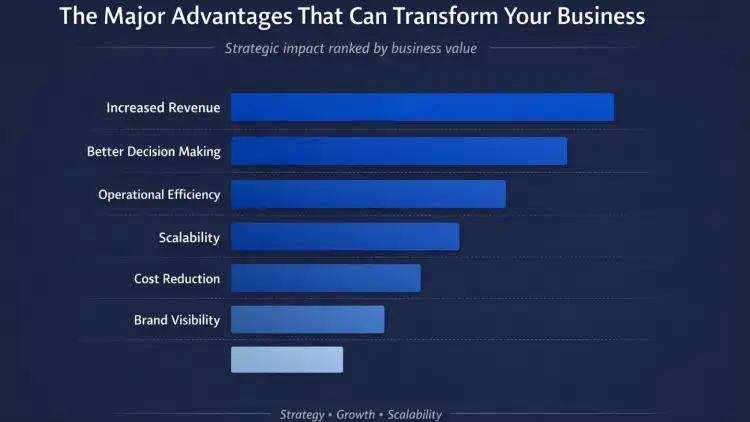
The Major Advantages That Can Transform Your Business
Intelligent automation delivers tangible results across multiple areas:
1. Cost Reduction & Efficiency: Companies often cut operational expenses by 25–40% in the first year by automating time-consuming manual tasks. For example, one insurance company reduced claims processing from 3 days to just 2 hours, freeing employees to focus on complex cases.
2. Reliability & Accuracy: IA systems minimise human errors, achieving 99%+ accuracy. In healthcare, automating patient data entry reduced medication errors by 87%, greatly improving safety.
3. Improved Customer Service: IA-driven chatbots provide real-time, contextual responses. Complex issues are seamlessly handed over to humans with full conversation history, reducing response times and boosting satisfaction.
4. Scalability at Lower Costs: Intelligent automation scales effortlessly. A retail company automated order processing and handled five times the usual volume during peak season without extra staff.
5. Employee Satisfaction: By removing tedious tasks like data entry, employees can focus on creative and meaningful work, increasing job satisfaction and reducing turnover.
Real-World Applications:
- Banking & Finance: Fraud detection, loan approvals, and customer inquiries. One bank automated 80% of routine queries, cutting wait time from 20 minutes to under 2 minutes.
- Healthcare: Appointment scheduling, insurance checks, and early disease detection through AI. Claims approval time dropped from 2 weeks to 2 days.
- Supply Chain & Manufacturing: Quality control, inventory management, and predictive maintenance. AI-based inspections increased defect detection by 35%.
- Retail & E-commerce: Personalised recommendations, inventory tracking, and customer support. Automated product suggestions increased average order value by 23%.
- HR & Recruitment: Resume screening, interview scheduling, and onboarding. Automation reduced time-to-hire by 40% and improved candidate quality.
Core Technologies Driving IA:
- RPA (Robotic Process Automation): Bots mimic human actions on computers to automate tasks using tools like UiPath, Automation Anywhere, and Blue Prism.
- AI & Machine Learning: Analyse data patterns, learn over time, and enable advanced activities like image recognition and language understanding.
- NLP (Natural Language Processing): Understands human language, powering chatbots, sentiment analysis, and document processing.
- Computer Vision & OCR: Interpret images and scanned documents, extracting accurate data for document-heavy workflows.
Intelligent automation is reshaping industries by improving efficiency, accuracy, customer satisfaction, and employee engagement while reducing costs and scaling effortlessly.
Roadmap to Implementation
Implementing intelligent automation (IA) successfully requires careful planning and step-by-step execution.
1. Identify High-Value Processes: Start by mapping your processes and look for tasks that are repetitive, time-consuming, error-prone, or high-volume. Examples include invoice processing, customer onboarding, and report creation. Focus on automating a few processes initially to build momentum.
2. Select the Right Tools and Partners: Choose platforms that match your budget and meet criteria like ease of use, scalability, and service quality. Use free trials to test solutions. If technical expertise is lacking, hire experienced consultants to speed up implementation and avoid common pitfalls.
3. Build Your Team and Skills: Successful IA needs both technical and business knowledge. Invest in training and certification programs to develop in-house capabilities rather than relying solely on vendors.
4. Start with Pilot Projects: Begin with small proof-of-concept projects. Measure outcomes such as time saved, errors reduced, and cost efficiency. Successful pilots build trust and support broader implementation.
5. Test, Expand, and Monitor: After pilot success, scale to other processes. Establish a centre of excellence to share best practices and maintain governance for quality. Regularly measure performance and fine-tune systems to ensure ongoing value.
6. Overcome Common Challenges:
- Employee Resistance: Address fears about job loss. Show how IA removes tedious tasks, making work more engaging. Involve employees in the automation process.
- Integration Complexity: Use API-based platforms or iPaaS to integrate IA with existing systems. RPA can sometimes bypass integration issues entirely.
- Data Quality: Ensure clean, structured data. Automate data collection and establish governance policies to prevent errors.
- Managing Expectations: Set realistic timelines and targets. Report progress regularly and celebrate small wins to maintain stakeholder confidence.
By following this roadmap, businesses can implement intelligent automation effectively, maximising efficiency, accuracy, and employee satisfaction while minimising risks.
At TechishWeb, we help you implement intelligent automation tailored to your needs. Increase efficiency, reduce errors, and delight your customers—let us show you how!
The Future Understanding of Intelligent Automation Trends
The technology continues to change. Here’s what’s coming next.
Hyperautomation and End-to-End Process
The second wave links various automation tools with the smooth workflow. Whole processes of business are carried out at an automatic level.
Value creation in this holistic method produces exponentially higher value than automated production of separate tasks.
Artificial Intelligence-Based Decision Intelligence
More complex decisions will be made in future systems. They will be able to think about several aspects, forecast results, and prescribe the best measures.
The distinction between automation and strategic planning will become vague.
No-Code and Low-Code Platforms
Automation software is becoming less complicated. Automation building by business users is code-free. This makes the technology democratised and accelerates adoption.
Citizen developers will develop thousands of small automations that will revolutionise companies.
Improved man-machine interaction
Instead of taking over people, the IA of the future will enhance the abilities of human beings. Routine parts will be processed by systems, and exceptions and strategies will be considered by human beings.
This partnership paradigm is the most effective one that exploits the capabilities of the human being and machines fully.

Conclusion
Sophisticated automation is no longer a science of the future. It exists here, is substantiated, and is open to all businesses.
It is not a matter of whether or not to adopt it, but when and how. Organisations that accept intelligent automation enjoy great competitive advantages. They are quicker, less costly, and more efficient than those that are not.
Start small. Identify one repeatable process that irritates your team. Automate it. Measure the results. Then expand from there.
It can be a long trip, but it will also be worth the destination. Imagine the operations of your business were easier, your employees were more joyful, and your buyers were more contented.
That future will come sooner than you may guess. Take the first step today.
It starts with one automated process to transform you. That is what you need to make a priority. When you can work on it early, the faster you will be able to get some results that are worthwhile.
Frequently Asked Questions
1. What is intelligent automation, simply put?
Intelligent automation is a concept that applies an artificial intelligence concept to the existing automation to accomplish tasks that have the ability to think, learn, and evolve, rather than strictly act on the set rules.
2. What is intelligent automation, and what is RPA?
RPA addresses the repetitive aspects as well as the rule-based nature of work, and intelligent automation builds in AI and machine learning to perceive statistics, determine, and enhance itself.
3. What are some of the businesses in which intelligent automation can be employed?
Intelligent automation can be applied to any business, from small businesses to large-scale hospitals, banks, retail stores, manufacturers, and service-oriented businesses.
4. Does intelligent automation involve high costs?
Not necessarily. Most of them are scalable in price and can provide a free trial, and most companies pay back within a short period due to fewer errors, faster operations, and decreased operational costs.