
Your rankings, traffic, and conversions will be negatively affected if your site is slow. Page Speed Insights is reasonably useful in identifying performance problems; however, the actual improvement is achieved through regular hands-on training. This guide takes you through real-life exercises, such as image optimization and Core Web Vitals fixes, that will directly improve your page speed insights score. These step-by-step measures will increase the speed of loading details and user experience, as well as the long-term performance of websites.
Test your Webpage with Page Speed Insights
Know the Current Performance of Your Website
The first step before making a change is to analyze your site using PageSpeed Insights to have a clear picture of the current speed and performance of your site on mobile and on desktop.
Perform a speed run Page Speed Insights Test
Type in your web address into the PageSpeed Insights and obtain a document that displays the performance point by point and loading characteristics
Check Performance Scores Thoroughly
Test the overall performance score that is based on legitimate user information and lab analysis to realize the extent to which your site is optimized.
Specialize in Core Web Vitals Metrics
Watch such important metrics as Largest Contentful Paint (LCP), Cumulative Layout Shift (CLS), and Interaction to Next Paint (INP) to discover the problem of the user experience.
Examine the bullets in the Opportunities Section
See proposed improvements in the section on Opportunities that can be enabled to achieve better load time and improve performance.
Diagnostics Report: Diagnostic report checked
Browse the “Diagnostics category to uncover underlying problems like code wastage, the big file, and the ineffective loading methods used.
Detect Presentation Trends
Find out whether your site is not responsive on mobile devices or if some pages take a longer time to operate compared to others.
Record Your Findings To Compare with the Chairman
Write down your original performance against which to compare improvement in the case of the exercise of optimization.
Baseline Tool Page Speed Insights Use Page Speed Insights as a Baseline Tool
Also, use PageSpeed Insights on a regular basis to make all optimization decisions based on actual data rather than assumptions.
Image Optimization to Quicken Loading
Recognize the Effect of Image on Performance
Images typically consume the most space on your website, and unoptimized images slow down your website and decrease your page speed insights score.
Audit All Website Images
Check all the pictures on your site and determine the big files that require compression to enhance the loading speed.
Reduce Image Size Without Damaging the Quality
Experiment with such tools as TinyPNG or ImageOptim so that the size of the image files can be minimized without changing the visual perception and user experience.
Turn Pictures into New Media
Users should migrate to formats such as WebP that offer an outstanding level of compression and quick loading relative to other formats, such as JPG and PNG.
Make the image size Flat to the dimensions.
Make sure pictures can fit the size they are shown in, since large pictures consume more bandwidth and require longer to load due to scaling through CSS.
Implement Lazy Loading
- Permit lazy loading so that images are loaded as soon as they are on the screen, and this speeds up the first page load time.
- Take Advantage of CMS-Based Optimization.
Usebuilt-int lazy loading or optimising modules in most present-day CMS.
Test Performance Following Optimization
Recurrently re-run Page Speed Insights to evaluate progress in the load time and other performance indicators such as Largest Contentful Paint (LCP).
Improve from the Start of the Overall Website Speed
Image optimization is one of the methods that can be used in order to dramatically increase the speed of your site and the user experience of your site.

Compressing CSS, JavaScript, and HTML
Know the Effect of Surplus Code
Unnecessary spaces, remarks, and code must make your site run slower, which decreases your Page Speed Insights rating.
Minimize CSS, JavaScript, and HTML Files
Minimise the use of tools such as UglifyJS or CSSNano and CMS plugins to trim down the number of characters and minimise file size.
Eliminate Unutilized CSS and JavaScript
Recognize and remove styles and scripts not required on particular pages to enhance the performance indicators.
Combine Files Carefully
Combining several CSS or JavaScript files is possible to minimize HTTP requests, although such a practice should be considered carefully in order to eliminate caching problems.
Compression of the Server Enabled
GZIP or Brotli compression may be used to reduce file sizes even more when transmitting files and make them load faster.
Re-Test Page Speed Insights
Repeat running Page Speed Insights after these optimizations, which will compare the performance of the page before and after optimizations to blocked resources and performance.
Offer Closest Code ninety only
The steps improve your websites to load more quickly as they contain only the code necessary to make them functional.
Enhance Responsiveness in servers
One of the most crucial things is server performance, which directly influences the speed at which your site loads. Despite the optimization of your frontend, a slow server will hurt your Page Speed Insights inferences.
Begin by assessing your host company. Targeting shared hosting conditions usually results in reduced response time, particularly when actions occur during peak traffic. Performance can be reduced by upgrading to a VPS or dedicated hosting.
Introduction of Content Delivery Network (CDN) is another effective strategy. A CDN copies the contents of your webpage to several servers that are located all over the globe and thus delivers the content of the webpage to the user more rapidly, depending on their locality.
It is also necessary to optimize databases. Eliminate redundant information, query optimization, and sufficient indexing. In the case of dynamic websites, slow database queries may also cause the load time to be very high.
Performance may also be increased by server-side caching. Caching of popular data placed on your server ensures that your server serves faster content without having to generate it each time someone requests it.
After optimizing these, rerun Page Speed Insights to verify that there is an improvement in Time to First Byte (TTFB). Reduced wait time of the server will result in enhanced user experience and ranking of the search results.
Enable Browser Caching
Know the Background Browser Caching Advantages
Browsing side caching enables users to save the web page sources on their local drive and thus saves them time when they revisit the same site, and enhances overall performance.
The settings of Cache Headers
Proper cache headers and expiration dates on the static resources,s such as images, CSS, and JavaScript files, es in order to make them load quicker for returning users.
Caching Plugins CMS Use OK
In the event that you are using tools like WordPress, cache plugins would also help in making the process easier since they will automatically do the work of configuring and optimizing the cache.
Storage Static Content Efficiently
Pay attention to caching of the files that are not dynamic, and the user does not need to download them each time they visit your site.
Test Caching Functionality
Check browser developer tools to ensure that resources are loaded by allowing the browser to use its cache instead of having to re-download resources.
Re-Test Page Speed Insights
Redo run page speed insights to determine the changes in performance scores with browser caching enabled.
Enhance Repeat Visitors Performance
Browsing history increases the speed considerably for returning users, resulting in a more streamlined user experience.
Minimize Server Load and Bulk Requests
Caching eliminates server accesses, enhancing the efficiency and scalability of the websites.
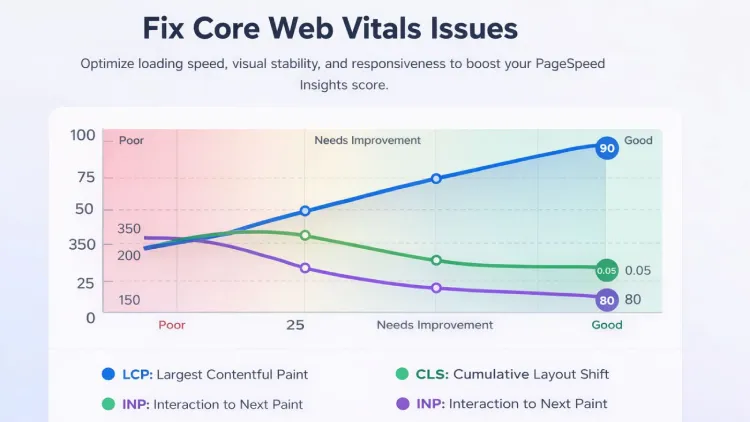
Fix Core Web Vitals Issues
- Core Web Vitals are an important part of the Page Speed Insights, and this has a direct effect on search ranking. This practice aims at enhancing the following key measures.
- Largest Contentful Paint (LCP) is a metric of content loading speed. Optimize images, faster hosting, and preloading critical resources to enhance LCP.
- Visual stability is measured in Cumulative Layout Shift (CLS). Layout drifts. Aim to ensure images and ads have set dimensions. Make sure that components are not shifted with less expectation.
- Responsiveness is measured by Interaction to Next Paint (INP) or by measuring First Input Delay(FID). Minimize large-scale JavaScript running and break large tasks into small subunits.
- These enhancements need to be analyzed and tested. Page speed insights should also be used to identify the changes in Core Web Vitals after implementing them.
- These metrics will not only be optimized to define your score higher but also will increase the real user experience, which is the key to success in the long term.
Minimize Render-blocking Resources
Conceptualize Resources of Render-Blocking
Resources that define a render-block have the effect of holding up the appearance of your webpage, even with content in the background that may be loading.
Find CSS and JavaScript Blocking CSS
Identify CSS and JavaScript files that do not allow the browser to load the page fast using PageSpeed Insights.
Inline Critical CSS
Add critical CSS in your HTML so that the browser can render the above-the-fold content instantly without any accuracy.
Repeat Non-Critical JavaScript
Defer loading of non-essential JavaScript pages till the primary content of the page is rendered.
Load Scripts Asynchronously
. You should use asynchronous loading of scripts since they may delay page rendering as they load in the background.
Get Rid of the Redundant Plugins and Scripts
Deactivate unnecessary plugs and third-party scripts that make your site slow, but also add to uploading time.
Improvement in Test Performance
Re- rerun page speed insights to test the improvement of the visual loading speed as well as overall measures of performance.
Performance Monitoring and Retesting
The improvement of a website is a continuous process. This last activity is concerned with the survival and enhancement of performance.
- Once all the previous exercises are performed, run a final test with Page Speed Insights. Measure the progress by comparing your new scores with the baseline scores.
- Design a routine monitoring plan. Checks on a monthly or a weekly basis can assist you in detecting new issues and preventing performance issues before they arise.
- Additional tools, such as Lighthouse and GTmetrix, should be used to get more insights. These are used in addition to PageSpeed Insights to give more specific data.
- Continue to update the site, the plug-ins,s and scripts to be compatible and performant. New optimization methods can be offered as technology is developed.
Regular review is a good way of making sure that you have a fast, efficient, and user-friendly site.

Conclusion
To increase website performance, running tests is not enough, but it should be done regularly. These page speed insights activities offer a systematic way of problem diagnosis and implementation of efficient solutions.
With the use of these exercises, it is possible to significantly increase the loading speed, Core Web Vitals, and the user experience. Optimization of images, lessening render-blocking resources, is just a step towards a more efficient and quicker site.
It is important to keep in mind that PageSpeed Insights does not include only a high score. It is the feeling of providing a smooth user experience to your customers. A quick-loading website will result in greater involvement, more alterations in conversion, and increased search results.
These exercises need to be a normal part of your optimization plan, and in the long run, you will enjoy the performance and even achieve success in SEO.
Frequently Asked Questions
What is Page Speed Insights, and its meaning?
Page Speed Insights is a web analysis tool created by Google and is used to assess the performance of websites both on mobile and desktop devices. It assists in the detection of the problems that slow down your site and affect the user experience and ranking in the search engine.
What can I do to increase the insights into page speed on my website?
Perform a test of page speed insights, study Core Web Vitals, and implement such exercises as optimization of images, code minification, browser caching, and reduction of server response time.
Which optimizations are the fastest?
Image optimization, allowing lazy load, and minification of CSS, JavaScript, and HTML, and browser cache are typically quick wins in load time and performance benchmarks.
What is the frequency of my speed testing on my site?
Regular monitoring is key.
Most websites should be tested monthly, or high traffic sites weekly, to monitor the progress and ensure the web pages load quickly.