
The concept of AI-based SEO combines old-fashioned search optimisation with AI to improve the ranking of websites. It processes extensive data, learns the actions of its users, and automates functionality such as research of keywords, optimisation of content, competitor analysis, and technical audit. As human creativity, strategic thinking and well-written content are essential when it comes to maintaining long-term search visibility and organic growth, AI can only streamline the process of SEO and make it more data-driven.
What is AI-Based SEO?
The AI-based SEO involves the application of artificial intelligence to optimise search engines. Rather than processing data manually, AI tools process it, identify patterns, and suggest something that could be improved to make websites rank higher.
It is a combination of machine learning, natural language processing, and data analysis to analyse such aspects as keywords, content depth, backlinks, user behaviour, and technical performance.
Key applications include:
- Automated Keyword Discovery: Discovers profitable and long-tail keywords in an efficient way.
- Intent-Based Content Optimisation: More content is matched to the search intent of the user.
- Competitive SEO Intelligence: Analyses the competition to make the strategy better.
- Predictive SEO Schools of thought: Projects search trends ahead.
Development of AI is based on the background components that include machine learning, NLP, robotics, computer vision, knowledge representation, planning systems, and neural networks. The 30 per cent rule in AI indicates that automation of an approximate third of repetitive work, such as keyword research and reporting, may be highly productive as specialists can concentrate on strategy and creativity.
How AI is Changing Modern SEO
The search engines have changed radically within the last ten years. Much more than just matching keywords to search words, the new-generation algorithms consider both contexts and user behaviour as well as content relevancy.
AI-based search engine optimisation is essential in keeping up with such changes, as artificial intelligence assists marketers in getting insight into how search engines audit websites.
AI is changing SEO in several of the most significant ways, such as:
Smarter Search Algorithms
Machine learning helps search engines to scan billions of web pages and provide the most useful results. Instead of being attentive to keywords, algorithms have achieved a sense of meaning, context, and their search intent.
- Natural language processing (NLP).
- NLP enables search engines to understand the language of conversation.
This indicates that material which comes out naturally to human beings usually works better in comparison to those which just repeat keywords.
Voice Search Growth
Google Assistant and Siri, voice assistants, are based on the technologies of AI. With the rise in voice searches, the tactics of SEO have to adjust to the more conversational searches.
User Behavior Analysis
Some of the metrics considered by AI are click-through, bounce rates, and time on page. These indicators can be used to identify the content that is gratifying to the user.
Search Trend Prediction
AI technology finds out search trends and predicts the occurrence of trends before they go mainstream.
- Due to such occurrences: several marketers are concerned about the possibility of AI fully displacing SEO professionals.
- As a matter of fact, AI-based SEO: does not drive AI to complete repetitive tasks. There is still a need for human knowledge in the strategy, creativity, storytelling, and perception of audience needs.
SEO has also been generally believed to be a critical digital skill in the wider IT and marketing sectors. Career opportunities in technology and marketing often have a high demand when professionals are knowledgeable in the elements of SEO, data analysis,s as well as digital marketing strategies.
Benefits of AI-Based SEO
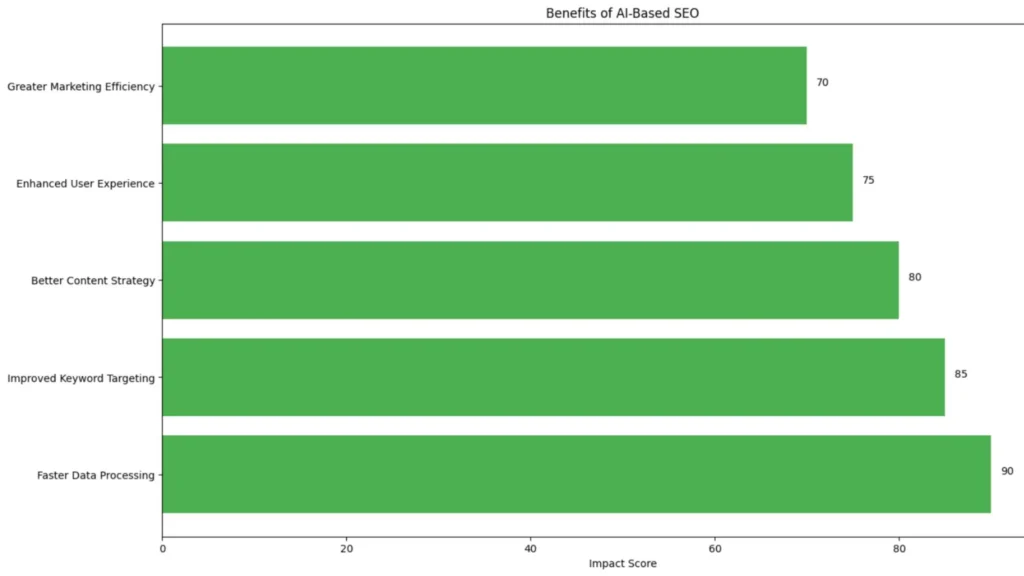
AI-based search engine optimisation has many benefits to the business, bloggers, and digital marketers because it can integrate automation with sophisticated data analysis. These tools contribute to the enhancement of efficiency, performance, and search visibility.
Key benefits include:
Faster Data Processing
By considering large amounts of data in seconds, AI algorithms can enable marketers to check the performance of their keywords, competitor strategy and prioritisation of opportunities at a much faster rate.
Improved Keyword Targeting
AI determines keywords having a high level of search demand and competitive control, and the probability of ranking will grow.
Better Content Strategy
AI can be used to detect trending content and content gaps by competitors that they may have overlooked to create more specific and effective content.
Enhanced User Experience
Artificial intelligence devices analyse readability, web design, and performance indicators to enhance participation in the web and the satisfaction rates of the user.
Greater Efficiency in Marketing.
- The automation will also save time that is used in doing repetitive activities, and the rest of the time will be used by the SEO professionals to strategise, be creative, and make high-value decisions.
The AI simplifies most of the SEO functions, but it cannot replace human knowledge. Creative jobs, problem-solving jobs, and any other jobs that need emotional intelligence will not be eliminated because AI is not intended to replace humans but to act as a support tool.
Best AI SEO Tools in 2026
The swift development of artificial intelligence resulted in an extensive selection of SEO tools that are supposed to allow marketers to streamline their websites in a more productive way. The selection of the appropriate platform relies on business objectives, content strategy and budget.
The most popular examples of AI-based SEO include:
Surfer SEO
Surfer examines the top-ranking pages and gives specific optimisation suggestions regarding the content set-up, words, and titles.
Frase
Frase focuses on the analysis of search intent and automated content research. It assists authors in creating briefs on content that are SEO friendly.
MarketMuse
There are gaps in content that are detected by MarkettMuse, which determines the authority of the topics and the gaps in content that are found across the websites.
Clearscope
Clearscope is an application that is concentrated on the optimisation of semantic keywords, as it assists writers to use related words that enhance topical relevance.
Jasper AI
Jasper aids in content creation, marketing copy, and article brainstorming, while tools like ChatGPT assist with research, planning, and productivity. AI content should be reviewed and refined by humans for accuracy and originality. Leading AI firms include Google, Microsoft, Amazon, and Meta, investing billions in AI R&D.
“Looking to boost your website’s SEO with AI-powered tools? At TechishWeb, we provide expert AI SEO services to optimise your content, improve rankings, and maximise results. Contact us today to get started!
Artificial Intelligence in Content Generation and Highlighting.
The success of search engine optimisation revolves around content. However, despite the sophistication of the algorithm, good information remains the most significant in ranking.
The Industry AI-based search engine tools have greatly enhanced the speed of content creation and optimisation.
Some of the critical aspects in which AI is used in content strategies are:
Idea Generation
Artificial intelligence programs monitor trends in all search results and provide information about new articles of interest to the user. Semantic keyword suggestions act as limits, guiding users only toward what the
Content Gap Analysis
To determine missing topics, AI compares the competitor content with your website.
Readability Improvements
The AI systems check the level of sentence complexity, paragraphs, and the level of readability.
Content Auditing
- Artificial intelligence applications continuously search the Internet to validate the presence of old-fashioned articles that are to be amended or extended.
- Conversational search optimisation is another feature implemented by many modern content strategies since voice search and searching using a question are becoming more popular.
Interestingly, billions of searches are made through search engines every daily however, most frequent searches are always about the weather updates, social network sites and other popular websites like video streaming sites.

AI and Technical SEO
- Technical SEO is concerned with the underlying technology that enables search engines to crawl and comprehend websites successfully.
- Technical analysis is one of the areas where artificial intelligence tools can be useful, since it enables the detection of problems that can influence the rankings in a short time.
The major technical enhancements made with the assistance of AI-based SEO include:
Crawl Error Detection
artificial intelligence-based audit systems detect dead links and page non-existence and indexing problems.
- We have performed an analysis of the website performance.
- AI considers the page speed, mobile usability and performance.
Internal Link Optimisation
- AI finds traffic: to interrelate or interlink content using internal linking patterns.
- Duplication Content Detected Finding.
- Similar or duplicated pages are detected by the AI resources and may negatively affect the rankings.
- Micro-Structured: Data Recommendations.
- Artificial intelligence: implies schema markup, which enhances search engines.
- Advanced programming technologies stand behind most of the AI tools.
- Some of the popular programming languages that are applied in the development of artificial intelligence include Python, Java, R, and C++. Python has been particularly popular because it has machine learning libraries, and it is simple.
Artificial intelligence can, in its turn, be subdivided into several classifications. There are four typical AI category such as reactive machines, limited memory systems, theory-of-mind AI, and self-aware AI.
Also, it is commonly broken down by the researchers into several subfields, including machine learning, computer vision, robotics, expert systems, natural language processing, planning systems, and neural networks.
Challenges of AI-Based SEO
Along with the numerous benefits that the use of AI technology offers, there are also issues and challenges that marketers have to take into account.
The AI-based SEO is not to be utilised as a substitute for the human experience, but as a complementary tool.
Some key challenges include:
Too Much Reliance on Automation
When automated too much, it will also make generic productions without originality.
Accuracy Limitations
Recommendations produced by an artificial intelligence can be outdated or inaccurate at times.
Learning Curve
The high-level AI requires time and training to be utilised.
Data Quality Issues
AI systems rely on large amounts of data, and results can be inaccurate if the data is incomplete or flawed. Search engines typically focus on content quality and usefulness rather than whether it’s AI-generated, so helpful, high-quality content is more likely to rank well.
Future of AI in SEO
AI-based search optimisation is getting progressively more sophisticated as artificial intelligence is going to continue influencing digital marketing and search optimisation.
The main trends that affect the future are:
Greater Personalization
AI will provide search results that are very personalised depending on the preferences of users, their behaviour, and their historical interactions.
Predictive Content Strategies
Artificial intelligence will predict the demand for search in the future more precisely, and the marketer will be able to create content before the trend.
Combination of Visual Search and Voice
Image recognition and voice queries will only continue to become common and will transform online searches.
Routine SEO Task Routine SEO Tasks Automation
Such activities as reporting, technical audits, and keyword search are going to be more automated.
Global AI Adoption
The major trends are the development of AI in such countries as the United States, China, and European countries; the direction of India is becoming a critical root of AI talents and technology.
Regulatory and Ethical Issues
The use of AI is not entirely welcomed by all countries because of ethical or legal reasons, which influence the deployment of AI around the world.
Evolving SEO Strategies
SEO will also be a necessity despite the automation process since companies will be trying to increase their online presence, but the strategies will still keep changing as the search engines become smarter.

Conclusion
With artificial intelligence, optimisation of search engines has become one of the most disruptive factors in search engine optimisation. With the aid of AI-based SEO, marketers can analyse the huge volumes of data, recognise trends, and streamline websites more effectively in comparison with the traditional methods of operation.
Although AI technology may automate most of the processes, human knowledge is still needed. Creativity, strategic thinking and analysis of human behaviour are skill, which artificial intelligence cannot simulate to its core.
The most successful organisations that integrate AI tools with the input of human thought will be the ones that are most competitive in the digital world. Accepting AI-centred SEO and keeping the content of the material high and adhering to ethical business practices, companies can shine on the internet once again and reach a wider audience in the future.
Frequently Asked Questions
1. What is AI-Based SEO?
The AI-Based SEO applies artificial intelligence to enhance the ranking of websites based on the analysis of data, optimisation of content, and automation of functions such as keyword research and competitor-analysis.
2. Does AI supplant SEO experts?
No. AI only helps to automate repetitive work, yet human creativity, strategy, and quality of the content continue to be crucial to an effective SEO.
3. The advantages of AI-Based SEO?
It accelerates the processing of data, increases targeting of keywords, improves content strategies, develops the user experience, and enhances marketing efficiency.
4. What holds with AI in the future of SEO?
AI will enhance personalised, predictive and automated SEO, but human experience will still be needed to achieve future success.